
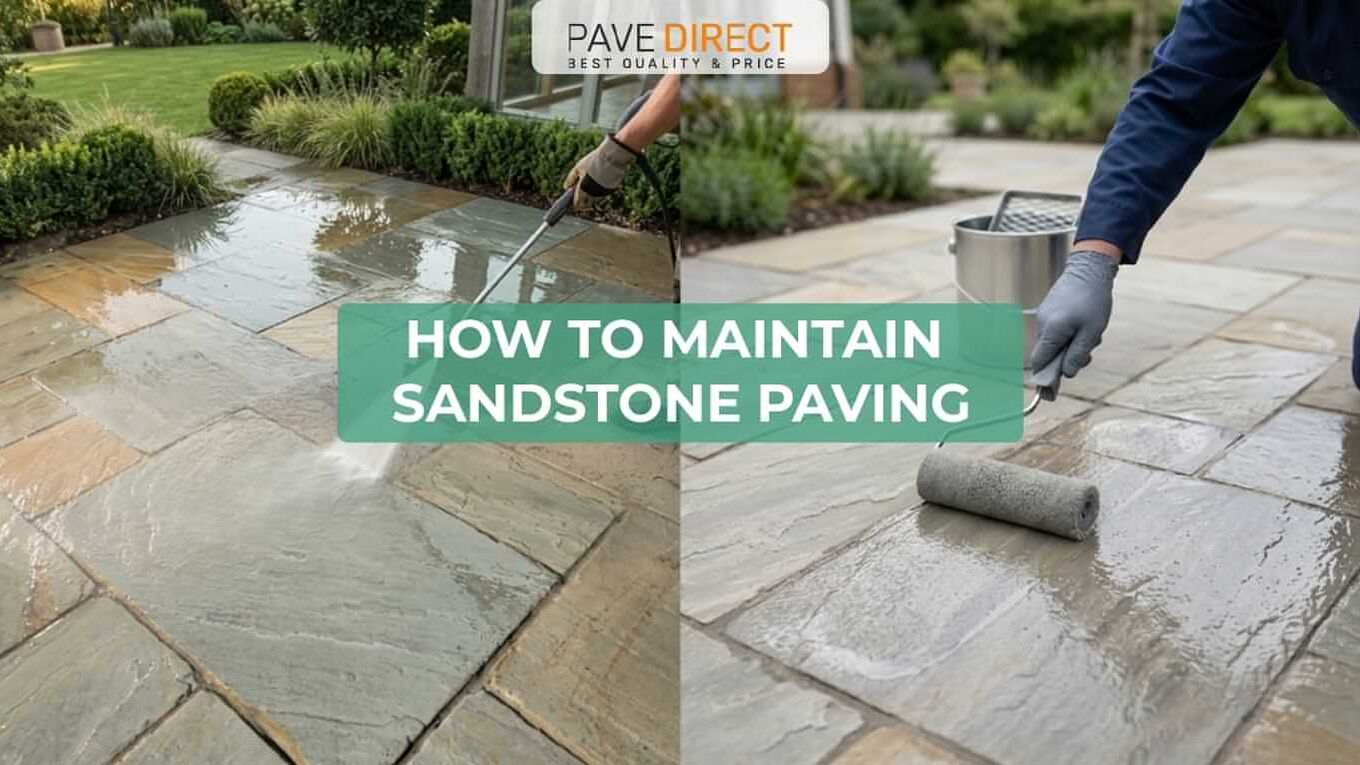
Here's the thing nobody tells you up front: Indian sandstone is basically a sponge that looks like rock. It's porous, and that one fact drives everything else.
If it is left untreated, it soaks up somewhere between 1.7% and 2.21% of its own weight in water (a figure cited in natural stone technical data from suppliers). Seal it properly, and you knock that under 0.5%.
That's the whole game, really, the difference between a patio that ages well and one that goes blotchy, green and flaky after a couple of winters.
What This Guide Covers
So this guide covers:
Whether you even need to seal in the first place.
How the sealer types actually differ, because they're not all the same despite what the tins suggest.
The method, step by step, and the safety side, which most guides skim over and shouldn't.
The reason all of this matters more here than, say, in Spain? Our weather. Long wet winters, muggy summers, and stretches where the ground just never properly dries.
That's the environment, and it's unforgiving on untreated stone.
Does Indian Sandstone Actually Need To Be Sealed
If you want it to keep looking decent without losing your weekends to a scrubbing brush, then yes.
That said, sealing sandstone is still more of a maintenance choice and an aesthetic one. The stone will naturally age and stay usable for years, even without it.
From a technical point of view, though, sealing does help a lot. It cuts down moisture getting in, reduces staining, and slows down algae build-up, especially in wetter climates.
Once that's in the stone rather than sitting on top, you're not cleaning it any more. It's part of the patio now.
Problems That Arise In The UK Garden
Three problems crop up again and again in UK gardens. There's a black spot, those dark lichen marks that just laugh at a wire brush.
There's green algae, which loves a wet autumn and turns the surface treacherous underfoot, and there's the staining: red wine, cooking oils and grease, which goes in deep over the summer when everyone's out entertaining.
Then there's the structural side, which is less obvious. Water gets into the stone, winter arrives, and it freezes and expands.
If that happens enough times, the surface starts to spall, flaking away layer by layer.
But, sealing it badly is worse than not bothering at all. Go too early, and you trap efflorescence, that chalky white bloom, under the surface.
Pick the wrong product and you either get a slippery sheen or you bottle damp up inside the slab.
So the verdict isn't a flat yes. It's optional in theory, well worth it for a patio or drive that gets used, as long as you do it right.
When to Seal: This Matters More Than the Brand
When to seal is the biggest concern compared to which product you buy. Most people get this wrong by rushing.
New patio? Leave it four to eight weeks before you go anywhere near it with sealer. The stone needs that time to push its salts up to the surface so you can wash them off.
Seal over the top of them, and they're locked in forever. If it's been a damp spell, stretch that out to eight or even twelve weeks and don't feel guilty about the wait.
Already got a patio down? Here’s an easy test. Tip a little water on the stone. If it beads up, the old seal's still working; leave it as it is. If it vanishes into the stone inside about thirty seconds, you need to do a reseal.
For the season, you're looking at late spring through early autumn, roughly May to September. Within that, three things aren't negotiable:
Stone and air temperature must be between 10°C and 30°C.
You need a dry window of at least six to eight hours after the last coat.
Ideally, nothing wet should be forecast for the next twenty-four hours.
One more, and it catches loads of people out: don't seal in blazing sunshine. The sun dries the top before the sealer has a chance to sink in. Start your work in the early morning or in the shaded bits, and you'll get a far better job.
The Two Sealer Types, Sorted
This is where eyes glaze over. There are two families, and choosing the right one between them is the most important technical call you'll make.
An impregnating sealer (you'll also see it called penetrating) soaks down into the pores and leaves the stone looking exactly as it does dry. The crucial bit: it breathes, moisture vapour from underneath- and can still escape.
That's what stops the long-term trouble, because a sealer that can't breathe traps the damp and eventually spalls the stone. These last you a year or two.
Surface Sealers (Colour-Enhancing)
A surface sealer, sometimes sold as colour-enhancing, lays a film on top and deepens the colour into that wet look a lot of people are after.
It hangs around longer, three to five years, but it breathes less, and it can get slippery when wet. Worth knowing before the look wins you over.
The chemistry's a second choice on top of that:
Quick Comparison: Water-Based & Solvent-Based Sealing
Feature | Water-Based | Solvent-Based |
Fumes And Odour | Low VOC, barely noticeable | Strong smell, needs ventilation |
Cleaning Up | Soap and water | Requires white spirit |
Durability | 1-2 years before resealing | 2-3 years before resealing |
Best for | First-time DIYers | Experienced users |
First time doing this yourself? Low-VOC, water-based, and impregnating features are the ones you should be looking for. It forgives mistakes, it keeps the stone's natural character, and it won't have you light-headed in the corner of the garden.
Safety Measures From HSE Guidance
Before you crack that tin open, read these instructions carefully. It's nothing heavy, but it'll stop you from getting hurt.
Sealers are chemicals. They are not poisonous, but it's better to keep them away from all body parts.
Gloves, goggles, and a mask should be worn properly. Getting this stuff in your eye is a nightmare.
If you're using a solvent sealer, then no smoking is allowed. It’s highly flammable.
Stop the runoff from going down drains. It'll kill pond life. Instead, stick a sandbag or an old towel over any drain.
Keep kids and pets off the patio for a day or two, most probably 24 to 48 hours. A dog licking wet sealer off its paws means an emergency vet visit.
Something Happened? First aid (NHS 111 recommends this)
If it is in your eyes? Rinse with clean water for fifteen minutes and get help.
If it is on your skin? Wash it off with soap and water.
If accidentally swallowed, do not panic. Call 111 / 999 straight away.
For the full safety details, grab the manufacturer's Safety Data Sheet or look up HSE guidance online. It's easy to find.
The Mistakes People Keep Making
Mistake | What Does It Cost You | How To Dodge It |
Sealing Too Early | White bloom is trapped permanently | Wait eight weeks after laying |
Sealing Damp Stone | Cloudy, peeling finish | Make sure it's bone dry first |
Coats Too Thick | White haze, sticky residue | Thin coats, every time |
Sealing In Full Sun | Won't sink in | Work in the shade or in the morning time |
Non-breathing Sealer | Trapped damp, which causes spalling | Stick with an impregnating type |
No Patch Test | Whole patio ruined | Always test first |
Disclaimer: Never seal the underside of a slab. It stops the slab from gripping the mortar, and you'll get lifting down the line.
While you're choosing, it's worth going with a supplier signed up to the Ethical Trade Initiative, since ethical sourcing matters for natural stone products.
Final Words
Look, seal that Indian sandstone properly, and you'll drop its water absorption from nearly two percent down to under half a percent. That means no black spot, no frost damage, and the colour actually sticks around for years.
You don't need much, just a breathable impregnating sealer, a dry day above ten degrees, and a bit of patience while it cures.
Sort those three things out, and instead of scrubbing the patio half to death every spring, you're just giving it a quick hose down.
While Indian sandstone needs regular care and sealing, some homeowners also compare it with outdoor porcelain tiles, which are non-porous and require far less maintenance.
When you're choosing a sealer or buying stone, it's worth checking that your supplier is signed up to the Ethical Trade Initiative. At Pave Direct, ethical sourcing is part of how we select every product we stock.
Frequently Asked Questions
Q1. Can you seal Indian sandstone before it's laid?
Don't; the slabs need to settle, joints need to cure, the salts need to surface, and be cleaned off first. Seal them loosely, and you'll probably coat the underside, which is precisely how you end up with slabs lifting later.
Q2. Why have I got white marks after sealing?
Because of efflorescence being trapped, or a haze from going on too thick. Either the salts hadn't finished blooming when you sealed, or the coats were heavy. A breathable sealer and a longer wait beforehand head off both.
Q3. Can I just use linseed oil instead of a proper sealer?
Best not. Linseed darkens patchy, never really cures areas outdoors, grabs dirt and can bring on mould. Use a breathable paving sealer made for the job.
Q4. I've sealed it, and the water won't dry off. Is that normal?
For the first few days while it cures, yes. Still sitting there after the full five-to-seven-day cure? Then you went on too thick and left a film that water can't pass through. A light buff with a cloth and a bit of solvent usually lifts the excess.
Q5. Why's water pooling on parts of my sealed patio?
Usually, uneven coverage or low spots from when it was laid. Sealer doesn't change the falls of a patio, so if the drainage was slightly off to begin with, repelling the water just makes it show.
Q6. Can sealing stop the joints from blowing out when I jet wash?
It helps, but the bigger factor is good jointing plus keeping the jet wash on a low setting at a sensible distance. Sealing softens the damage; it doesn't replace solid pointing.
Worth a Read
British Standard BS 7533 for natural stone paving design
The safety data sheets from your sealer's maker, Resiblock and Bond It, among them
Met Office regional rainfall and frost data, handy for picking your window
Last reviewed: June 2026
Written by the Pave Direct Team
Pave Direct has supplied Indian sandstone paving across the UK for over 20 years, operating from Lincolnshire.
Phone: 01778 343999
Work out your exact order in seconds
Our coverage calculator turns your patio size into the precise number of slabs and packs — 10% waste allowance included.
Free delivery, £0.98 samples, breakage guarantee
Every order ships free with no minimum spend. Order a £0.98 sample first, choose your delivery date, and if a slab arrives broken we replace it — no quibbling.