Our site uses cookies. By continuing to use our site you agree to our cookie policy.

  • Free Delivery on all Orders

  • All Samples only £0.99

  • Highly Rated

  • Competitive Prices

Outdoor Porcelain Paving Slabs

Outdoor porcelain tiles are the most low-maintenance paving option available for UK gardens, patios, and driveways. Unlike natural stone, they require no sealing, resist frost and algae naturally, and hold their colour for decades. 

Available in 16mm and 20mm thickness, 900×600mm porcelain paving slabs at Pave Direct are the most widely used format in UK hard landscaping, with free delivery nationwide. Prices start from £17.81 per m² and samples from £0.99.

Laying a contemporary patio, a pool surround, or a high-traffic driveway? Our porcelain range is built to perform in the British climate without demanding anything back from you.

Why Outdoor Porcelain Tiles Are the Right Choice for UK Gardens 

The UK climate is hard on outdoor surfaces. Wet winters, freeze-thaw cycles, shaded areas that breed moss and algae, and UV exposure in summer, most materials degrade faster than homeowners expect. Porcelain paving outperforms every alternative in these conditions, and the reasons are technical, not just marketing.

Porcelain tiles are fired at temperatures above 1200°C, which produces a dense, non-porous surface with less than 0.5% water absorption. That figure matters because water absorption is the root cause of most outdoor paving failures; frost damage, staining, algae growth, and surface spalling all begin with moisture entering the tile. At below 0.5%, there is simply not enough water penetration to cause any of these problems.

The result is a tile that does not need sealing on installation, does not need resealing annually, the way sandstone or limestone does, and does not require specialist cleaning products. A brush and soapy water are genuinely sufficient for routine maintenance.

Our outdoor porcelain tiles are also R11 slip-rated across the entire range. R11 is the slip-resistance classification used in commercial and public spaces, such as swimming pools, hospital entrances, and school playgrounds. Applied to a residential patio or driveway, it means you can walk on wet porcelain in full confidence. This is not a feature limited to select products in our range; every slab we stock carries this rating.

The Practical Benefits at a Glance

  • Frost and Freeze-thaw Resistant: Less than 0.5% water absorption means no cracking through UK winters

  • R11 Slip-rated: Safe on wet surfaces, including pool surrounds, steps, and exposed patios

  • No Sealing Required: Ever, unlike sandstone, limestone, or concrete

  • UV-stable Colour: The colour will not fade after years of sun and rain exposure

  • Algae and Moss Resistant: The non-porous surface gives organic growth no foothold

  • Stain Resistant: Food, oil, fertiliser, and weathering clean off with minimal effort

  • No Specialist Maintenance: Soapy water and a brush, nothing more

  • 20+ Year Lifespan: Harder than granite, outlasts concrete under comparable conditions

Thickness: 16mm or 20mm

This is the most important decision before you buy, and it is straightforward once you know the rule.

16mm Porcelain Paving

16mm outdoor porcelain tiles are the standard choice for residential patios, garden paths, roof terraces, and any area where foot traffic is the primary load. They are slightly lighter per slab, which makes them easier to handle and cut on site. For the majority of domestic garden projects, 16mm is the correct specification.

20mm Porcelain Paving

20mm outdoor porcelain tiles are required wherever vehicle weight is involved — driveways, parking areas, and commercial or high-traffic environments. The additional thickness distributes load across a larger cross-section of the tile, preventing the cracking that 16mm slabs would eventually develop under vehicle pressure. If your patio connects directly to a driveway and you want to continue the same tile across both surfaces, use 20mm throughout for consistency and safety.

If you are genuinely unsure which applies to your project, default to 20mm. It covers every use case that 16mm covers, and removes the risk of underspecifying for a space that ends up bearing more load than anticipated.

900×600mm: Why This Format Works

Starting from £17.81 per m², all our outdoor porcelain tiles are supplied in 900×600mm, the most widely specified slab size in contemporary UK hard landscaping. This is not a constraint; it is the format that most professionals now default to, for practical reasons.

A 900×600mm slab covers 0.54m² per tile. That coverage rate means fewer joints across a given area, which produces a cleaner, more continuous visual surface. Larger tiles also make patios read as more spacious, a well-documented effect in both interior and exterior design. 

For a standard 4×5m garden patio, you would need approximately 74 slabs at this size, compared to 200 slabs at 600×300mm. Fewer slabs means faster installation, less cutting, less jointing compound, and less labour time.

The 900×600mm format also aligns well with standard UK garden dimensions. Most rectangular patios divide cleanly into this format with minimal cutting waste, particularly when laid in a standard stretcher bond or stacked pattern.

How to calculate how many tiles you need:

  1. Measure your area in m² (length × width)

  2. Divide by 0.54 (the coverage of each 900×600mm slab)

  3. Add 10% for cuts and waste on a straightforward rectangular area

  4. Add 15% for irregular shapes, diagonal laying patterns, or areas with multiple obstacles

You can also use our Square Meter Calculator to calculate the exact packs you need for your outdoor space. 

Outdoor Porcelain Tiles by Colour

Colour choice is where the practical decision becomes a design one. Our range covers the full spectrum of what works in contemporary UK gardens.

Grey Porcelain Paving

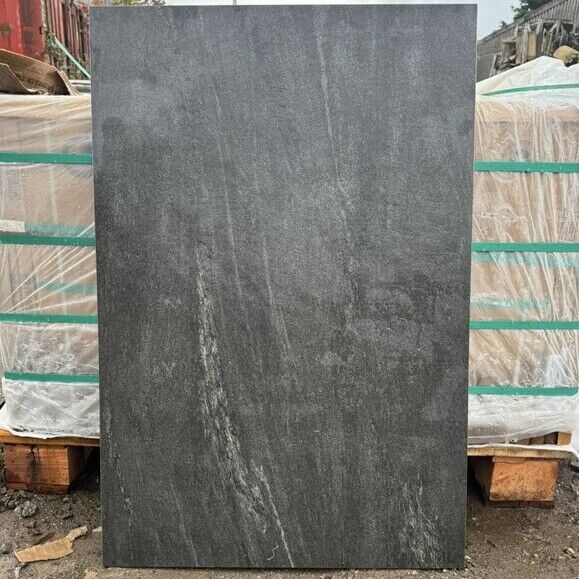
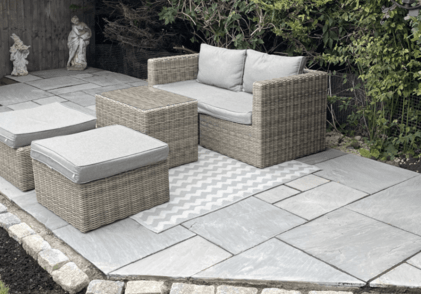
Grey porcelain paving is one of the most popular choices in the UK right now, and has been for several years. Grey porcelain pavings work with almost every architectural style, from Victorian terraced houses to new-build extensions, and pair naturally with timber, steel, and planted borders. Lighter greys open up smaller spaces; darker charcoal tones add definition and drama to larger gardens.

Black Porcelain Tiles

Black porcelain tiles are one of the boldest options in the range. A black porcelain patio reads as deliberate and contemporary, works particularly well with white render or brick exteriors, and handles reflected light from water features better than any other colour. If your outdoor space is designed rather than simply paved, black porcelain slabs are worth serious consideration.

Beige and Cream Porcelain Paving

These neutral tones suit gardens where warmth is the priority, countryside settings, cottage gardens, and spaces designed around natural materials and planting. Cream/Beige porcelain pairs well with timber furniture, terracotta pots, and herbaceous borders in a way that grey and black do not.

White and Marble-effect Porcelain Tiles

White porcelain slabs are the choice for pool surrounds, roof terraces, and contemporary outdoor spaces where a light, premium finish is the brief. Marble-effect porcelain specifically delivers a luxury aesthetic without the maintenance demands of real marble; no sealing, no staining risk, no specialist cleaning.

Not sure which colour suits your space? See our best porcelain paving colours or order a sample for £0.99 before committing to a full pack.

Where Our Customers Use 900×600mm Porcelain Tiles 

Our Porcelain outdoor tiles 600 x 900mm are mostly used in:

  • Garden Patios and Outdoor Entertaining Areas

  • Driveway (20mm+ thickness only)

  • Pool and Hot Tub Surrounds

  • Roof Terraces and Balconies 

  • Garden Steps and Risers

  • Outdoor Kitchen and BBQ Areas

  • Commercial Courtyard and Hospitality Spaces

  • Side Passages and Garden Paths

The surface of outdoor porcelain tiles is non-porous and R11 slip-resistant, making these paving slabs appropriate for any outdoor application where water exposure, frost risk, or slip safety is a concern. 

Porcelain vs Natural Stone: Which Should You Choose

This is the comparison most buyers get confused about before landing on a porcelain category page. The honest answer? It depends on what you value. 

Natural stone, such as sandstone, limestone, and granite, has textural variations and organic character that the porcelain cannot fully replicate. If the authenticity of material matters to you and you are willing to invest in annual maintenance, natural stone delivers just that. 

However, for the majority of UK homeowners, porcelain is the favourite. But why are porcelain slabs better than sandstone? Natural stones require sealing on installation and every one to two years. They stain easily and are more susceptible to algae, mould, and frost damage. 

Porcelain, on the other hand, has none of those requirements. Over a ten-year period, homeowners see a £150–£300 maintenance cost difference between the two materials.

Modern porcelain has closed the aesthetic gap significantly. Stone-effect, concrete-effect and slate-effect looks can be easily replicated visually. The distinction is hardly recognisable to most people when looking at a finished patio. 

If you want the look of natural stone but with durability and low maintenance, porcelain is one of the most rational choices available in the UK market. 

FAQs About Outdoor Porcelain Tiles

Are outdoor porcelain tiles suitable for driveways? 

Yes. 20mm porcelain paving, as a minimum thickness, can be used in domestic driveways. 16mm porcelain slabs are rated for foot traffic in outdoor areas and will crack under vehicular load. Specify at least 20mm thickness for any driveway application. 

Do porcelain tiles get slippery when wet? 

Antislip porcelain slabs with an R11 rating are classified for wet surfaces. R11 is used in commercial and heavy foot traffic wet environments, including swimming pools and public walkways. They are safe for exposed patios, pool surrounds, and steps.

How do porcelain tiles compare to concrete paving?

Concrete paving is cheaper upfront but degrades faster due to spalling, staining, and fading within ten years. Porcelain requires no sealing, does not spall, and retains its colour indefinitely. The total cost of porcelain in the long run is lower than that of concrete paving. 

Can porcelain tiles be used on a roof terrace? 

Yes. The low water absorption and frost resistance make porcelain an ideal choice for roof terraces. Make sure to specify 16mm for weight considerations only where structural load is genuinely limited. Confirm with your structural engineer for larger installations. 

What base preparation is needed before laying porcelain tiles? 

Porcelain requires a full mortar bed laid on a solid base. Do not lie on a loose or compacted gravel base as you do on natural stones. A concrete sub-base with a full bed of cement mortar is the standard approach. Read our step-by-step laying porcelain paving guide to learn more. 

How are orders delivered? 

Free pallet delivery across the UK with no minimum order requirements. Slabs arrive banded on a pallet, but someone needs to be present to accept delivery. Read delivery information for more details. Split packs are available on selected lines. 

Call us woman

Call us on 01778 343999

Got a question or having trouble with an order? We’re here to help.

Available Mon-Fri: 9am-6pm
Highly Rated

Buy with confidence

Free Delivery UK Orders

No minimum spend required

All Samples only £0.99

Posted out the next working day

Safe & Secure Payment

Fast & reliable transactions

Sign up to our newsletter!

Get our latest offers and deals, new product info and more direct to your inbox.