
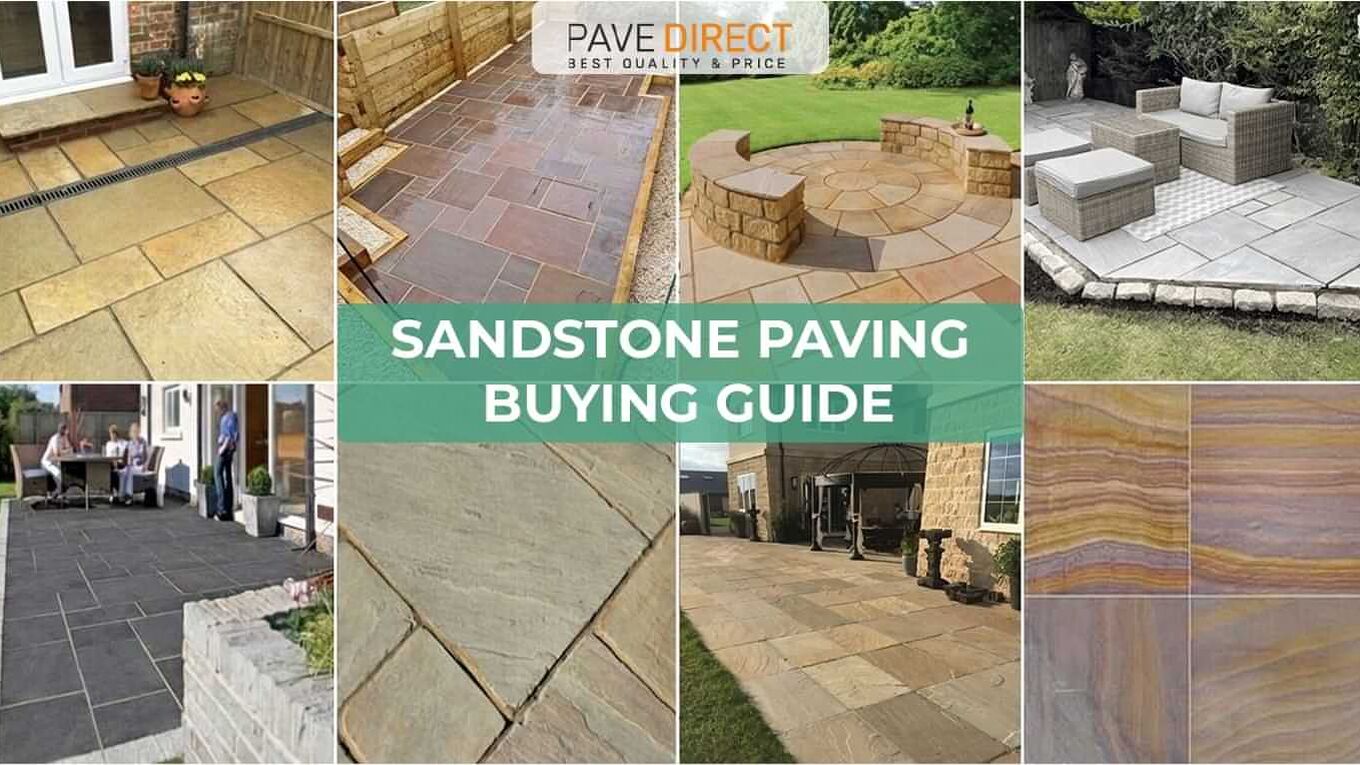
UK weather exposes bad paving decisions fast. A wet winter, a hard frost, and cheap sandstone start rocking, cracking, and growing a carpet of green algae within two seasons. The right Sandstone patio slabs, properly laid and properly sealed, are a different story entirely.
What This Guide Covers
This guide covers:
- Different colour variations.
- Quality grades.
- UK standard costs.
- Laying of Indian Sandstone.
- How to seal your sandstone properly.
- The mistakes that turn what should be a 30-year patio into a five-year problem.
What Is Indian Sandstone?
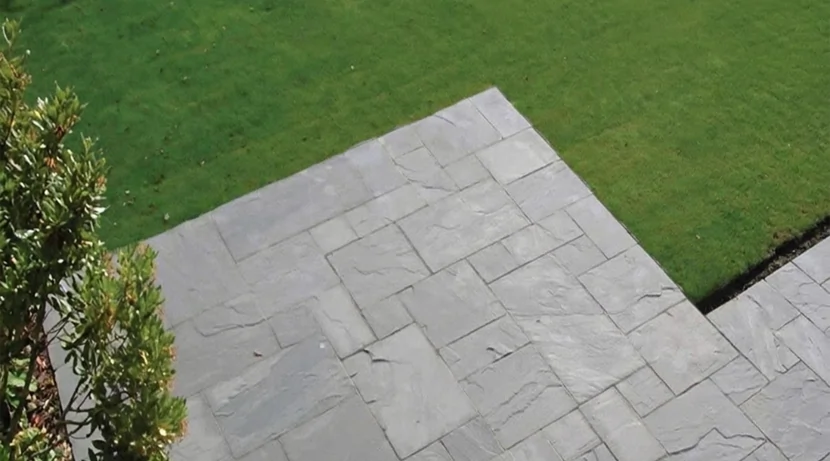
Indian sandstone is a sedimentary rock quarried in India. It was formed millions of years ago through the compression of sand, minerals and organic material under geological pressure.
The natural riven surface most British homeowners would recognise is due to the geological compression of these elements as well. It is mainly quarried in the states of Rajasthan, Gujarat and Madhya Pradesh.
This colour variation is directly due to the mineral content in each seam of the quarry, ranging from warm buffs and greens to deep greys and rich reds.
Key Differences Between Indian Sandstone And Other Natural Sandstones
One of the most frequently asked questions by UK buyers is whether or not Indian sandstone is a good option to consider over home-quarried stone. It can be determined based on the following options below that are needed for any type of project.
Feature | Indian Sandstone | European / UK / Yorkshire Sandstone |
Origin | Comes from the Indian subcontinent | Yorkshire, Scotland, Belgium, Germany |
Hardness | Medium (varies by grade) | Generally denser, harder |
Porosity | Higher (requires sealing) | Lower overall porosity |
Frost Resistance | Good when calibrated and sealed | Excellent (naturally denser) |
BS 7533 Compliance | Always verify the CE/UKCA mark | Typically compliant by default |
Colour Range | Very wide (grey, green, buff, red, pink) | Limited (sandstone browns, ochres) |
Typical Supply Cost | £21-£28/m² | £37-£80+/m² |
Availability In The UK | Widely available | Limited; often on special order |
Best For | Cost-conscious buyers who want natural character | Premium builds requiring maximum longevity |
Indian sandstone delivers the natural stone look at roughly a third of the cost of Yorkshire stone. The trade-off is simple: it needs proper sealing and a correctly specified sub-base to hold up in a British climate.
Pro Tip: Always confirm that any Indian sandstone carries CE or UKCA marking and meets British Standard BS 7533, which governs natural stone paving for external use in the UK.
Without that certification, there is no verified guarantee of freeze-thaw performance, and that matters considerably in northern England, Scotland, and Ireland.
Why Choose Indian Sandstone
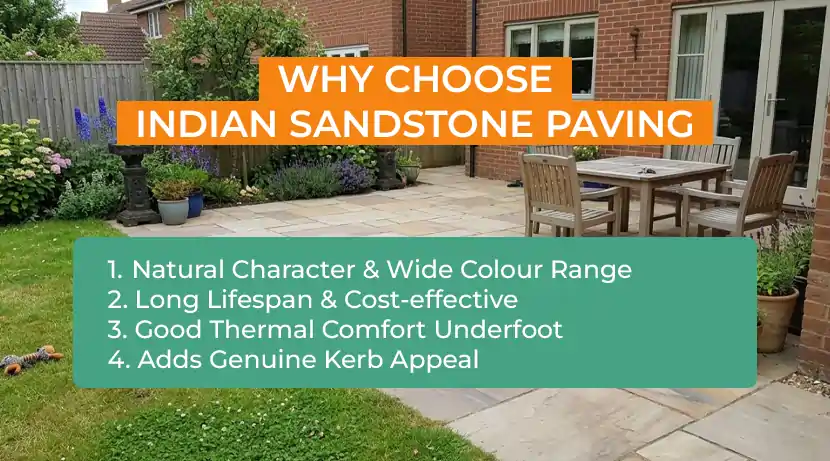
The UK's interest in Indian sandstone goes back more than two decades. Pave Direct has been part of that market for twenty-seven years. That kind of longevity doesn't happen by accident. Here's what actually earns it:
- Natural, Unrepeatable Character: No two slabs are identical. The colour variation and surface texture give a finished patio a depth that porcelain or concrete simply cannot produce.
- Cost-effective Against Alternatives: At £21-£28/m² for quality calibrated stone, Indian sandstone comes in well below Yorkshire stone (£59-£184), limestone(£37-£58), or premium porcelain(£50-£80+) at comparable thicknesses.
- Wide Colour Range: From cool Kandla Grey to warm Raj Green and rich Autumn Brown, the options suit everything from a modern urban garden to a traditional cottage plot.
- Workable and Cuttable: Indian sandstone cuts cleanly with a disc cutter. Intricate patterns, curved edges, and feature circles are far more achievable than with harder stone types.
- Good Thermal Comfort Underfoot: Unlike porcelain, Indian sandstone does not become uncomfortably hot in direct summer sun. A genuinely underrated benefit for barefoot use.
- Adds Genuine Kerb Appeal: Natural stone patios feature consistently in UK estate agent valuations as a positive resale factor, particularly when maintained well.
- Long Lifespan When Specified Correctly: A calibrated Indian sandstone patio, laid on a proper mortar bed and resealed on schedule, will comfortably see out 25 to 30 years before it needs anything beyond routine maintenance. Some go well past that. It comes down to how well it was laid in year one.
Material, Size, Shape, and Weight of Natural Sandstone
Before ordering a single crate, understand what you are actually working with. Indian sandstone comes in a range of formats, thicknesses, and weights, and getting these details right up front saves a lot of headaches on delivery day and during installation.
Standard Sizes
Indian sandstone comes in a range of standard formats to suit different laying patterns and garden scales.
Format | Common Dimensions | Typical Use |
Single Size | 600x600mm, 900x600mm, 600x300mm | Contemporary, grid patterns |
Project Packs | Mixed (e.g. 600x600, 600x300, 300x300mm) | Traditional random patterns |
Planks | 900x300mm, 1200x300mm | Modern linear layouts |
Feature Circles | Varies | Focal points within a patio |
The most popular single size in the UK market is 900x600mm. It gives a strong visual impact without being unmanageable to handle.
Thickness and Weight
Standard calibrated Indian sandstone for patios is 15mm, 18mm, 20mm, and 22mm thick. 30mm and 40mm options exist for driveways or areas with vehicle access.
Weight per m² varies by thickness:
- 22mm slab: approximately 52-58kg/m²
- 30mm slab: approximately 70-78kg/m²
A standard 15 m² patio pack of 22 mm calibrated Indian sandstone generally weighs between 775 kg and 920 kg, depending on the supplier, stone density and pack configuration. (NBS)
Check the access route before the lorry arrives. Most Indian sandstone is delivered on pallets by hiab or flat-bed and offers free delivery by Pave Direct within the areas of Birmingham, Cambridge, Oxford, and Peterborough. However, there is a minimal additional charge for deliveries within Scotland, Wales, and the Republic of Ireland.
Colours of Indian Sandstone
Not all Indian sandstone looks the same, and that is exactly the point. The stone comes in distinct colour families, each quarried from a different region of India, and carrying its own character, density, and best-fit applications.
1. Grey and Black Sandstones
Grey and black Indian sandstones have a cool, contemporary appearance. The surface tone is fairly uniform and can be used in modern and Scandinavian garden styles. Popular options for grey and black stones are:
1.1 Kandla Grey
There are good reasons why Kandla Grey Indian sandstone is the most popular Indian sandstone in the UK today. It is available in a riven finish, with a base tone of blue-grey to mid-grey, which is slightly lighter on weathering. It is appropriate for contemporary, coastal and urban garden styles. The material cost for silver grey sandstone is around £22 to £32/m².
1.2 Sagar Black
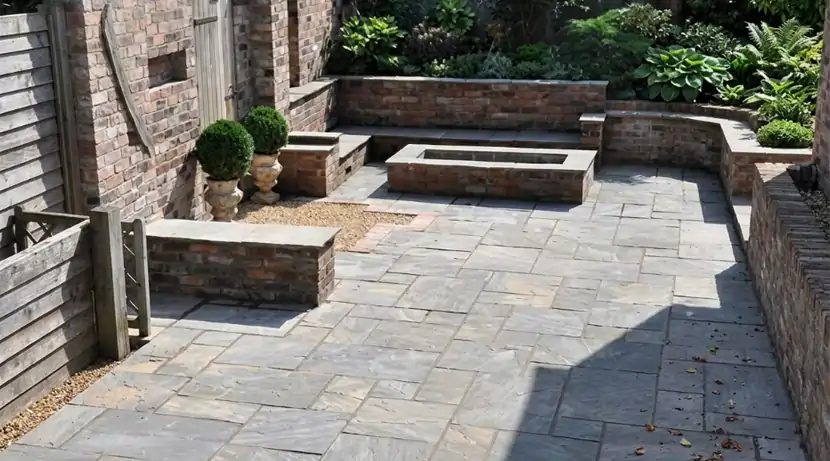
Sagar Black sandstone is a deep, charcoal to black sandstone with a faint veining of grey. It's darker than Kandla Grey and can be used in more minimalist designs where contrast is a key element. It is important to seal regularly to preserve the depth of colour. The stone costs around £28-£38/m2.
2. Yellow and Mint Sandstones
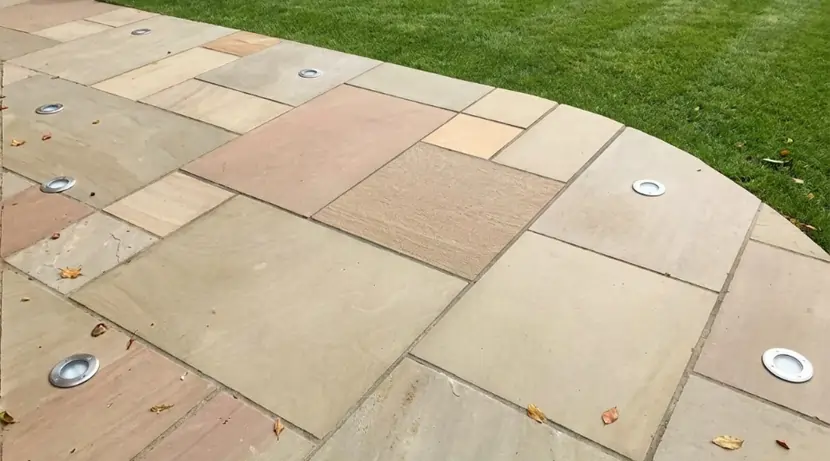
The yellow and mint are warmer and more golden in direct sunlight. They are best for cottage gardens, traditional properties, and south-facing patios. The different options available are:
2.1 Jaisalmer Yellow
It originates from the Thar desert, is bright, and uniform in colour. It contains more natural silica than most of the Indian sandstones, which makes it more durable. Bright in the sun, and is suitable for south-facing gardens. Paving cost of Golden sandstone is around £28-£40 per m².
2.2 Mint Sandstone
Mint sandstone is a neutral tone, which is soft sage green to pale cream in UK light. Great with light render, white or off-white walls and planting schemes. Suitable for those homeowners who desire warmth, but not so intense. Mint Indian sandstone purchase cost is around £24-£35/m2.
3. Red, Pink, and Orange Sandstones
They are the warmest and most interesting ones in the range. They are more at home in traditional, period and cottage settings than modern designs. Some famous choices you can consider are:
3.1 Agra Red
The colour of Agra Red is deep brick red to terracotta with natural buff/brown veining. It is ideally suited to red-brick properties and old English garden facades. Stone supply price is near £26-38 per m².
3.2 Jodhpur Pink
A softer tone of dusty pink with warm buff undertones. The Jodhpur Pink colour is ideal for Victorian and Edwardian buildings as it has a natural harmony with period brickwork. The supply price for Jodhpur Pink sandstone is around £28/m2 to £40/m2.
3.3 Rainbow Sandstone
Rainbow sandstone combines red, orange, purple, buff and brown colours into a single piece of rock. Each one of the slabs is completely different from the others, making it one of the most visually stimulating slabs that are available. It works best in informal and naturalistic gardens. Base cost supply cost for Multicolour sandstone is around £24-36/m².
4. Earthy and Multi-Colour Sandstones
These are the most common types of UK residential patios. The complex multi-tone surfaces match most brick colours and planting schemes and harmonise naturally. They come in different alternatives, which are well-known in the UK and are listed below:
4.1 Raj Green
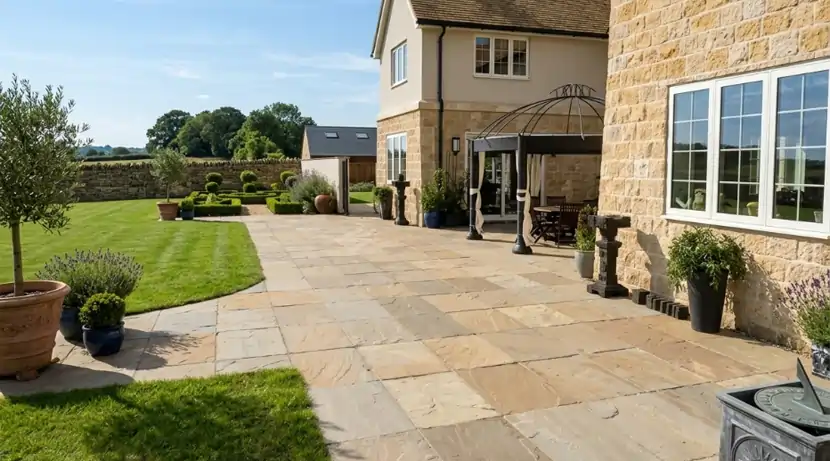
Raj Green Paving Slabs are perhaps one of the most popular Indian sandstones used in the UK period and traditional gardens. The colour is a mix of green, brown, buff and rust tones, which varies depending on the light and moisture conditions. The richness and depth of colour of wet stone are greatly enhanced, while the lightness of dry stone is greatly understated. Raj Blend sandstone’s retail price is around £24-£36/m2.
4.2 Autumn Brown
Deep rusts, warm browns and some purple shades are combined by Autumn Brown sandstone. It is suitable for inclusion in autumn planting schemes and for properties that are either red-brick or warm-render. The market price for Autumn Blend sandstone is around £24-£34 per m².
4.3 Rippon Buff
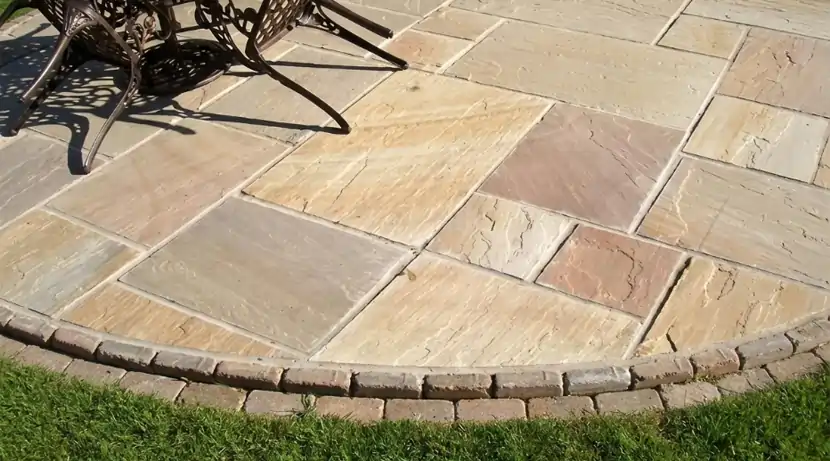
Rippon Buff patio slabs are warm cream to buff in tone with a light brown and gold variation. It's one of the more neutral options in the earthy range, thus versatile throughout traditional and contemporary settings. The per m² price of buff sandstone is around £22-£32.
Finishes of Indian Sandstone
The finish you choose changes everything: how the stone looks, how it feels underfoot, its slip-resistant rate, and in what ways it suits the space. Here is a clear breakdown of the four main finishes available and where each one works best.
Riven (Natural Split) Finish
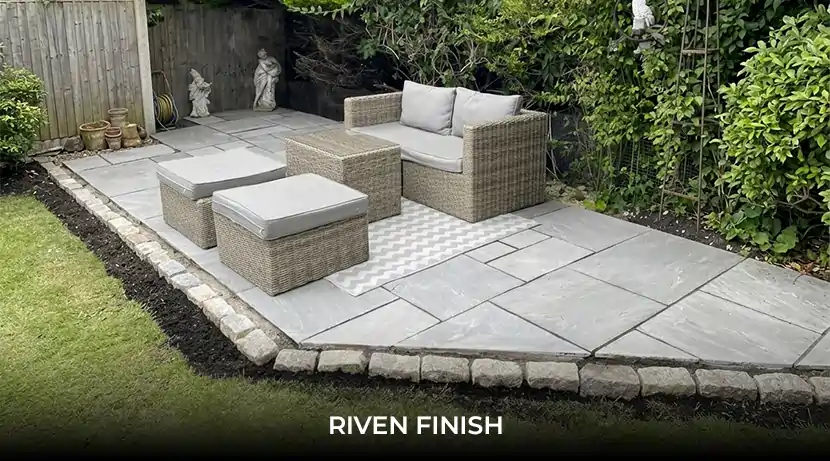
How It’s Made: The stone is naturally bedded and splits along its plane, resulting in a textured, rough surface and tonal variation in each slab, made evident by the natural bedding planes.
Best For: Ideal for traditional gardens, cottage gardens, country-style gardens, ragstone walls and any area where natural style is more important than uniformity.
Grout Colour Combination: A grout that is mid-grey or buff will have classic results, while dark charcoal pushes it towards a more modern feel.
Sawn (Smooth) Finish
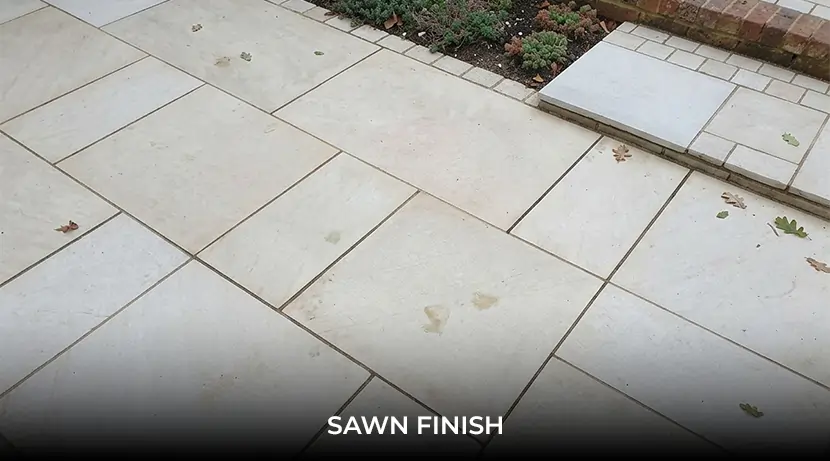
How It’s Made: The surface is machine-cut to a smooth, consistent surface with less variation in tone across the slab.
Best For: Ideal for modern, Scandinavian, and urban garden styles, where accuracy is important.
Grout Colour Combination: Charcoal or light grey grout is a good choice, as it will buff the shades if the stones are smooth.
Tumbled Finish
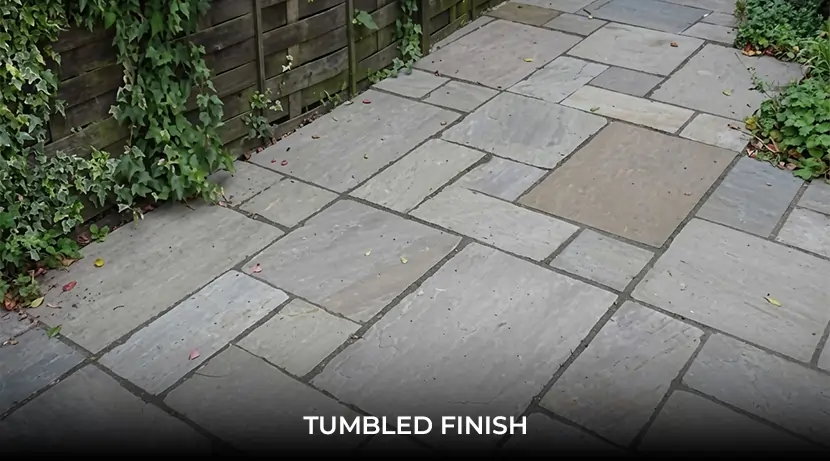
How It’s Made: Slabs are mechanically tumbled to round corners and edges to simulate the worn look of old stone.
Best For: The outcome looks great for the cottage and Mediterranean style. Mostly in earthy/buff colours.
Grout Colour Combination: It will be finished off well with a warm buff or mid-brown grout that blends in with the rest of your space.
Sandblasted Finish
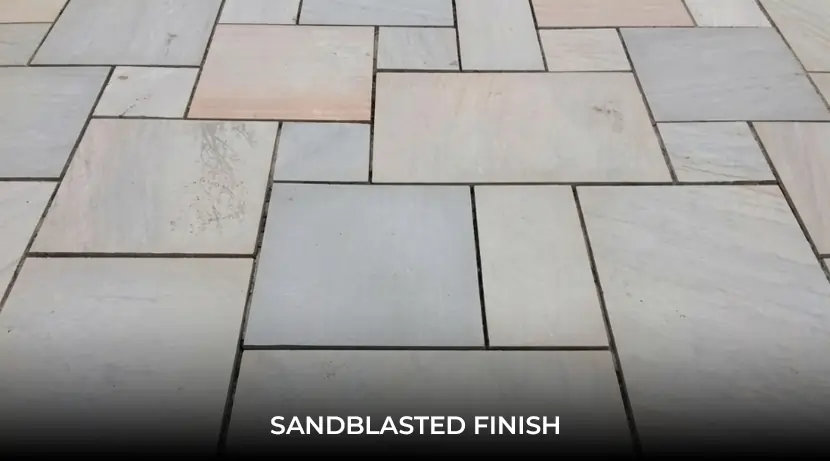
How It’s Made: A roughened matte surface is achieved by blasting the surface with an abrasive medium.
Best For: This is definitely a positive change in wet slip resistance and is the perfect choice for high foot traffic locations, poolside settings, or for use where anti-slip performance is essential.
Grout Colour Combination: Sandblasted finish can be best fit with many colour variations due to its uniform surface, colour neutrality, and enhanced contrast. Choose the grout colour to coordinate with the predominant colour of the stone.
Installing Indian Sandstone Indoors
Yes, sandstone from India is suitable to be used in domestic purposes. It comes in many styles and finishes and can be used in several ways, such as the floor, wall cladding, fire surround or countertops.
Why Choose Sandstone Patio Slabs Indoors
When it comes to indoor use, sandstone tiles are regarded as one of the best options available, as it has a long lifespan and are of a natural colour variation. Some of the additional advantages are:
Looks: It can add an aesthetic touch to any space. Widely available in many different shades from light grey to warm beige to bright pink, it can be used for contemporary or traditional decor.
Durability: It is a durable and hard stone and can be used in hallways and kitchens where there is a high amount of foot traffic.
Thermal Comfort: Sandstone has good thermal properties; that is, it is warm during the winter and cool during the summer, maintaining the indoor temperature.
Eco-Friendly: It is a natural material, requiring less heavy chemical processing as compared to many man-made materials.
Underfloor Heating Compatibility
The most important thing to take into account is the underfloor heating. Natural sandstone can be used with wet underfloor heating (UFH) systems, but the UFH system must be commissioned and tested before laying sandstone patio slabs, and it must be acclimatised to room temperature for a minimum of 24 hours before installation.
Indian Sandstone Colour Ideas
Indian sandstone covers a broader colour range than most natural paving materials. These popular Indian sandstone colours offer classic appeal across a variety of design styles.
- Kandla Grey
- Raj Green
- Rippon Buff
- Mint
- Autumn Brown
- Jodhpur Pink
- Sagar Black
The main interior and exterior areas where these colour families best fit are:
Different UK Home Styles
The architectural style of a property is one of the most reliable starting points when choosing Indian stone. Certain stones have been used on certain property types long enough that the combinations feel natural, and the table below reflects that real-world track record.
Home Style | Best Stone | Best Finish | Grout Colour |
Victorian / Edwardian | Raj Green, Jodhpur Pink | Riven | Buff or mid-grey |
Traditional Cottage | Autumn Brown, Rippon Buff | Riven or tumbled | Warm buff |
Modern / Contemporary | Kandla Grey, Sagar Black | Sawn / sandblasted | Charcoal |
Scandinavian | Kandla Grey, Mint | Sawn | Light grey |
Coastal | Kandla Grey, Mint, Rippon Buff | Riven or sandblasted | Mid-grey |
Period Farmhouse | Raj Green, Autumn Brown | Riven | Buff |
In Kitchens
Indian sandstone works well in country, farmhouse, industrial, and cottage-style kitchens. Sawn or honed finishes are the better choice for kitchen use; they are easier to clean and provide a more consistent surface in a food preparation area.
Raj Green and Rippon Buff suit country and farmhouse kitchens with painted or timber cabinetry.
Kandla Grey in a sawn finish works cleanly in industrial and modern kitchen designs. Sealing is critical indoors; an unsealed or poorly sealed Indian sandstone kitchen floor will stain from cooking oils, sauces, and daily foot traffic faster than most homeowners expect.
In Bathrooms
Indian sandstone works well in full bathrooms and en-suites when properly sealed with a penetrating impregnating sealer rated for wet environments (2 to 5 square metres per litre per coat, depending on material porosity).
Riven finishes provide a natural grip underfoot. Sawn or honed finishes are elegant but need a sandblasted or brushed treatment to perform safely in a wet setting. With that in mind, here is how Indian sandstone performs in different bathroom spaces:
Large bathrooms: Any colour works well. Raj Green and Kandla Grey read particularly well in larger spaces with natural light.
Small bathrooms: Lighter tones, such as Mint, Rippon Buff, or Kandla Grey, prevent the space from feeling enclosed. Keep the grout light to match.
Wet rooms: Sandblasted finish only. Full tanking beneath the stone and a continuous fall to the drain are both non-negotiable. Indian sandstone can work beautifully in a wet room, but the waterproofing membrane beneath it is not optional.
Cloakrooms: Smaller-format slabs at 300x300mm or 600x300mm suit tight spaces better than large-format stone. Rippon Buff and Kandla Grey are both practical choices here.
Living Room
In open-plan homes where Indian sandstone is used as an internal living room floor, Rippon Buff or Mint paired with a warm white or pale clay ceiling keeps the space feeling light.
Wall tiles in a light limestone-effect or textured plaster finish complement the stone without competing with it. Kandla Grey reads sharper and suits rooms with darker furniture and stronger accent walls.
Patios And Outdoor Dining
Raj Green and Kandla Grey are the two most versatile bases for a patio dining area. A natural hardwood or powder-coated anthracite dining set sits well against both. A warm grey or sage-green pergola overhead keeps the tonal balance natural.
For a broader look at how these colour families sit alongside other natural stone options, natural stone colours for outdoor paving covers the full comparison across material types.
In Spa Rooms & Saunas
Indian Sandstone appears in spa environments and saunas across the UK, but the main concern is sustained heat, steam, and chemical cleaning products. A sandblasted finish is the right choice for slip safety in these environments.
Rippon Buff and Mint sandstone are the most natural fit for spa environments, both in a sandblasted finish for grip and a soft, calming surface feel. Kandla Grey sawn works well too, particularly in more modern or minimalist spa designs where a cleaner, cooler aesthetic is the goal.
Cost and Anti-Slip Ratings (UK Standards)
Two questions come up on almost every Indian sandstone project: what is it going to cost, and is it safe underfoot when wet? Both deserve a straight answer rather than a vague range, so the table below lays out the real 2026 UK figures guide to slip ratings.
Cost Per m²
Stone Type / Grade | Supply Only (per m²) | Labour (per m²) | Total Installed (per m²) |
Standard / Commercial grade | £22-£27 | £30-£60 | £52-£87 |
Mid-grade Calibrated | £25.02-£36 | £35-£45 | £55.02-£81 |
Premium Calibrated/sawn | £38-£60 | £40-£55 | £78-£115 |
All the costs mentioned above can vary by region. London and the South East consistently sit at the higher end. These are approximate 2026 UK market rates which exclude skip hire, sub-base materials, and membrane.
Anti-Slip Ratings
Indian sandstone's slip resistance is measured using the Pendulum Test Value (PTV) system under UK HSE guidelines. A PTV of 36 or above is considered low slip risk for pedestrian areas.
Riven-finish Indian sandstone typically achieves a PTV of 36-45 in wet conditions, which clears the threshold for safe external use.
Sawn and honed finishes score lower, at PTV 28-36 wet, making them better suited to sheltered or internal applications unless a sandblasted treatment has been applied.
Does Indian Sandstone Increase A UK Home's Resale Value
Yes. Research cited by the Royal Institution of Chartered Surveyors (RICS) indicates that well-designed outdoor spaces, including quality natural stone patios, can add between 5% and 10% to a residential property's perceived value, particularly in the family home market.
Estate agents across the UK consistently report that natural stone patios, when properly laid and maintained, are viewed as a premium feature by buyers. The key qualifier there is "properly laid." A cracked, mossy, or poorly jointed Indian sandstone patio can actively work against a property's appeal in viewings rather than for it.
The strongest return on investment comes from:
- Correctly specified, calibrated stone rather than low-grade uncalibrated.
- Clean, well-maintained joints without powdering or organic growth.
- A coherent design that connects the garden space to the house visually.
Quality Tiers Consideration Before Buying
Buying Indian sandstone without checking a few key things first is where most projects run into trouble. Knowing what to ask for and what to look out for is worth some time before any money changes hands. Indian sandstone is sold in three quality tiers across the UK market.
Commercial Grade
It is the lowest specification. Often uncalibrated, meaning thickness varies from slab to slab, with higher porosity and more surface variation than is practical for clean installation. Cheaper upfront, but the extra labour needed to level inconsistent slabs quickly absorbs any price saving, and moisture-related problems in UK winters are significantly more likely.
Standard Grade
This is calibrated to a consistent thickness, typically with a tolerance of ±2mm to ±3mm. With a density of 2590 kg/m³(NBS), it is suitable for most residential patios when properly sealed and laid. The majority of Indian sandstone sold by UK suppliers falls into this category.
Premium Grade
It is tightly calibrated to ± 2mm to ± 5mm, with higher density, lower porosity, and more consistent colour and surface quality. Often available in sawn and honed finishes. It costs more upfront but performs considerably better, particularly in exposed northern UK locations.
Is Indian Sandstone Water-Resistant, Frost-Resistant, and Slip-Resistant
These three questions get asked more than almost any others about Indian sandstone, and the answer to all three is the same: it depends on the grade and finish. The table below cuts through the uncertainty and gives a clear picture of how the stone actually performs across each condition.
Property | Performance | Condition |
Water Resistance | Moderate, requires sealing | Unsealed stone absorbs water; sealed stone repels water effectively |
Frost / Freeze-thaw resistance | Good for calibrated, sealed stone | Poor if uncalibrated or unsealed; risk of spalling |
Slip Resistance (wet) | Good when riven finish is used | Riven PTV 36-45; sawn PTV 28-36; sandblasted best across all conditions |
Calibrated stone plus a breathable penetrating sealer gives reliable performance through British winters. Uncalibrated, unsealed commercial-grade stone in a frost-prone area is a genuine risk that no amount of remedial treatment will fully correct.
How to Check If Your Indian Sandstone Is Original or Fake
Counterfeit and misrepresented sandstone, often concrete pressed to mimic natural stone texture, does exist in the UK market. Five checks to make before buying:
- Ask For The CE or UKCA Mark: Genuine, compliant Indian sandstone carries this certification. A supplier who cannot provide it is not worth the risk.
- Inspect The Surface Grain Closely: Natural Indian sandstone has a completely random, organic grain pattern throughout the slab. Reconstituted or fake alternatives are cast in moulds and will show repeated surface patterns or a uniformity that no quarried stone ever naturally produces.
- Look At The Underside: Natural sandstone shows visible sedimentary layering on the back face. A uniform, cast texture suggests concrete reproduction.
- Water Drop Test: Drop a small amount of water on an unsealed slab. Natural sandstone absorbs it within seconds. Concrete with a surface treatment will repel the water.
- Weight Check: Natural Indian sandstone at 22mm weighs approximately 52-58kg/m². Slabs that feel unexpectedly light may not be natural stone.
How To Lay Indian Sandstone (Step-by-Step Guide)
For a full technical walkthrough, a proper guide about how to lay Indian sandstone in detail should be preferred more that discuss each stage before any groundwork begins. However, the following are the steps that should be tracked properly:
Step 1: Sub-base Preparation
The minimum compacted depth of the sub-base (usually MOT Type 1 aggregate) recommended for most standard domestic patios is 100mm for Indian Sandstone. It should be raised to 150mm to 200mm or more if the driveway/area is to be used by motorised vehicles.
Mark Brown from Pavestone TV emphasises that correct sub-base preparation is vital to prevent the patio from failing or sinking in the future. His key recommendations include:
- Make sure that the excavation is approximately 150-160mm deep.
- The ground where you want to dig must be firm. To check, place your heel onto the ground; if it sinks, you should dig deeper.
- For layering and compaction, use a whacker plate to install the sub-base in two stages; during the first stage, pass the whacker plate over the area about four or five times and repeat the process about seven times for the final compaction.
Step 2: Lay A Weed Membrane
Place a permeable landscape membrane over the compacted sub-base before the mortar bed goes down. This prevents organic growth from below without trapping moisture beneath the stone.
Step 3: Mix The Mortar Bed
Use a semi-dry mix of 5 parts sharp sand to 1 part cement. For clay-heavy or unstable ground, incorporate a small proportion of hydrated lime using a 1:1:6 or 1:¼:3 ratio of sharp sand, cement, and lime. The mortar should clump when squeezed, but must not be wet or sloppy.
Step 4: Lay On A Full Mortar Bed
Spread the semi-dry mortar to approximately 30-40mm depth across the full surface area of each slab position. Place the slab, tap level with a rubber mallet, and check falls with a spirit level. Every patio needs a minimum 1:60 fall away from the property to shed standing water.
Step 5: Allow The Mortar To Cure
Keep foot traffic off newly laid slabs for at least 24-48 hours. Leave a consistent joint gap of 8- 15 mm between slabs throughout.
Step 6: Apply Jointing Mortar
Once the bed mortar has cured, fill the joints with a polymer-modified jointing compound for natural stone, or a brush-in pointing mortar. Standard cement jointing mortars are too rigid and will crack with ground movement.
Step 7: Seal The Stone
Apply a breathable penetrating impregnating sealer once the jointing mortar has fully cured, typically after 5-7 days. In a UK climate, this step is not optional.
For homeowners who want to deepen or refresh the colour, a colour-enhancing penetrating sealer is the right product. It enriches the natural tones without blocking the stone's ability to breathe, and it will not produce a peeling, patchy surface by the following spring.
How To Seal Indian Sandstone
Sealing Indian sandstone is not optional in a UK climate. An unsealed sandstone patio will absorb standing water, develop black algae and lichen within one to two seasons, and grow increasingly vulnerable to frost damage as winter approaches.
The product type matters enormously here. Use a penetrating impregnating sealer, not a film-forming topical sealer. By using an impregnating sealer, follow the steps below:
Step 1: Ensure The Stone Is Clean And Completely Dry
At least 48-72 hours of dry weather after any cleaning or rainfall is needed before sealing. Sealing damp stone traps moisture beneath and causes the exact problem the sealer is supposed to prevent.
Step 2: Apply The First Coat
Work the sealer into the stone with a brush or low-pressure sprayer, in manageable sections of approximately 2-3m². Allow it to penetrate for the time the manufacturer specifies, typically 10-20 minutes.
Step 3: Remove Any Excess
Wipe away sealer that has not absorbed within the penetration window, using a clean cloth. Pooled sealer dries to a sticky, patchy residue that is difficult to remove and looks poor.
Step 4: Apply The Second Coat
Once the first coat has cured, which typically takes 1-4 hours depending on the product, apply the second coat in the same manner.
Step 5: Allow Full Cure Before Use
Most penetrating sealers reach full cure in 24-48 hours. Keep foot traffic and rain off the surface during that period.
How Long Does The Sealing Last
In a typical UK outdoor setting, a quality penetrating sealer lasts two to three years before reapplication is needed. In exposed, high-rainfall locations such as northern England, Scotland, or Ireland, plan for resealing every 18-24 months. Internal applications in bathrooms and kitchens generally hold for three to five years under normal domestic use.
A simple field test: pour a small amount of water onto the stone. If it beads and sits on the surface, the sealer is still active. If it absorbs within a few seconds, it is time to reseal.
Does Indian Sandstone Fade
All natural stone changes in appearance over time, and Indian sandstone is no exception. UV exposure mellows the surface tones over the first two to three years, and the stone also loses a little of its "fresh cut" sheen as the surface weathers.
Neither of these is structural damage. Both are just the stone settling into itself, and most homeowners end up preferring the weathered look to how it appeared the day it was laid.
Problematic fading is sustained UV exposure on an unsealed stone, combined with biological growth such as algae and moss that gradually discolours the surface from below. That combination is preventable.
How To Prevent Indian Sandstone From Fading
- Seal with a UV-stable penetrating impregnating sealer every two to three years.
- Clean annually with a pH-neutral patio cleaner; bleach-based products strip the sealer and accelerate fading.
- Remove organic growth as soon as it appears, rather than letting it establish over winter.
- Avoid pressure washing at high settings, which opens the stone's surface pores and accelerates moisture ingress.
How To Restore Indian Sandstone Patio
- Clean the patio surface with a specialist natural stone patio cleaner, following the manufacturer's dilution rates precisely.
- If black algae or lichen is present, apply a dedicated biological treatment and allow the full recommended dwell time before rinsing.
- If the surface looks flat and dull after cleaning, apply a natural stone colour enhancer before resealing. This deepens the tone and restores visual richness without altering the stone's character.
- Apply two coats of a quality breathable penetrating sealer, allowing the first coat to cure fully before the second goes down.
- Leave the sealer to cure for the manufacturer's recommended period, typically 24-48 hours, before the patio returns to use.
Common Problems After Laying Natural Sandstone (And How to Prevent Them)
- Efflorescence (white salt deposits): This happens when soluble salts from the mortar or sub-base travel to the surface through moisture movement.
Fix: Use a properly proportioned lime-based mortar and seal the stone before jointing. For existing efflorescence, a diluted natural stone cleaner is the correct treatment; acid-based products should never be used on sandstone. - Cracking Along Natural Bedding Planes: Almost always caused by an inadequate sub-base, dot-and-dab mortar application, or slabs laid directly onto building sand.
Fix: The fix is nearly always a full relay. - Moss, Algae, and Black Organic Growth: Inevitable in shaded or north-facing areas on unsealed stone.
Fix: A breathable penetrating sealer slows growth noticeably. Annual cleaning with a pH-neutral patio cleaner keeps it manageable without stripping the sealer. - Joint Failure (mortar crumbling out): Nearly always caused by standard high-cement mortar that cannot flex with seasonal ground movement.
Fix: A lime-modified mortar mix or a polymer jointing compound for natural stone resolves this. - Surface Flaking or Spalling: Freeze-thaw action on porous, unsealed stone forces water into the surface. It freezes, expands, and causes the stone to delaminate.
Fix: Calibrated stone sealed before the first winter is the only real prevention.
Common Mistakes to Avoid
- Buying Uncalibrated Stone To Save Money: Any saving on the stone gets absorbed by extra labour and shorter lifespan.
- Laying On Dots And Dabs Of Mortar Rather Than A Full Mortar Bed: This is the single most common cause of rocking, cracking, and joint failure in UK residential patios.
- Using A Film-forming Sealer Instead Of A Penetrating Impregnating Sealer: Film-forming products trap subsurface moisture, leading to peeling, blistering, and a cloudy surface finish.
- Skipping The Sub-base Or Using Insufficient Depth: Minimum 100mm compacted Type 1 MOT for a pedestrian patio; 150mm for any area with vehicular access.
- Buying Without Checking For CE/UKCA Marking: Not a formality. The only verified way to confirm the stone has been tested for UK freeze-thaw conditions.
Can I Paint My Indian Sandstone
This question comes up regularly, usually when a homeowner has grown tired of their sandstone's colour and wants a fast solution. Technically possible, genuinely not advisable.
Painting Indian sandstone traps subsurface moisture inside the stone. In a UK climate, that trapped moisture freezes, expands, and forces the paint coating to blister, flake, and peel, usually within one to two winters. The damage to the stone surface beneath is often considerably worse than whatever the paint was supposed to fix.
Conclusion
Indian sandstone earns its place as one of the best-value natural paving materials on the UK market right now. Nowhere else at this price point do you get this much choice in colour, finish, and format, and stone bought and laid properly will shrug off British winters for decades.
What separates a patio that lasts from one that doesn't comes down to three decisions, all made before the first slab goes down: calibrated stone with proper CE or UKCA certification, a full mortar bed over a compacted sub-base rather than dots and dabs, and a breathable sealer applied before the first frost hits.
Get those three right at the outset, and there's very little left to go wrong. The stone does the rest.
Frequently Asked Questions
Q1. How long does Indian sandstone last?
Somewhere between 25 and 30 years is the realistic figure for a patio that's been specified and laid correctly, and that's backed up by resealing every two to three years with joints kept clean. Cut corners on the sub-base or skip the calibration, and you're looking at visible problems (cracking, rocking slabs, joint failure) within two to five years instead. The stone itself isn't the variable here. The installation is.
Q2. Is Indian sandstone eco-friendly?
Compared to concrete or porcelain, natural stone has a lower embodied carbon profile and does not require kiln firing. The main environmental consideration is the transport distance from India. Reputable UK suppliers provide full sourcing transparency on request, including information on responsible quarrying practices.
Q3. Can a chiminea be placed on Indian sandstone?
Yes, with a heat-resistant mat or stand beneath it. Direct, sustained high heat on any natural stone can cause thermal cracking. A fireproof base pad distributes the heat and protects the surface.
Q4. Should stone be bought online or in-store?
Both have genuine trade-offs. In-store allows buyers to assess actual colour and natural variation before committing, which matters considerably with natural stone, where screen colours rarely match reality. Online buying offers convenience and often better pricing. When buying online, request a sample first, and confirm the supplier holds the specific batch the sample came from.
Q5. Is Indian sandstone suitable for a driveway?
Yes, but specify 40mm thickness rather than the standard 22mm patio slab. The sub-base also needs to be deeper, at a minimum of 150mm compacted Type 1 MOT, with the mortar bed proportioned to handle the additional load.
Work out your exact order in seconds
Our coverage calculator turns your patio size into the precise number of slabs and packs — 10% waste allowance included.
Free delivery, £0.98 samples, breakage guarantee
Every order ships free with no minimum spend. Order a £0.98 sample first, choose your delivery date, and if a slab arrives broken we replace it — no quibbling.