
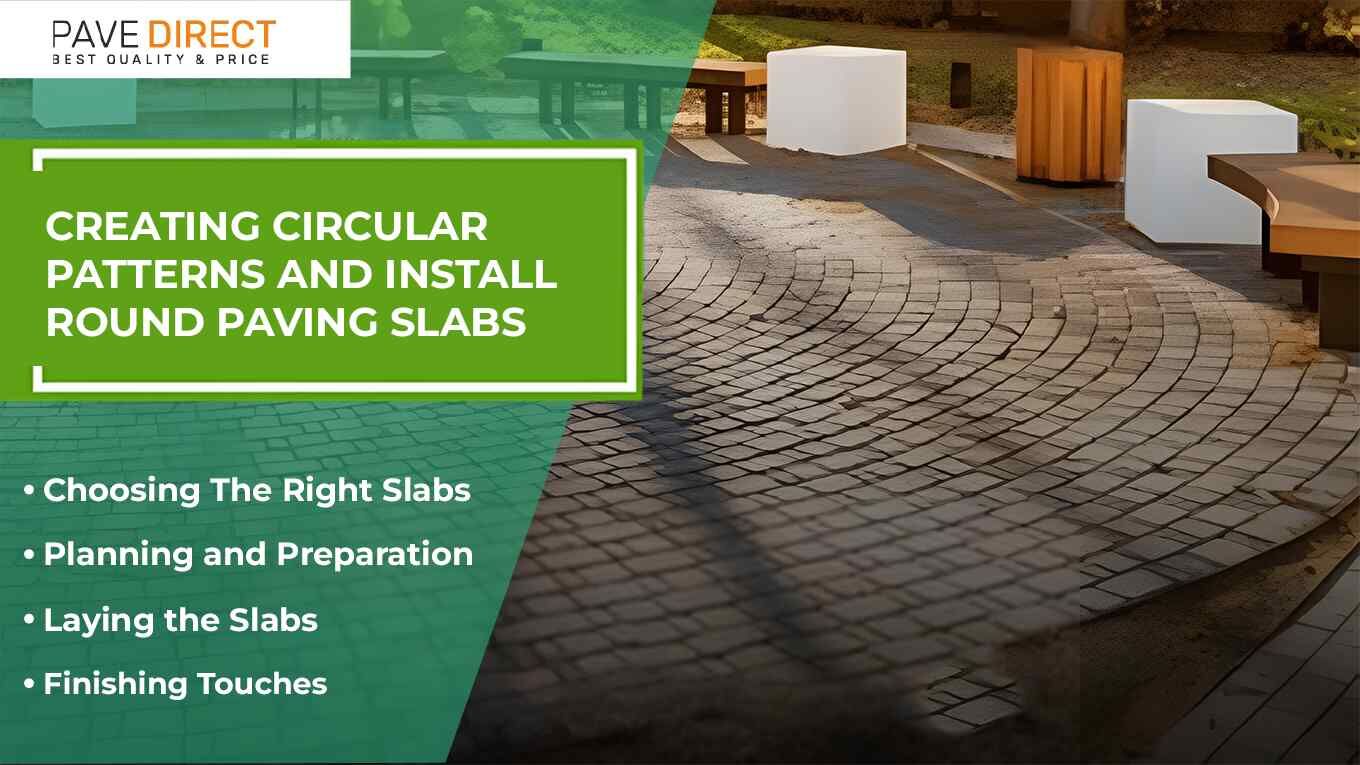
Circular paving stones are an interesting and practical element that can be installed in any area of the exterior, and again, are a great contrast to the traditional square and rectangular pavers.
These circular slabs give a natural feel to patios, pathways, driveways, and gardens. Creating a comfortable pedestrian area, a large square, a circular terrace, or a driveway with round porcelain paving stones is a perfect solution for any outdoor area!
This article will provide all the information including:
1. What Are Circular Paving Slabs?
2. Applications of Circular Paving Slabs
3. Types of Circular Paving Slabs
4. Materials Used for Circular Paving Slabs
5. Pros of Round Paving Slab
6. How to Install Circular Paving Slabs?
7. Design Concepts for Circular Paving Slabs
8. Conclusion
What Are Circular Paving Slabs?
Circular paving slabs are circular-shaped stones that are designed for the construction of hard surfaces in exterior zones.
Traditional paving slabs come in square or rectangular shapes. While round slabs offer the same functional use as the former, they give the space a softer, curvaceous feel.
These slabs are available in different dimensions, hues, and types of materials, providing a versatile design with high endurance.
Applications of Circular Paving Slabs
Circular slabs are commonly used in a variety of outdoor applications, such as:
Garden Pathways: As a result of this, designing meandering and free-form paths.
Patios: Creating circular zones or points of interest.
Driveways: This article explores the aesthetic and functional benefits of a unique, sophisticated solution to typical driveway paving.
Pool Areas: The formation of a visually integrated and functional plane adjacent to pools or water features.
The round paving slabs are of different kinds, and each type has peculiarities and applications. Here are some of the most common types:
Types of Circular Paving Slabs
The round paving slabs are of different kinds, and each type has its peculiarities and applications. Here are some of the most common types:
Standard Round Slabs
These are plain, without any design, and are circular with different sizes and colour options. The standard round slab has a smooth finish, is considered for general application, and is suitable for normal paving.
- Uses: These slabs are suited for most garden applications including use in garden paths, small patios or in areas with low traffic.
Textured Round Slabs
These slabs also offer a renewed surface that looks like it is made of cobblestones, natural stone or even an abstract design. The texture creates a more appealing surface and also enhances the friction that is important in areas that need more friction such as paths or around the pool.
- Uses: It is suitable for installing in areas that are prone to mobile traffic or areas that are exposed to moisture such as paths, patios, or swimming pool areas since the surface has good friction.
Decorative Round Slabs
These slabs are more aesthetical in nature and can have either inlaid patterns, mosaics or even are embossed. These can be made of different materials such as stone, concrete or clay and may additionally have contrasting colors, patterns, engravings, or geometrical shapes.
- Uses: Perfect to use for specific design features, detailed designs or to make a particular statement in your garden or patio.
Interlocking Round Slabs
These slabs have specially made edges that fit into one another meaning that they cannot be easily dislodged during installation. This kind of interlocking round slabs are usually cast in concrete or other strong material.
- Uses: These are most beneficial in large areas as the slabs which are used in driveways or patios for instance require to be in place for quite long. The design also features interlocking which makes it easy to fit them without the need for a professional to do so.

Materials Used for Circular Paving Slabs
The type of material used on your circular paving slabs will define its looks, its sturdiness, and of course its price. Here’s a closer look at some of the most popular materials used for round paving slabs:
1. Concrete
- Advantages: The most popular is concrete as the material for round paving slabs. It is economical, flexible in application, and can be made in different forms and dimensions. These slabs come in a variety of colours and surface patterns. Such as smooth, troweled, or imprinted patterns on the surface.
- Durability: These applications include outdoor structures because concrete is a rather sturdy material that does not decompose easily. But it may get stained or may even succumb to pressure and crack if not well fitted.
2. Natural Stone
- Types: Some of the most widely used natural stones for round paving slabs are granite, limestone, sandstone and slate.
- Advantages: Natural stone has a lavish and ageless appearance and is extremely long lasting and hard wearing. They all have different sizes, shapes, textures, as well as colors that give the overall look a natural touch.
- Durability: Natural stone is very tough, does not get easily scratched and can endure all forms of weather extremities. Nevertheless, it is frequently more costly than concrete and, in some cases, may need to be refinished periodically in order to retain its original appearance.
3. Clay / Terracotta
- Advantages: Terracotta or clay round paving slabs add a nice touch of warmth to many Mediterranean or vintage-style landscaping designs. These can be more porous than concrete or stone and may need to be sealed in order not to stain.
- Durability: Even though rather long-wearing, clay slabs are more likely to crack under stress or when exposed to temperature changes. It is therefore recommended that the structure be sealed appropriately.
4. Recycled Materials
- Advantages: Round paving slabs that are made of recycled material including used concrete, glass or plastic are a suitable choice. These slabs can be produced from eco-friendly materials and are characterised by high aesthetic value owing to the use of various types of material.
- Durability: The recycled material slabs are known for their strength but there is a difference in the quality of the materials used.
5. Rubber / Composite
- Advantages: Rubber and composite round slabs are manufactured from recycled rubber or synthetic rubbers. They are not very hard on the feet and are also very safe for use. In places that may be slippery, for instance playgrounds, areas with pets or in wet conditions.
- Durability: Very tough, waterproof, and needs almost no upkeep. They are not very attractive as compared to stone or concrete but they have a lot of advantages.

Pros of Round Paving Slabs
Aesthetic Appeal
These are round paving slabs that give a feeling of bringing down the hard shape of the paving and integrating it into the natural environment. Which is perfect for curved paths, round seating areas, and any other area where a loose, less formal design is called for. It also has round edges which give it a nice complement to squares and straight lines in the environment.
Versatility in Design
From the simplest round path to the most complicated spiral pattern, round paving slabs offer many design options.
You may arrange them in a circular pattern starting from the center, in a circular pattern but in spiral form, in a circular pattern but clockwise or counterclockwise, or in an irregular circular pattern for a more natural appearance.
You can combine them with other forms, such as square or rectangular, to create a different design or a mosaic.
Durability
Circular paving slabs, concrete or stone, are durable, lasting for many years. It can handle pressure from walking, driving (for driveways) and other weathers to ensure that your exterior surface is well protected and in good shape for a long time.
Ease of Installation
Laying round paving slabs is not complicated, particularly when you are using the interlocking paving slabs. While the square or rectangular slabs must be placed in a very accurate manner to ensure.
With their proper and level arrangement, the round slabs can be installed in several ways with significant deviation. From the true measurements which are quite advantageous for do-it-yourself.
Low Maintenance
Circular paving slabs especially the manufactured ones including concrete or stones are relatively easy to maintain. They do not fade, crack, or stain (provided that they are sealed), and can be hosed down or swept clean.
Eco-Friendly Options
These circular paving slabs come in a variety of green options such as recycled concrete, rubber, or natural stones. They are environment-friendly, to say the least.

How to Install Circular Paving Slabs?
Here’s a step-by-step guide to installing them:
Step 1. Prepare the Site
Remove all the debris on which you wish to have the slabs installed. Clear all the grass, weeds, and debris.
Remove topsoil to a depth of 3-4 inches, particularly for small circular paving slabs and 5-6 inches for large circular paving slabs. When working with larger slabs, however, you may have to dig down more to lay the sub-base and make the structure strong enough.
Step 2. Lay the Base Layer
Dig the site and then put a layer of compacted sand, gravel, or crushed stones on the area. This would ensure that there is a good stable foundation and also to enable a proper drainage system.
Compact or tamp the base material to settle it properly and make it level for the layer to be put on top.
Step 3. Position the Slabs
Begin the installation of the slabs from the center of the room or any corner. There should be a gap of 1/4” to ½” between each slab to provide space for expansion and drainage.
For circular patterns, it is recommended that the slabs are well-spaced and well-aligned.
Step 4. Grouting and Filling
After all the slabs are tiled in place, sand or polymeric jointing compound can be used to fill the gaps thus sealing them in position.
Clean off any sand that may be left over and then use a tamper to compress the joints.
Step 5. Finishing Touches
Peel off the film from the slabs and then wash the slabs to get rid of any dirt. That could have been brought in during installation.
Do not use the area that has been installed for at least a day or two.
Design Concepts for Circular Paving Slabs
Circular Garden Paths:
Place the round slabs in circular form to form a tortuous path in your garden. This works especially in natural landscapes or scenarios that resemble wooded landscapes or even paths to a centerpiece with garden circular paving slabs, for instance, a fountain or a statue.
Spiral Patio Design:
This way you can place circular paving slabs in a spiral pattern in your outdoor living space. This creates a dynamic and fluid appearance to the space and can be a real feature within the design.
Driveways with Character:
Bigger circular slabs can be used to design an attractive driveway for the home. Installed in a circular form or placed in a random, free-form pattern, round slabs add character to your driveway.
Circular Seating Areas:
To design a comfortable and functional round seating area in your garden or yard place round pavers around the fire pit or a table in the center. This is particularly good in outdoor areas where one would like people to mingle and converse.
Conclusion
Circular paving slabs are great, and practical way to improve the look of your backyard. Whether you want to construct a beautiful pathway in your garden, a round patio, or an attractive driveway, these slabs will be versatile and long-lasting. The curved edges give a tender and smooth look suitable for both the contemporary and the shabby chic backyard.
Available in several materials, dimensions, and looks, there is something for everyone and any style of exterior decoration. A properly installed and maintained circular kit remains a beautiful feature in your garden for many years.
Knowing these tips, you’re ready to start your project. All the very best!
Most Commonly Asked Questions
1. What is the function of circular paving slabs?
Circular paving slabs are a very flexible product that can be used in several external environments such as paths in the garden, patios, driveways, pool surrounds, and other ornamental uses. The round shape of the pavers gives an impression of natural living in any area. It makes them ideal when used to pave curves or as accent pieces.
2. Can round paving slabs be laid down in a driveway?
Yes, round paving slabs for driveways is a possibility however you should opt for the ones made from concrete or natural stone. Circular slabs with larger diameters will be able to bear vehicle weights. It is also important to oversee the preparation of the base in a way that the ground is well-compacted and leveled to avoid any movement or cracking when heavy traffic is received.
3. What can be done in order to achieve stability in circular paving slabs?
If you want to keep your round paving slabs in place for years, you have to make sure that the base is well put in place. First of all, remove the ground up to the required level. Lay the base of sand or gravel similarly compressed. For enhanced stability, the round slabs can be laid in a manner that they interlock or the slabs can be anchored in position using polymeric sand in the joints. This will prevent movement and shifting as the surface will be well-maintained and leveled.
Get Your Free Consultation!
Click Here to get started!
Start your project now with Pave Direct!
Need more information? Call us today at 01778 343999 to talk to one of our professional landscapers or come to our store to get more information about it.
Get your outdoor space looking great and working hard with round paving slabs beauty and toughness combined.
Start your project now with Pave Direct!
Additional Reading!
How To Lay Porcelain Paving Slabs
Work out your exact order in seconds
Our coverage calculator turns your patio size into the precise number of slabs and packs — 10% waste allowance included.
Free delivery, £0.98 samples, breakage guarantee
Every order ships free with no minimum spend. Order a £0.98 sample first, choose your delivery date, and if a slab arrives broken we replace it — no quibbling.