
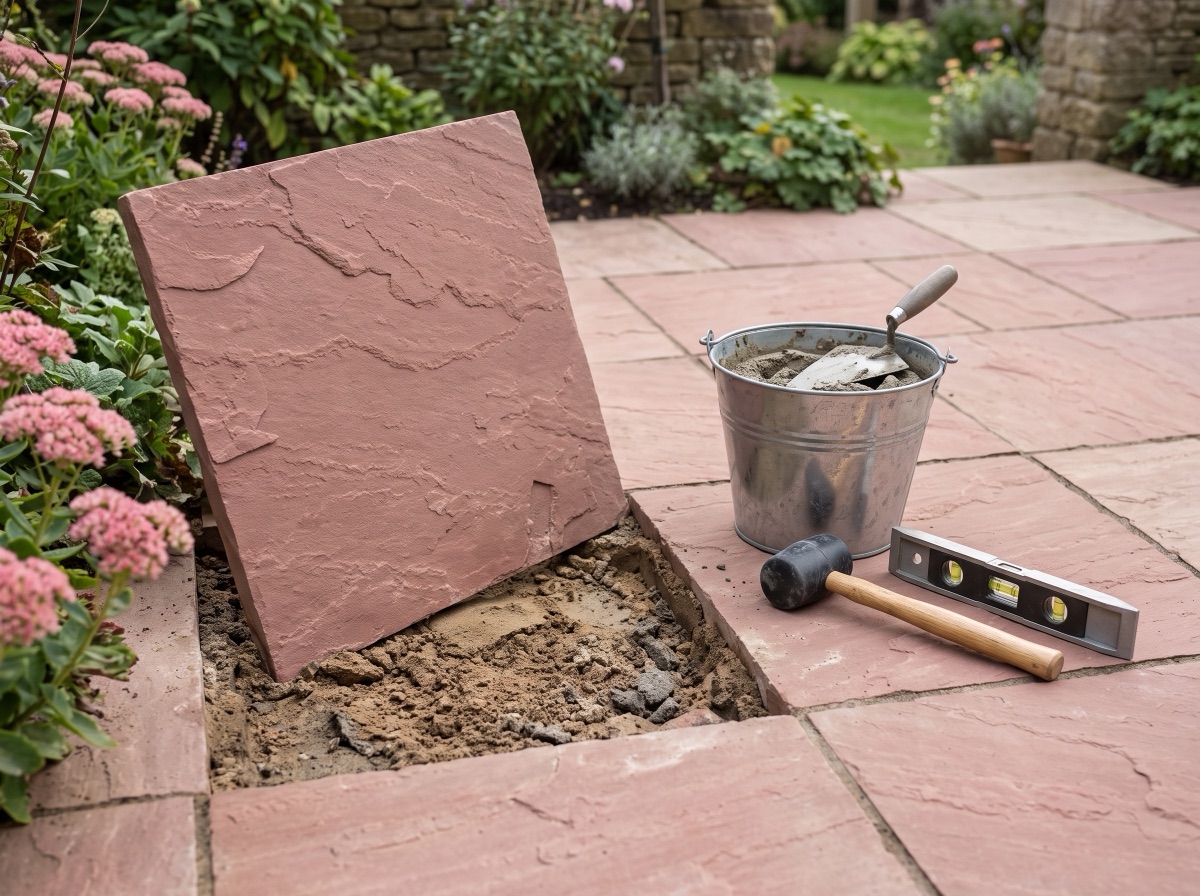
To fix a loose or wobbly paving slab properly, lift it, clean off the old bed, lay fresh full-bed mortar, prime the slab (essential for porcelain), re-lay it level and re-joint — then keep traffic off for 48 hours. Re-wedging with sand or dabs of mortar only postpones the wobble.
A loose slab is a bedding failure, not a slab failure — somewhere under it there's a void, a crumbled bed or washed-out ground. The permanent fix is always the same: lift the slab, remove the old bed, re-lay on fresh full-bed mortar and re-joint. It's a half-day job for one or two slabs, and everything short of it (sand packed under a corner, a squirt of adhesive into the gap) is temporary by design.
Why slabs come loose
- Spot bonding — the slab was laid on dabs of mortar, and the voids between them finally collapsed. The most common cause by far.
- Water and frost — open joints let rain wash fines from the bed; freeze-thaw then pumps the slab loose.
- No bond on porcelain — porcelain laid without a priming slurry can debond in one piece, rocking on a perfect-looking bed.
- Ground movement or loads — soft spots in the sub-base, tree roots, or vehicles crossing pedestrian-spec paving.
Diagnose first: one hollow-sounding rocking slab is a re-bed; a whole run of sunken slabs points at the sub-base, and relaying one slab won't cure a base problem — see how the ground should have been built.
Tools and materials
- Bolster or brick chisel, rubber mallet, trowel, spirit level, stiff brush.
- Two timber battens or a pry bar for lifting; a helper for large-format slabs.
- Sharp sand and cement (about 4:1) for the bed; priming slurry or SBR primer if the slab is porcelain; jointing compound or mortar to finish.
- Gloves and eye protection — slab edges and wet cement both bite.
Step 1: Free the joints around the slab
Cut or rake out the jointing on all four sides with a bolster, plugging chisel or an old wood chisel, right down to the bed. Trying to lever a slab against intact joints is how neighbouring slabs get chipped.
Step 2: Lift the slab
Work a pry bar or bolster under one edge, lift a few centimetres and slide battens underneath, then walk the slab up and out. Large-format porcelain wants two people or slab-lifting suction grips — a dropped 900×600 rarely survives.
Step 3: Break out the old bed
Chisel and scrape all the old mortar off the base — and off the back of the slab if it lifted with mortar attached. Fresh mortar bonds badly to old; a clean substrate is most of the fix. Dig out and recompact any soft ground you expose.
Step 4: Mix and lay a fresh full bed
Mix sharp sand and cement at about 4:1, semi-dry (holds its shape when squeezed). Lay a full bed 30–50mm thick, slightly proud of the finished level, furrowed with the trowel so the slab can bed down. Never re-lay on dabs — that's what failed the first time.
Step 5: Prime and re-lay the slab
Brush priming slurry onto the back of a porcelain slab (essential) or dampen the back of natural stone. Lower the slab in, aligned with its neighbours, and tap down with the rubber mallet, checking the level and fall against the surrounding paving in both directions.
Step 6: Re-joint
Once the bed has firmed (24–48 hours), refill the joints to match the rest of the patio — mortar pointing or a brush-in compound (methods compared here). This step is structural, not cosmetic: open joints are how water gets back under.
Step 7: Keep traffic off while it cures
48 hours foot-free (longer in cold weather), and keep vehicles off relaid driveway slabs for a week. Then it's fixed — properly.
When to call a professional
Multiple slabs sinking together, cracked slabs over a firm bed, drainage pooling, or any relaid area that fails again within months all point to sub-base or drainage problems — that's excavation work, not spot repair. Broken slabs from a discontinued range are also a good moment to reassess: matching new paving to the old, or refreshing the whole area, is sometimes the better spend (browse the current ranges or order samples to compare against your existing slabs).
Work out your exact order in seconds
Our coverage calculator turns your patio size into the precise number of slabs and packs — 10% waste allowance included.
Free delivery, £0.98 samples, breakage guarantee
Every order ships free with no minimum spend. Order a £0.98 sample first, choose your delivery date, and if a slab arrives broken we replace it — no quibbling.
Frequently asked questions
How do you fix a wobbly paving slab?
Lift it, chisel off the old bedding, lay a fresh full mortar bed (sharp sand and cement about 4:1, 30–50mm thick), prime the slab back if it's porcelain, tap it down level and re-joint. Packing sand or mortar dabs under a corner is only ever temporary.
Can I use adhesive instead of mortar to fix a loose slab?
Exterior slab adhesives exist for bonding to sound concrete bases, but squirting adhesive under a rocking slab without cleaning off the failed bed doesn't address the void that caused it. For slabs on a mortar bed, re-bedding is the reliable fix.
How long does it take to repair a loose paving slab?
About one to two hours' work per slab (lifting, cleaning, re-bedding), then 24–48 hours before jointing and another day or two of curing before normal use.
What if the slab cracks during removal?
It happens, especially with thin or already-stressed slabs. Lift the pieces, re-bed as normal and lay a matching replacement slab — order a sample first if you're matching an older range, as batches and colours shift over time.
Why do paving slabs come loose?
Mostly failed bedding: slabs laid on mortar dabs (spot bonding) rather than a full bed, water getting in through open joints and washing out the bed, porcelain laid without a priming slurry, or soft spots in the sub-base beneath.