
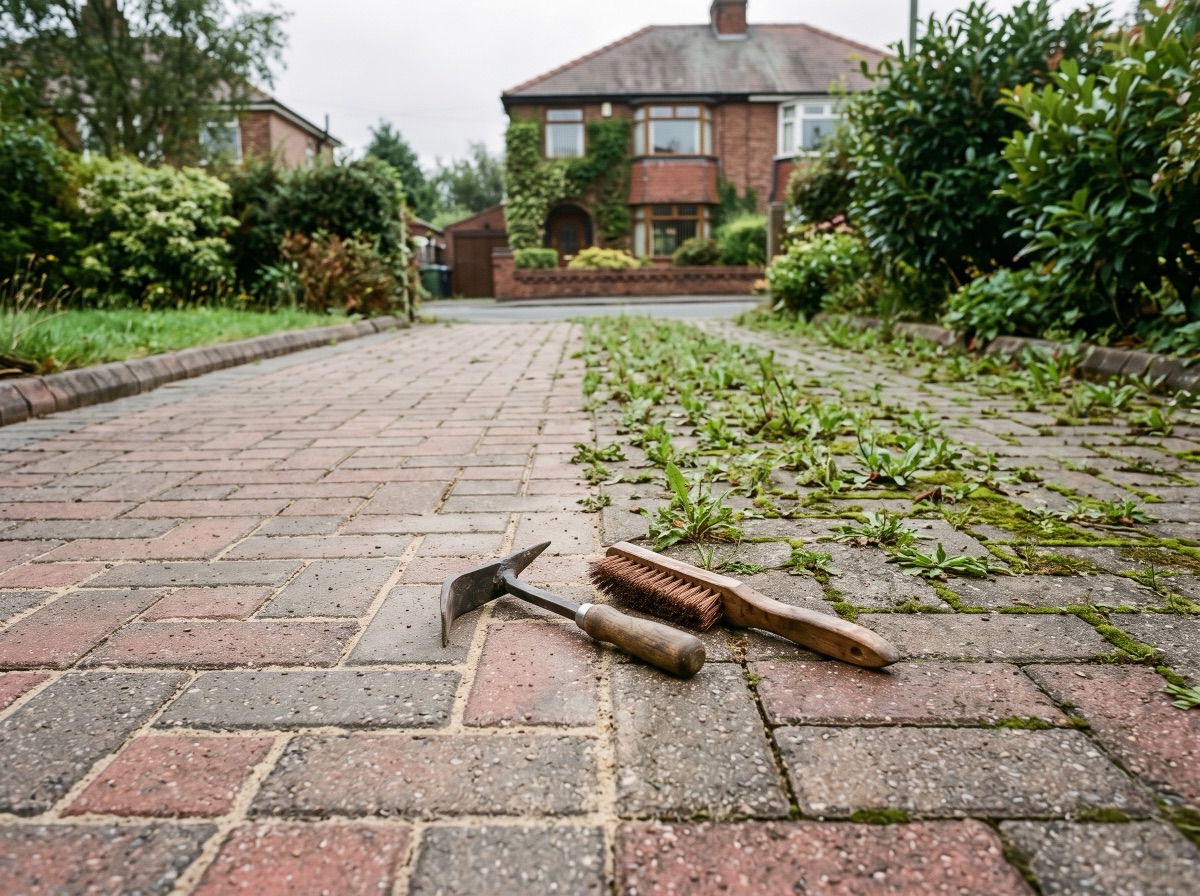
Weeds in block paving grow from seeds landing in the joints, not up from below — so the fix is joint care: remove growth including roots, clean out the joint debris they root into, refill with kiln-dried sand and stabilise with a sealer. Membranes under the paving won't stop surface-seeded weeds.
The counterintuitive truth: paving weeds grow down, not up. Almost every weed in block paving started as an airborne seed that landed in a joint holding a little organic debris and moisture — which is why a membrane under the drive doesn't stop them, and why the permanent fix is joint hygiene: clear, clean, re-sand, stabilise.
Know your enemy
Shallow annuals (chickweed, spurge, annual meadow grass) pull out whole and are easy wins. Perennials with taproots or creeping roots (dandelion, plantain, couch grass) regrow from any root fragment left in the joint — those need the root out or killed, not just the top snapped off. Moss is a different organism with the same cause: damp, dirty joints in shade.
Step 1: Remove what's growing — roots included
After rain (joints grip roots less when damp), pull annuals and hook out perennials with a weeding knife or L-shaped joint scraper. For stubborn taproots, either dig the root tip out or spot-treat that weed with a systemic weedkiller (one that translocates to the root — glyphosate-based products are the common example) and let it die back fully before removal. Spot-treat individual weeds; don't blanket-spray the drive.
Step 2: Clean the joints and the surface
Scrape remaining debris out of the joints, then clean the paving — a pressure wash does joints and surface in one pass and flushes out exactly the organic silt weeds root into. Accept that washing empties the joints: that's the next step, not a problem.
Step 3: Let it dry, then re-sand with kiln-dried sand
On a fully dry surface, brush kiln-dried sand diagonally into the joints, compact, top up and sweep off — full joints leave no room for seed and debris to accumulate. The complete method is in the re-sanding guide.
Step 4: Stabilise — sealer or polymeric sand
To make the result last, bind the joints: a joint-stabilising sealer applied over fresh kiln-dried sand glues its surface against seed lodgement, washing and ants; or use a polymeric jointing sand (sets when wetted) in the first place. Neither is forever — expect to refresh every few years — but both cut weeding to minutes a season.
Step 5: Maintain little and often
- Sweep the paving regularly — a clean surface gives seeds nowhere to sit while they wait for rain.
- Deal with seedlings on sight; a ten-minute monthly walk beats an annual war.
- Improve drainage where the drive stays damp (moss country) — standing moisture is half the invitation.
- Top up joints after every wash.
Salt, vinegar, bleach and boiling water — the honest verdict
- Boiling water — kills the tops of small annuals; harmless to blocks; does nothing to taproots. Fine as a spot tactic.
- Vinegar — a contact killer for seedlings, but it acidifies joints, can mark concrete blocks, and doesn't kill perennial roots. Not a strategy.
- Salt — genuinely effective and genuinely a bad idea: it persists, poisons adjacent beds and lawn, leaches into drains and can effloresce on the blocks. Avoid.
- Bleach — surface stain risk, kills nothing below the crown, hazardous runoff to plants, pets and watercourses. Avoid.
If the joints themselves have failed across the area — washed out, cracked, chronically weedy — treat it as a jointing renewal job rather than a weeding one, and if you're at the point of replacing the surface entirely, sealed-joint slab paving carries far fewer joints per square metre than blocks (see slab jointing methods and paving types compared).
Work out your exact order in seconds
Our coverage calculator turns your patio size into the precise number of slabs and packs — 10% waste allowance included.
Free delivery, £0.98 samples, breakage guarantee
Every order ships free with no minimum spend. Order a £0.98 sample first, choose your delivery date, and if a slab arrives broken we replace it — no quibbling.
Frequently asked questions
How do I permanently stop weeds in block paving?
There is no one-off "permanent", but the closest is: remove weeds with their roots, clean out the joints, refill with kiln-dried sand and bind it with a joint-stabilising sealer or polymeric sand — then sweep regularly and pull seedlings on sight. Weeds seed into joints from above, so joint hygiene is the whole game.
Should I use bleach to kill weeds in block paving?
No — bleach can stain blocks, only burns the visible growth, and the runoff is harmful to borders, pets and drains. Pull weeds or spot-treat perennials with a systemic weedkiller instead.
Does salt stop weeds in block paving?
It kills them, but it stays in the ground, spreads to adjacent lawns and beds, can leave white efflorescence on the blocks, and washes into drains — so it's not recommended.
Can you seal block paving to stop weeds?
Sealing helps significantly: a joint-stabilising sealer applied over fresh kiln-dried sand binds the joint surface so seeds can't lodge and sand can't wash out. It needs re-applying every few years.
Why do weeds keep coming back between my blocks?
Because the joints keep offering what seeds need — organic debris and moisture — or because perennial roots were never fully removed. Clean joints, full kiln-dried sand and prompt seedling removal break the cycle.