
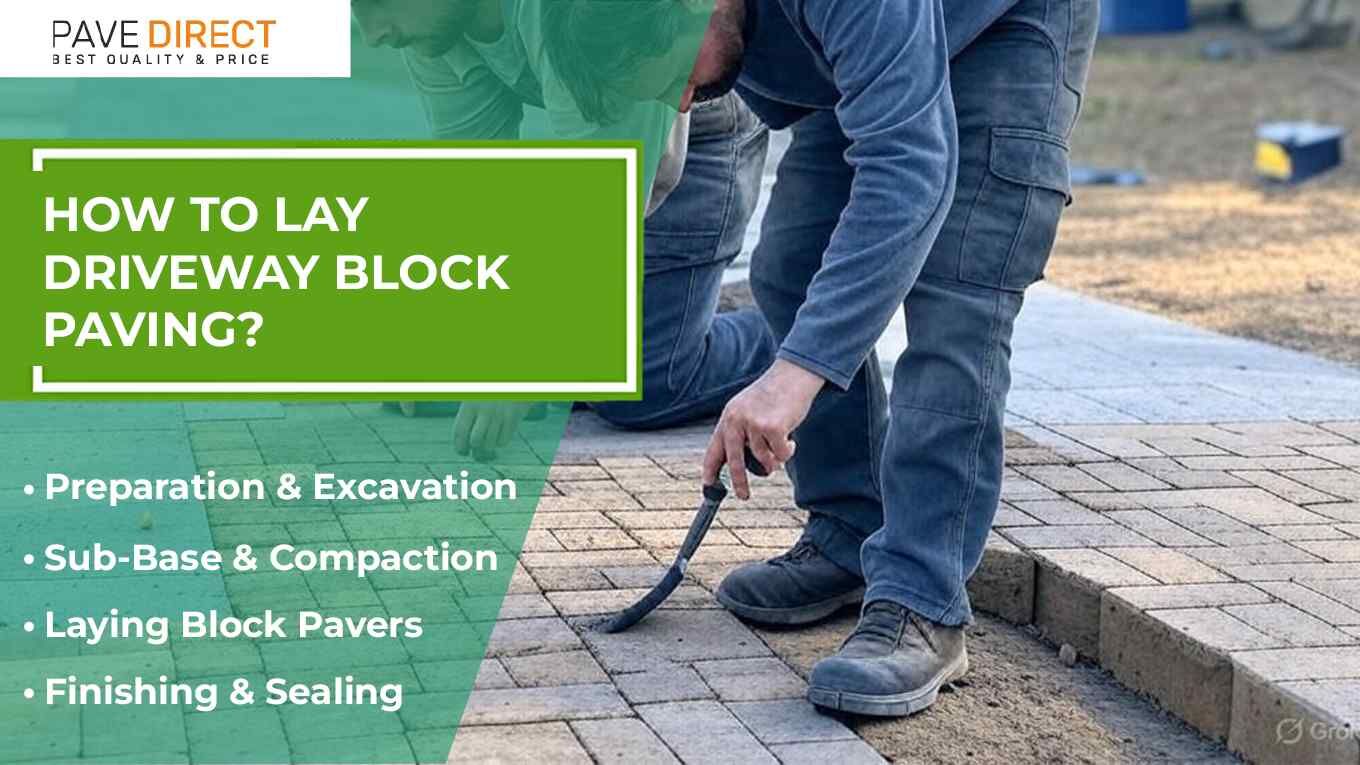
How to you lay driveway block paving? We will answer that question soon, but here are a few things you must know before starting your driveway paving project.
Driveway Block Paving, also known as Brick Paving, is made up of individual blocks or bricks. It is versatile, highly durable, looks great, and plays a significant role in raising your property’s worth. The varying pattern and edging give it a unique look and work well with any style or house design.
Benefits of Block Pavers

Block Paving is one of the most popular paving options for domestic and commercial projects. Below are some of the reasons why you should opt for block paving stones from your heavy foot and vehicular traffic areas.
- Individual Paving Blocks are stronger and more durable.
- If any of the block stones break, you can easily replace them without redoing the whole area.
- Block Paving is available in concrete, clay, and natural stones depending on your preference.
- They come in a huge variety of colours and textures.
- You get the flexibility to create your desired patterns and designs.
- A good quality laid block paving boosts your property value.
Block Paving Laying Patterns
For driveways, below are some of the recommended block paving laying patterns that will not only look aesthetically pleasant but also be beneficial for high durability.

- 45° Herringbone
Laid at 45° angle providing excellent interlocking. This pattern is ideal for driveways and heavy-traffic areas where there is a risk of movement. - 90° Herringbone
45° angle but the next block is laid at 90°. This pattern gives a structured look and also is great for heavy foot and vehicular areas. - Stretcher Bond
Laying blocks in straight rows and each line differs by half a block. This pattern creates a clean and simple look and is used best for driveways, patios, and pathways. - Basket Weave
Placing pair blocks in alternating horizontal and vertical lines. This pattern not only gives a classic woven effect for a traditional look but also is a good decorating and functional factor for pathways and driveways.
Tools and Materials
Experts recommend that you use very high-quality items for laying block paving on soil. Choosing specifically designed paving blocks for your requirements saves you a lot of money and time in the foreseeable future. Do it right and do it once!
Tools:
- String Line
- Broom
- Rake
- Shovel or Spade
- Spirit Level
- Vibrating Compactor
- Tape Measure
- Rubber Mallet
- Wheelbarrow
- Pegs
- Screed Rails
Materials:
- MOT Type-1 (Sub-base)
- Sharp Sand
- Block Paving Stones
Step-by-Step Guide to Driveway Block Paving
Before you move toward the driveway paving preparation and installation, you must consider several factors including drainage, slope of your area, design options, and accurate measurements for base preparation.
Now that we have given you the disclaimer, let’s get into it.
Excavation
The first step is excavation using a spade/shovel while laying block paving on soil; using a mini excavator will save a lot of time if you have the budget. You need to dig out a minimum of 150mm to 200mm (15cm-20cm) area. Want to know how to lay blocks knowing the correct measurements? Let’s see:
- MOT layer: 100mm - 150mm
- Sharp Sand Bed: 40mm
- Paving Block: 50mm
Pro-Tip: Paving block thickness depends upon the area of use. 50mm is adequate for normal domestic use, 60mm for heavy domestic areas, and 80mm thickness for commercial projects to ensure their durability and longevity.
Now that you know your measurements, you also need to incorporate slope in your area for better drainage. You need to add a 1cm of slope to every 60cm of your area.
Edging
The next step in your UK block paving guide is to edge your paving area using mortar mix. Edging helps your paving blocks to stay in place. It is like having a frame for your picture.
Start by defining the edges of your driveway using string lines, and pour mortar mix of 4:1 ratio of sand and cement mixed in water (the water should be in a perfect proportion to make a mix and not drain at the same time). Place the edging stones over the mix and wait for 24 hours to cure before applying your sub-base. Make sure that the edge is level with the measurements of your paving blocks.
Sub-base
After curing the edges, you will have to apply at least a 100mm - 150mm layer of MOT Type 1 sub-base. This must be enough for a perfectly laid driveway paving. The sub-base is typically made of crushed granite, limestone, or concrete. They help in the stability of the ground and prevent it from sinking.
The correct way is to apply a 75mm hardcore aggregate layer of MOT in the area with the help of a wheelbarrow and shovel or a mini excavator. Whack the area with a compactor and then apply another 75mm layer and compact it again. Compacting will help in giving you an even, and finished look for laying block paving.
Laying Sand
After your MOT layer is all set, you have to fill all the void with sharp sand or grit making a bedding layer of 50mm or 5cm.
The sand layer should not be laid dry. It should be moist enough to make a ball in your hand and if it does not break, you are good to go. After applying the layer, use a vibrating compactor to compact and screed it. Use a spirit level to level it right and a string line above 3 to 5cm for final surface measurement.
Laying Driveway Paving Blocks
After preparing the base, now, how to lay block pavers? Start from the corner at the bottom of your slope or the straight edges of the paving area. Lay one stone by one considering the choice of design and maintaining consistent spacing between each block.
The blocks should be 10mm - 15mm above the string line planned at the start of the project. Lay all of your stones in the area and check alignments using the alignment tool. Do not forget to add drainage channels for water to flow.
After you almost finished laying your block paving, you will get small spaces at the end that a full block paving cannot fit in. The hack is to put a block over the space, chalk draw over the block where it needs to be cut, and use a bench-mounted saw to split it to fit the area perfectly.
If you want to explore how to lay paving slabs, you can find it here.
Final Touches
The final step of laying driveway block paving is to use kiln-dried sand to fill the paving joints. This will prevent the block pavers from moving horizontally or vertically, creating friction among them. The jointing also helps in preventing weed growth.
Before you finish your paving project, consider sealing your driveway. This will not only protect your driveway from stains and fading but also will elongate the overall life of the driveway paving area.
Dos and Don'ts of Laying Driveway Blocks
Dos
- Plan and measure your area accurately.
- Use good quality materials like joints, paving blocks, etc.
- Ensure proper drainage to avoid water pooling.
- Seal the driveway to protect it from stains and fading.
Don'ts
- Use soft sand instead of sharp sand.
- Lay blocks on uneven ground.
- Rush the paving process.
- Drive or use the area immediately after laying the paving blocks.
Conclusion
Starting from excavation, edging, laying your aggregate MOT, and installation, it is quite a straightforward procedure on how to lay block paved driveway, in it? However, it might not be as easy as it seems to lay your paving blocks for driveways but with quality information and a careful step-by-step method, you are good to go. Or, if you are not willing to handle the project yourself, you can always use the information to know how the professionals work.
You must know all the benefits related to your project and the pattern choices for your perusal. And, if you want further assistance regarding your paving choice, feel free to contact us here. We will be glad to help!
Frequently Asked Questions!
How do you prepare the ground for block paving?
For DIY driveway block paving installation, prepare your ground for block paving by doing this:
- Measure and specify the area you want to pave.
- Clear the area.
- Dig the area up to 150mm - 200mm depth spending on your hardcore aggregate, sharp sand, and paving blocks.
- Edge the area using mortar mix.
- Add your sub-base, and compact down while checking the slope for water drainage.
- Add sand bedding and compact it down.
Your base ground is good to go.
What do you lay under block paving?
One of the most crucial parts of how to prepare for block paving is knowing what to lay under block paving. You lay a 100mm - 150mm layer of hardcore aggregate of MOT Type-1 sub-base and a 40mm layer of sand bedding to give your base ground stability so that it does not move or sink in.
How deep to dig for driveway pavers?
For laying the perfect paving, you should first know how deep should driveway block paving be.
- Normal driveway paving with medium-level traffic: 100mm minimum depth.
- High-traffic driveways: 150mm depth.
- Commercial driveways: up to 200mm to give it the perfect stability.
Can you lay block paving on sand and cement?
Yes, you can lay block paving on sand and cement but it is not a widely used or recommended method. They are less flexible than sand bedding leading to cracks. They are also harder to replace individual blocks and if not done properly, they lead to poor drainage. However, this method is used to make the ground more stable for high traffic, reducing the chances of weed growth between the joints.
How to lay driveway block paving on concrete?
Block paving installation is possible on concrete however, the process is a lot more tedious...
How to lay driveway block paving on a slope?
You need to prepare and plan ahead for a sloppy driveway to pave.
Additional Reading!
How To Re-Sand Block Paving? Step-by-Step
How To Stop Weeds in Block Paving
Circular Patterns and Install Round Paving Slabs
Work out your exact order in seconds
Our coverage calculator turns your patio size into the precise number of slabs and packs — 10% waste allowance included.
Free delivery, £0.98 samples, breakage guarantee
Every order ships free with no minimum spend. Order a £0.98 sample first, choose your delivery date, and if a slab arrives broken we replace it — no quibbling.