
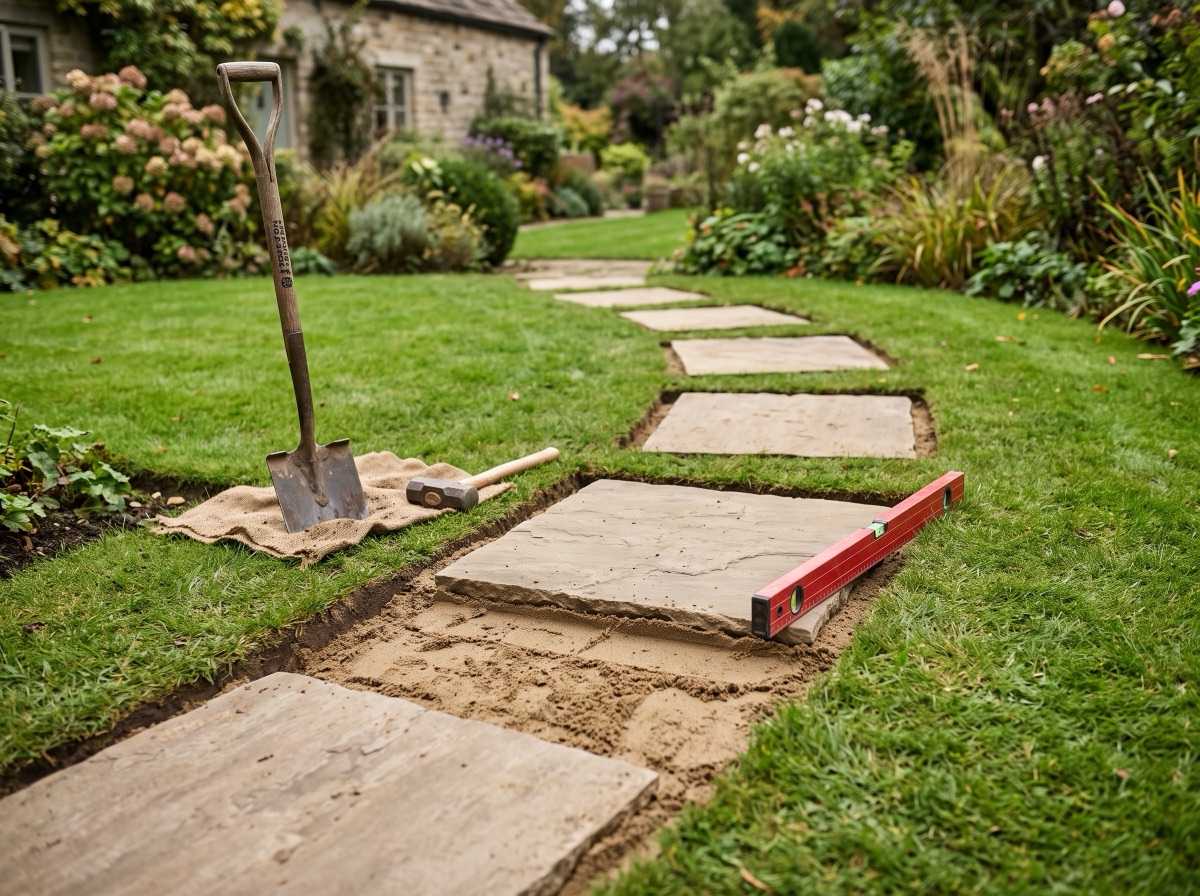
To lay paving slabs, start by marking the area and digging to about 150mm deep. Add a 100mm hardcore base and compact it, then spread 30-40mm of sharp sand and level it. Prepare a mortar mix (4:1 sand to cement) and lay each slab on a 30-40mm mortar bed, tapping gently with a rubber mallet. Keep 10-15mm gaps between slabs and ensure a slight slope for drainage. After 24-48 hours, fill the joints with jointing compound or mortar and clean the surface.
If you are laying paving slabs like natural stones, for example Raj Green or Kandla Grey; seal them to retain their colour and ensure their durability and longevity.
Pave Direct is a one of the best seller of porcelain paving and natural stone to customers across the UK, focusing on quality and long-term performance. With competitive prices and reliable materials, we help create outdoor spaces that last.
How to Lay a Patio Using Paving Slabs
Laying a patio means starting with a strong base, making sure water can drain away, and fixing the paving slabs firmly onto a mortar bed. Taking time to level the slabs, leave even gaps, and finish with a good jointing compound helps create a patio that stays strong and lasts for years.

Important Tools and Materials Laying patio paving slabs
Laying the paving slabs on soil is something, which can be done well if you have necessary tools as well as materials at your disposal. What I want to do is distill exactly what is required if you are going to get into it.
.jpg)
Required Tools
Before that we need some of the tools for the Best ways to install paving slabs on soil. Digging and edging the area requires a shovel and spade. In bigger jobs, it may be worth your while to rent a mini excavator to save time and energy. You can't do without a wheelbarrow in the site for shifting materials around.
Then you need something to make sure that the surface will be flat like some kind of spirit level, or a string line with stakes to mark it along. They will also help keep you on track to keep proper grading and alignment throughout the project. You will need a rubber mallet to tap the slabs into place gently.
You need a plate compactor or hand tamper to compact the soil and base materials. For a small area, a hand tamper will do the job, but if you want to tamp a large area, a plate compactor is the way to go.
Necessary Materials
Let’s discuss the materials needed now. As you can imagine, the star of this whole shebang is the actual paving slabs. Choosing the right porcelain paving slabs, natural stone or concrete slabs, is a personal choice depending on your style and budget.
The base you’ll need is MOT Type 1 (also known as crushed quarry rock or road base gravel). It makes a stable base for your paving. The bedding mix to lay the slabs with is a sharp sand and cement mix. For every 15 square meters of paving you will need roughly one bulk bag of sharp sand.
Remember to add edge restraints to provide a clean finishing product. Their design choices might range from cobble setts or linear paving.
Safety Equipment
Laying paving slabs on soil should always be about safety. Begin with a nice pair of work gloves to prevent your hands from getting sliced and carrying heavy objects. If you’re going to be cutting any slabs, safety glasses are a necessity.
Wear boots with steel toes as shocks to protect your feet in case materials fall on them. To protect yourself from inhaling harmful cement particles, a dust mask or respirator is a must if you’re mixing cement, or cutting up pavers.
My last point is don't forget ear protection. If you are using power tools or a plate compounder, when doing so always use earplugs or earmuffs to protect your hearing.
Putting all these tools, materials, and safety equipment together in one place before you start with your project will prepare you for your paving. The laying of paving slabs on soil: Don’t forget that preparation is everything, and the importance of this is also linked to achieving beautiful and a long lasting result.

Soil Preparation Techniques For paving Slab Installation
On soil, laying paving slabs requires proper preparation in order to ensure a firm, long lasting result. Let’s talk about the techniques which are the most essential when it comes to getting your soil ready to go for your paving installation.
Testing Soil Composition
It is essential now to understand what we are dealing with before we start laying paving slabs on soil. We test the soil composition for paving suitability and what alterations might need to be made. Grab a handful of soil and squeeze it, then we can do a simple hand test.
It is good for paving if we are able to open our hand and it still holds its shape, but if we poke it then it crumbles. If it falls apart into a tight little ball and won’t ‘stick’ together, it’s likely too clay heavy and needs more work.
We can get more accurate results by using a soil testing kit or having a lab look at a sample. This will provide us with good information about the soil's pH, content of nutrients, and texture. With this knowledge we can decide if we need to add more materials to help with drainage or to increase stability.
Compacting the Soil
Preparation of soil for laying paving slabs is a critical step and compaction is its most important component. It helps create a stable base through reducing air pockets and increasing the density of soil. We will use a plate compactor or a hand tamper to compact the soil orderly.
First we take out the loose top soil and level it. We next dampen the soil a little to help with compaction. Using this horizontal compactor means not to saturate the soil, otherwise you'll end up with poor compaction results.
We overlapped each pass with the compactor and made several passes so that the compression would be even.
We find it best to compact the soil in small 'lifts' (like 2–4 inches thick). This prevents compaction only on the surface; instead it is providing thorough compaction to the depth of the soil.
So we keep doing this until we reach the compaction that we want, usually when the next layer of soil no longer compresses under the weight of the compactor.
Adding a Sub-Base Layer
Once soil has been compacted, we then put a sub base layer in to give a further stabilizing layer and to aid drainage. It is usually MOT Type 1 aggregate, such as gravel or crushed stone.
For pedestrian areas we spread this material even over the compacted soil to a depth of 4–6 inches or for areas that will bear vehicle traffic to a depth of 6–10 inches.
We once again spread this and use the plate compactor to compress it, making many passes to get it compacted. We keep checking the level along the way in this process and adjust accordingly so that it has a slight slope away from any structures for proper drainage.
All of which prepares a solid base for the placing of paving slabs. This careful preparation also makes sure that however you're using porcelain paving, natural stoneor concrete slabs, our paving project will be stable, level and long lasting.

How To Laying Paving Slabs On Soil
If you are laying paving slabs on soil you need to be aware of the best practice to get a result that will stay and look good for years.
We’ll cover some key techniques to guarantee your project goes as planned.
Proper Spacing and Alignment
Getting the spacing and alignment right for a paving slab is one of the most important aspects of laying them. To get our layout started we use a string line as a straight edge and as a guide. It also keeps us on a similar pattern, and makes our paving look professional.
First we place the slabs using the click and drop method. That’s lining up the slab to the corner of the existing field and sliding it down into place carefully. Where possible we avoid dropping or throwing the slabs to prevent dropped slabs from lying in the bedding and causing lumps in the surface.
It's also good to work at a 45 degree angle to the main line of the patio. This way makes maintaining square and straight lines much easier along the project.
Using Sand and Cement Mix
We use a mix of sharp sand and cement as a stable foundation. Five parts sharp sand to one part cement is the usual ratio that is recommended. The slabs are then simply placed on top of this mixture where it provides a solid base, but will also drain properly.
While making the mix, we add water slowly and don't want it too dry or too wet. The best texture is creamy, not sloppy. If it's too dry it will be difficult to tamp the slabs down to the correct level. The slabs will slide around and the whole thing will be messy if it’s too wet.
Ensuring Level Installation
A level surface was needed both for esthetic and functional reasons. First, we create a sub base that is created from crushed stone or gravel (MOT Type 1 aggregate). In that case, this layer is spread evenly aggressively compacted to form a stable foundation.
To the sub base we add a sand or sand cement mix, and a bedding layer. To make sure this layer is perfectly flat we use a screed rail. This is important because anything uneven on the covering layer is transferred into the final paved surface.
We lay the slabs, check with our spirit level for each, to make sure they’re level. We want to make changes and as we go we are adjusting, adding bedding material, removing bedding material, etc. For proper drainage we also slope it away from any buildings.
With adherence to these best practices, we can design a beautiful, long lasting paved area. When laying paving slabs on soil then remember patience and attention to detail really is the key.
To get each step right you will have to take a little time but this will leave you with a professional finish that you can enjoy for years to come.

Troubleshooting Common Problems When Doing Paving On Soil
While laying paving slabs on soil we come across some common problems that can ruin the overall look of your paving. We’re going to look at these problems and their solutions to help ensure a good paving project.
Dealing with Uneven Surfaces
Unfortunately, for even surfaces, we quite often encounter one of the main problems. Patterns in paving slabs can become sunk unevenly with time and present trip hazards as well a very poor appearance.
To solve this problem we will evaluate the location that we observe the problem. With a level we get to determine how far down the slabs have sunk. Yet if it is more than one-fourth of an inch thick, it is high time to take measures in this respect.
To begin with, we lift the affected slabs off the paving in order to fix uneven paving. We also then add lime or gravel crushed to level the area. We’ll compact the slabs, meaning we need more material than will be needed. With a rubber mallet we tap them back into place, making sure they are level as we go.
If there is a lot of area or quite the settling, concrete leveling may be necessary. The way we do this is by pumping a compound beneath the slabs to lift them back into place. This is a low cost, efficient solution saving on average 70% of the cost of replacement.
Preventing Weed Growth
A common frustration is weeds coming up between paving slabs. In order to battle this issue, polymeric sand is placed between the pavers. When water mixes with this special sand, it forms a binding like agent hence, with the weeds finding it harder to grow through.
Laying a geo textile fabric underneath the paving provides another effective method. Whilst acting as a barrier to weeds, it also strengthens the base for the patio.
To go green you might consider using natural weed killers such as vinegar or baking soda. These substances dry out weeds, which causes them to die off not affecting the environment.
Addressing Drainage Problems
Poor drainage can lead to all these ills and include erosion, foundation damage, and even wet basement. We make sure the paving slopes away, to allow proper drainage away from any structures. It usually takes a quarter inch dropping per linear foot to direct water away.
Of course, if the area is inclined to be extra wet, we would perhaps require adding in another drainage system. Direction water running away from paved area can be done through French drains or catch basins. Such systems collect excess water and stream it to a defined drainage area.
A rain garden near the paved area is of course more eco-friendly and can be considered for a more eco-friendly solution. This landscaping feature is used to collect and filter runoff water allowing it to flow slowly into the soil.
We have outlined these common issues because by addressing them we can all help make sure that our paving project is beautiful, functional and lasting long outside. In the first instance, remember that many of these problems can actually be mitigated with proper preparation and installation.
Final Thoughts!
Paving slabs on soil effect a huge change to outdoor spaces and turn them into something beautiful. By adhering to the best practices spelled out in this guide, you can build an attractive and highly durable paved surface. Every step, from picking which tools and materials to use right through to making sure your ground is prepared properly, contributes to the success (or failure) of your project.
As with most things, remember patience and attention to detail are the key to completing a paving project. If you invest time and work in rectifying things like undulations, weeds and bad drainage situations you will be richly rewarded and your reseeding venture will proceed as clockwork and your area will look great for many years to come.
Why Trust Pave Direct?
Pave Directspecialises in supplying high-quality paving and porcelain solutions for outdoor projects across the UK. Our guidance is shaped by industry knowledge and real-world feedback from homeowners, landscapers, and trade professionals, ensuring practical advice you can rely on.
Get ready to work because Pave Direct going to transform that back also into the desire destination.
Important Note!
Installation methods can vary depending on ground conditions, usage, and climate. Always assess your site carefully and follow manufacturer recommendations. For complex projects or poor ground conditions, consulting a professional installer is advised.
FAQs!
1. Is it possible to pave directly on soil?
It is possible to put laying paving slabs on soil, but you definitely need to prepare them properly. There will be some testing of soil composition, that the ground is level and that you will use the right materials for a stable installation.
2. How do you put pavers on top of soil?
Laying pavers on soil involves several key steps: Cleared grass and soil, prepared the patio area by paver base and leveling it with the sand, considered if the edging stones be used, placed the paver stones, cut the pavers as needed, and last but not least sealed the pavers if you want them to last.
3. How to lay slabs on concrete?
To lay slabs on concrete, make sure the concrete is clean, flat, and fully set. Spread a thin layer of mortar or adhesive, place the slabs evenly, and fill the gaps with jointing compound for a strong, lasting finish.
4. Can laying paving slabs on dry mix?
Yes paving slabs can be laid onto a dry mix of concrete as long as you get it packed down enough. For the dry mix it is important that it is at least 150mm deep and that all topsoil is removed from the site and that the sub base is laid on solid earth for best stability.
5. How do I properly test soil before laying paving slabs?
You can test soil composition by squeezing a handful to feel it. It’s good for paving if its shape holds but it crumbles when poked. If you’re looking for more accurate results, a soil testing kit or a laboratory analysis works wonders for testing pH, texture, and nutrient levels in your soil.
6. How do I ensure the paving slabs are level?
You should pay great attention to installation and use a spirit level and screed rail. Changing the bedding of the lake will require adding or removing material as needed to maintain an even surface and down drain slope.
7. How to lay slabs on soil without cement?
Here are the steps to lay slabs on soil without cement:
1. Excavate the area to 100-150mm depth.
2. Add a 50-100mm compacted gravel or hardcore base.
3. Spread 25-50mm of sharp sand evenly.
4. Lay the slabs, ensuring they are level and stable.
5. Fill gaps with sand and compact.
8. How to lay a patio?
Laying a patio means starting with a strong base, making sure water can drain away, and fixing the paving slabs firmly onto a mortar bed. Taking time to level the slabs, leave even gaps, and finish with a good jointing compound helps create a patio that stays strong and lasts for years.
Additional Reading:
How to Lay Porcelain Slabs? | A Step-by-Step Guide!
How to Lay Porcelain Paving Slabs: Quick 7 Step Guide
How to Install Porcelain Floor Tile for a Professional Finish

