
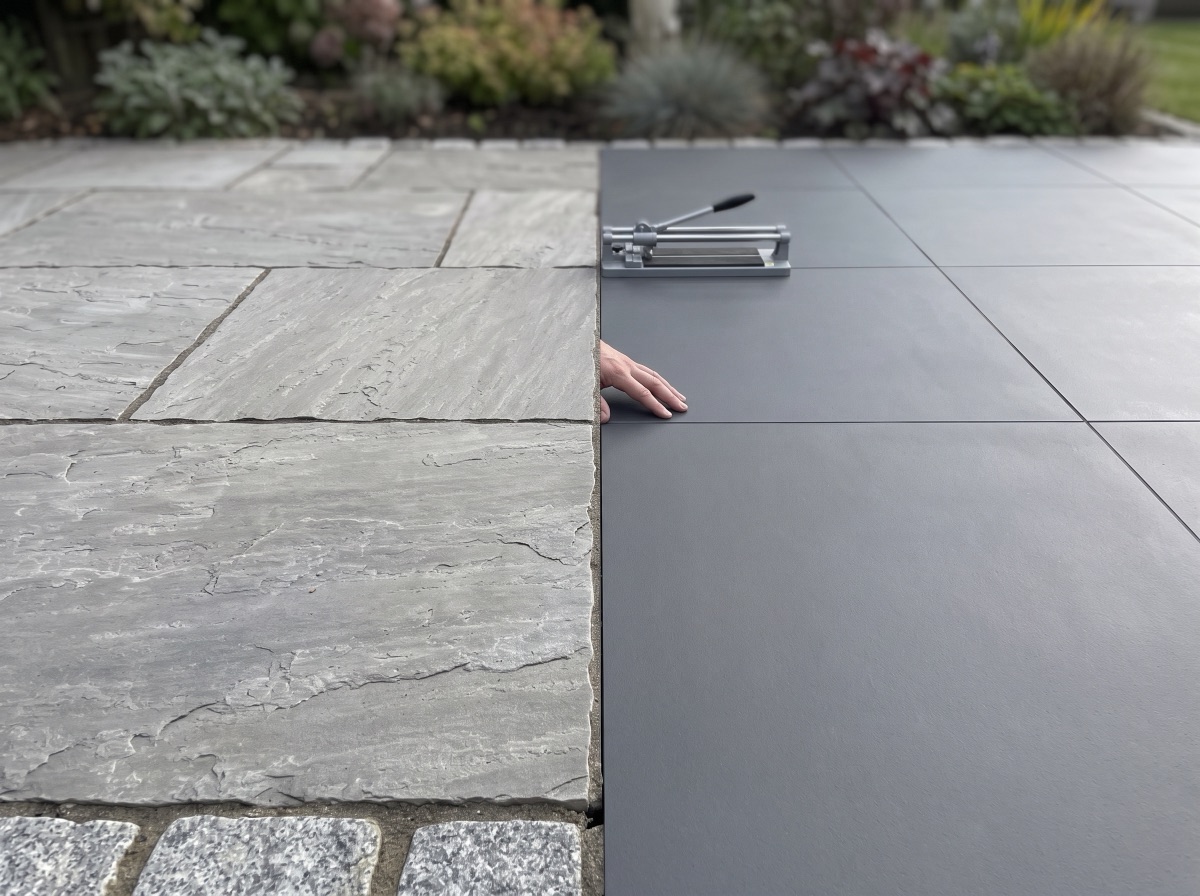
Sandstone is a natural stone with genuine character and colour variation; porcelain is a manufactured slab engineered for consistency and near-zero maintenance. Neither is objectively better — this guide compares appearance, durability, upkeep, thickness and cost so you can choose for your project.
Both are proven, widely-used external paving materials in the UK. Sandstone is a natural stone with genuine character and colour variation; porcelain is a manufactured product engineered for consistency and low maintenance. Neither is objectively "better" — the right choice depends on the look you want and how much upkeep you're prepared to do. For a two-minute version, see the quick-answer hub.
Appearance
- Sandstone: natural riven or sawn texture, genuine tonal variation slab-to-slab, warmer and more traditional feel. Browse the sandstone range.
- Porcelain: consistent colour and surface texture across the whole batch, sharper contemporary lines, and a wider range of large-format and stone/slate/marble-effect finishes. Browse the porcelain range.
Durability and maintenance
- Porosity: porcelain is fired at very high temperatures and is close to non-porous, which means it resists staining and generally doesn't need sealing. Sandstone is naturally more porous and can be more prone to staining (oil, tannins from leaves) without an impregnating sealer.
- Frost resistance: both, when correctly specified as an outdoor-rated product and properly laid with adequate falls for drainage, are frost-resistant — poor drainage or laying is a more common cause of frost damage than the material itself.
- Slip resistance: look for a slip rating (commonly quoted as an R-rating, e.g. R10/R11) on outdoor paving — this is specified per product rather than being a fixed property of "sandstone" or "porcelain" as a category, so always check the individual listing. Anti-slip finishes are collected under anti-slip porcelain, and R-ratings are explained here.
Thickness and installation
Porcelain paving for external use is typically supplied at a slimmer nominal thickness (commonly 20mm) than natural sandstone (commonly 22mm for calibrated packs), because porcelain's manufactured density gives it comparable strength at a slimmer profile. Installation differs in one important way: porcelain needs a priming slurry on the back of each slab to bond to the mortar bed. See the laying guide for the full sequence, and the thickness guide for 16mm vs 20mm vs 30mm.
Cost
Pricing varies by finish, pack size and supplier, so compare on a per-m² landed cost (including delivery) rather than per-slab — use the coverage calculator to get a like-for-like total for your project, and remember that sandstone's lower upfront price carries a small ongoing cost in sealing and more frequent cleaning.
The same colourway in both materials
Popular colourways — most famously Kandla Grey — exist as both a natural sandstone and a porcelain interpretation, so you can pick the material without giving up the colour you want.
Work out your exact order in seconds
Our coverage calculator turns your patio size into the precise number of slabs and packs — 10% waste allowance included.
Free delivery, £0.98 samples, breakage guarantee
Every order ships free with no minimum spend. Order a £0.98 sample first, choose your delivery date, and if a slab arrives broken we replace it — no quibbling.
Frequently asked questions
Is porcelain or sandstone paving more durable?
Both are durable when correctly specified for outdoor use and laid with proper drainage falls. Porcelain resists staining better due to low porosity; natural sandstone can be protected with an impregnating sealer.
Does porcelain paving need sealing?
Generally no — porcelain's low porosity means sealing isn't usually required, unlike natural sandstone which is more porous.
Which is cheaper, sandstone or porcelain?
It varies by finish and pack size — compare products on a per-m² landed cost (including delivery) using the coverage calculator rather than assuming one material is always cheaper.
Is porcelain paving harder to lay than sandstone?
Slightly — porcelain must be primed with a bonding slurry on the back of each slab and cut with a good diamond blade, but the ground preparation and mortar bed are the same for both.