
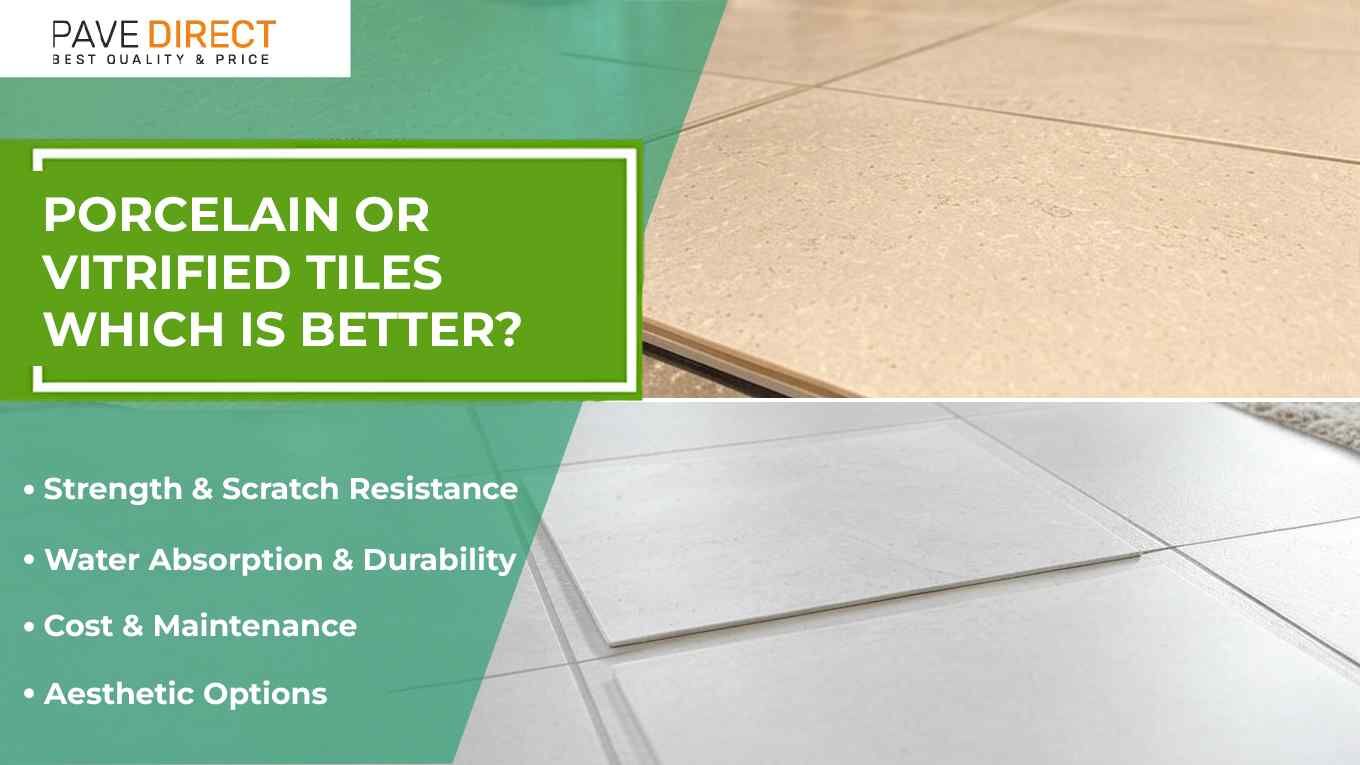
One of the productive and positive aspects of the current markets is the competition for quality between the companies. Choosing Porcelain or Vitrified tiles comes under the same shadow as the best tiles for UK homes; for indoor and outdoor spaces.
Outdoor Porcelain tiles or vitrified tiles have their own advantages and are similar in some aspects. You must know where you are supposed to use them, i.e., in a residential or commercial space. Other important and major parameters must also be considered, like manufacturing, maintenance, usage, and durability.
Let’s go through all the differences and you can give the score to the best according to your personal preference.
Tile Comparison: Porcelain vs Vitrified Tiles
Before you make a choice, you must intentionally know all the differences between the tiles and whether or not you are making the right choice according to your space.
Manufacturing

Porcelain Tiles
Porcelain tiles are made from Kaolin Clay, sand, and water and fired at high temperatures of 1200℃ to 1400℃ making them dense and durable.
Vitrified Tiles
Vitrified tiles are made of Clay, Silica, and Quartz undergoing the process of Vitrification. This allows the tiles to be extremely durable and denser than Porcelain.
Maintenance

Porcelain Tiles
Porcelain outdoor tiles as well as indoor ones are low maintenance and require less keep-up because of their stain and scratch-resistant qualities.
Vitrified Tiles
If you have concerns about how to clean vitrified tiles, you do not need to worry. Vitrified tiles are even more resistant to scratches and stains than Porcelain. This makes them very low maintenance requiring minimum to no keep-up.
Porcelain vs Vitrified Tiles: Durability
Porcelain Tiles
Porcelain tiles are very popular for their strength and durability for indoor and outdoor high-traffic areas.
Vitrified Tiles
Vitrified tiles rank even higher on the durability scale suitable for high-traffic indoor and outdoor spaces.
Finishes

Porcelain Tiles
Porcelain tiles are available in finishes like Matte, glossy, and textured.
Vitrified Tiles
You can find vitrified tiles in glossy, matte, double-charged, and full-body finishes.
Water Absorption

Porcelain Tiles
Porcelain tiles are highly resistant to water. To be more specific, their water absorption is less than 0.5%.
Vitrified Tiles
Vitrified tiles have a water absorption of 0.05%, which is even lower than Porcelain paving due to their high density.
Usage
Porcelain Tiles
Porcelain tiles are suitable for use on indoor and outdoor walls and floors with high traffic.
Vitrified Tiles
Vitrified tiles are designed to be used in high-traffic areas, outdoors, and commercial spaces.
Slip Resistance
Porcelain Tiles
Porcelain tiles are R11-rated for their anti-slip properties which means they are safe to walk on.
Vitrified Tiles
Vitrified floor tiles are slip resistant too but the glossy finishes can be slippery to walk on.
Cost Comparison
Porcelain Tiles
Porcelain tiles come in a moderate range of prices for tiles. They are more expensive than ceramic tiles but less expensive than Vitrified tiles.
Vitrified Tiles
Vitrified tiles are more expensive than porcelain tiles due to their extended qualities and benefits. In addition, the vitrified tiles are harder to cut and require professional installation, increasing the overall installation cost.
Which Tile is Better? Vitrified or Porcelain tiles?
So, you ask: Which is better: porcelain or vitrified tiles for UK homes? It all depends on the space you want to tile and how much of certain properties you would like your space to have.
Need assessment (Vitrified tiles vs Porcelain tiles for high-traffic areas)
- Moderate to High-Traffic Indoors and Outdoors: If you want to tile your indoor or outdoor space with moderate to high foot and vehicular traffic, Porcelain is a good option.
- Very High-Traffic Outdoors and Commercial Use: Vitrified tiles are great for massive-traffic areas like outdoor patios and commercial spaces.
- Wet Areas: Porcelain (<0.5% absorption) works just fine but Vitrified tiles (<0.05% absorption) have more moisture tolerance and are ideal for wet areas like bathrooms.
Durability Requirements
Porcelain Tiles
They are highly durable, scratch and stain-resistant, and suitable for moderate to high-traffic areas.
Vitrified Tiles
If you do not want to compromise on durability, choose Vitrified tiles. They are extremely durable, stain-resistant, and best for heavy foot and vehicular traffic areas including commercial.
Slip Resistance
Porcelain Tiles
If you want to install them in wet areas, they have more slip-resistant qualities and excellent foot grip. They are great for bathrooms, kitchens, and outdoors.
Vitrified Tiles
The glossy surfaces are not ideal for underfoot and try using textured and matte vitrified tiles in bathrooms and other wet areas.
Variations: Design, Finish, Texture
Porcelain Tiles
If you are more inclined towards the design of your home, porcelain provides more finishes: Matte, Glossy, and Textured finishes. They can also be found in Natural stones, Wood, and Concrete replicas.
Vitrified Tiles
If you want more luxurious and high-gloss effects, Vitrified tiles are the way to go. They are available in Polished, Double-Charged, Full-Body, and Digital Printed designs. You might want to choose these tiles in Textured finishes for wet areas around the house to improve the foot grip.
Budget
Porcelain Tiles
If you are on a budget, Porcelain tiles are one of the more pocket-friendly options for your high-traffic indoor and outdoor spaces.
Vitrified Tiles
If you do not have any budget constraints, Vitrified tiles are a better option due to their extended list of qualities and installation costs compared to Porcelain.
Conclusion
Porcelain and Vitrified tiles are some of the most reliable tile options for domestic and commercial use. However, are vitrified tiles more durable than porcelain? Yes, Vitrified tiles are dense and rank higher on the durability and low maintenance chart; however, they are much costlier than Porcelain.
People ask: Should I choose porcelain or vitrified tiles for my UK home? You need to do your needs assessment while choosing any of the tile options and decide whether or not they are the perfect option for your home in the UK. You can buy Porcelain tiles online in the UK with Pave Direct. Pave Direct provides affordable Porcelain tiles and paving slabs for your indoor and outdoor use. Click here to find out more.
Frequently Asked Questions!
What is the disadvantage of porcelain tiles?
- Difficult to cut and install. Needs professional installation and supervision for a polished look.
- Feels cold underfoot. The UK has mostly cold weather, so homeowners may find it not so ideal walking barefoot.
- High-quality Porcelain tiles are expensive.
- If not installed properly, might crack under pressure.
What are the disadvantages of vitrified tiles?
- Glossy Vitrified tiles can be slippery and, thus less suitable for high foot-traffic areas.
- Requires precise professional installation.
- Requires high-quality adhesives due to their low porosity.
- More expensive than Porcelain and Ceramic tiles.
Which tiles last longer?
Vitrified tiles last longer than Porcelain and Ceramic tiles; as they are more sturdy, low-maintenance, higher scratch and stain-resistant, and have the lowest water absorption of 0.05%. So, are vitrified tiles good for UK homes? Vitrified tiles are great, especially for outdoor and commercial areas as they can withstand heavy foot traffic and unpredictable UK climate. They can last for 25-30 years or more as compared to Porcelain (20-30 years).
What are the 4 types of vitrified tiles?
- Double-Charged Vitrified Tiles: Extremely durable with a thick top layer.
- Full Body Vitrified Tiles: Uniform colour and texture throughout the tile. They are considered the best vitrified tiles for modern interiors.
- Glazed Vitrified Tiles: Textured tiles with a wide variety of finishing options.
- Soluble Salt Vitrified Tiles: Printed surface tiles while being budget-friendly. Suitable for low-traffic areas.
Porcelain or vitrified tiles, which one is better for bathrooms?
For wet areas like bathrooms, vitrified tiles are better because of their low porosity and water absorption of less than 0.05% reducing the risk of dampness and mold. Choose Glazed Vitrified tiles with textured finish options for improved foot grip in order to be safer while walking on them.
If you have budget constraints, Porcelain tiles are also a great option. They have high durability, low water absorption, and excellent anti-slip properties.
Additional Reading!
Best Types of Tiles for Your Home
Best Non-Slip Porcelain Tile Options
Work out your exact order in seconds
Our coverage calculator turns your patio size into the precise number of slabs and packs — 10% waste allowance included.
Free delivery, £0.98 samples, breakage guarantee
Every order ships free with no minimum spend. Order a £0.98 sample first, choose your delivery date, and if a slab arrives broken we replace it — no quibbling.