
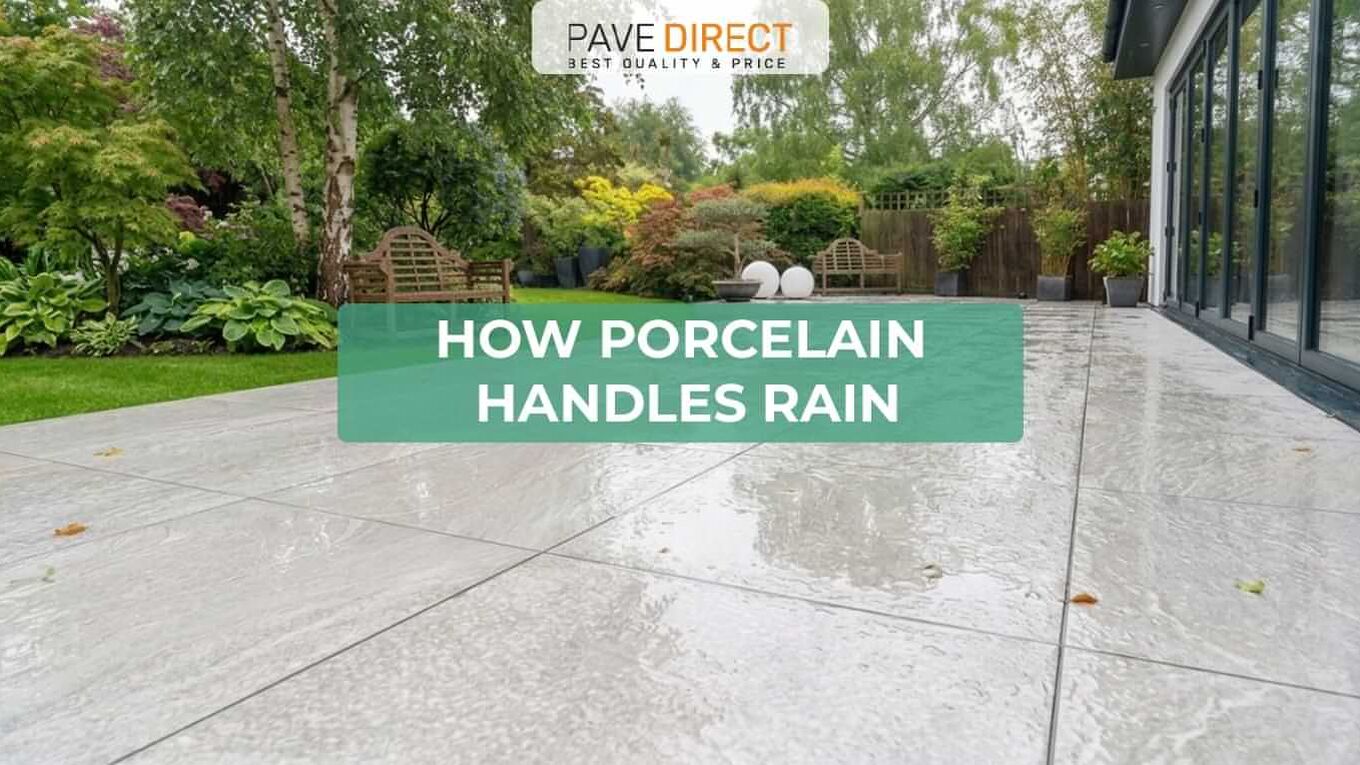
Yes, properly specified porcelain paving handles UK rain better than any natural stone alternative.
With a very low water absorption rate (≤0.5%) compared to sandstone's 3-6%, there's simply nowhere for moisture to enter, which means no frost cracking, no green algae taking root, and no annual sealing bill.
Does Rain Soak Into Porcelain Paving Slabs
This is where porcelain separates itself from everything else. Outdoor porcelain paving slabs are fully vitrified, fired at over 1,200°C until the material becomes almost non-porous, glass-like in density.
The result is water absorption of ≤0.5%, certified under BS EN 14411, the European standard for porcelain classification.
To put that in perspective, here is how porcelain, sandstone, limestone, and concrete paving actually compare when British weather gets involved.
Material | Water Absorption |
Porcelain Paving | ≤0.5% |
Indian Sandstone | 3–6% |
Limestone | 2–4% |
Concrete Blocks | 5–10% |
Think of it like the difference between a sponge and a dinner plate.
Rain sits on top of porcelain; it doesn't go in. That matters enormously in a British climate where persistent rain is just a fact of life from October through to April.
Because moisture can't penetrate the slab, there's nothing inside to freeze, expand, and cause frost heave or cracking.
That's the science behind why porcelain outperforms natural stone in damp winters; That is just how the material works.
Pave Direct stocks outdoor porcelain tiles rated to this exact standard, so if comparing sizes and finishes is the next step, knowing the absorption specs beforehand makes the decision far simpler.
“Pave Direct are the best company I have dealt with for a competitive price . I dealt with vik who deserves 10* for customer service. The delivery was fast and efficient. The porcelain tiles are of good quality also . Would highly recommend Pave Direct! You will not be disappointed. Well done vik if only everyone else was as helpful as you .” | Sam Davies |
Is Porcelain Paving Slippery When Wet In The UK
This is the fear that stops most people. And it's fair that some tiles genuinely are slippery underfoot. But the answer depends entirely on the slip rating, not whether it's porcelain.
Rating | Grip Level | Suitable For |
R-9 | Low surface grip | Indoor floors |
R-10 | Moderate, for dry patios only | Covered low-traffic outdoor areas |
R-11 | Good for wet pavement level | Patios, paths, pool surrounds |
R-12 | High, mainly used in industrial ramps | Driveways (more than enough) |
According to experts at Verified by Expert Trades, many porcelain manufacturers apply a surface coating to slabs with R-9 or R-10 ratings to improve grip. However, heavy water exposure can still make them slippery.
R-11 is the standard for outdoor porcelain tiles here in the UK. It's a textured, matte surface that stays grippy even when it's soaking wet.
Pendulum Test Value Rating
The more precise measure is the PTV rating (Pendulum Test Value), used by the HSE to assess slip resistance.
A PTV of 36 or above is considered safe for wet surfaces. Quality R-11 exterior porcelain tiles typically score between 40 and 50, comfortably above that threshold.
Will Porcelain Paving Crack In Frost Or Snow
Frost cracking happens when water gets inside a material, freezes the material, then expands it and finally breaks it apart.
With a very low water absorption rate, there's virtually nothing inside porcelain to freeze. This is why porcelain passes the frost resistance standard for paving in the UK.
Real Cause of Winter Cracks in Patio Slabs
Porous Indian sandstone, cheap ceramic tiles, and poorly installed concrete are also the core concerns that cause slabs to crack in a UK winter. Not properly specified porcelain patio slabs.
In shaded north-facing gardens, the difference is stark: de-icer is safe to use on porcelain without surface damage, unlike some natural stones, where salt causes surface spalling over time.
Does Porcelain Paving Get Algae & Moss In the UK
In north-facing and shaded gardens across the UK, algae and moss are a consistent and recurring problem. Also, the difference between paving types does matter.
Paving Type | Algae Growth | Cleaning Frequency |
Porcelain (R-11) | Very low | Once a year (jet wash) |
Indian Sandstone | High | Every 3–6 months |
Limestone | Medium-high | Every 6 months |
Concrete Blocks | High | Every 3 months |
Because porcelain has such high density, organic growth can't root into the surface the way it does with porous materials or settle deeply into the grout joints.
Disclaimer: Though porcelain is non-porous and resistant to algae growth, grout joints still need refreshing every 2-3 years as part of routine maintenance.
Most of what accumulates washes off with a garden hose or mild detergent. For anything more stubborn, a pressure washer on a low setting sorts it without any damage to the slab or the joints.
No harsh biocides, bleach, or specialist algae wash needed regularly. That's a meaningful difference if a low-maintenance paving surface is the goal.
Which Porcelain Paving Shows Less Organic Residue
Grey porcelain paving and black porcelain paving tend to show less organic residue visually between cleans.
White porcelain paving stays bright but shows up any surface dust more readily. Personal preference, but worth knowing.
Thickness For Rainfall
Thickness | Best Use | Vehicular Traffic | Rain/Frost Performance |
16mm | Patios, paths, balconies | No | Identical to 20mm |
20mm | Driveways, heavy loads | Yes (cars, small vans) | Identical to 16mm |
Warning:
Never use 16mm porcelain on a driveway. Even for a small car, the load will cause cracking over time.
Always specify 20mm+ for vehicle areas. This applies to all hard landscaping materials used in driveways, not just porcelain.
The best porcelain paving for driveways comes down to more than thickness alone. Other things to keep in mind are:
Sub-base depth
Adhesive type
Drainage falls
All these factors play an equal part in how long it lasts.
Porcelain vs Sandstone vs Limestone: A Fair Fight in UK Rain
Factor | 20mm Porcelain Paving ( R-11 ) | Indian Sandstone | Limestone |
Frost Crack Risk | None | Medium to high | Medium |
Slip Risk When Wet | Low (R-11) | Medium | High (polished) |
Algae Growth | Very low | High | Medium-high |
Sealing Required | No | Yes, every 1–2 years | Yes, every 1–2 years |
Staining From Rain | No | Yes | Yes |
Lifespan In The UK | 20+ years | 15–20 years | 10–15 years |
UK Verdict | Best all-weather choice | Suits dry, sunny gardens only | Higher maintenance, higher risk |
Kandla Grey porcelain is one worth knowing about, specifically.
It mimics the look of traditional Kandla Grey Indian sandstone closely, but without the porosity, sealing, or algae growth.
It's a common choice for homeowners who love that natural stone aesthetic but want something that genuinely holds up through damp winters.
Does Porcelain Paving Need Sealing In The UK
Porcelain does not need sealing to resist rain, frost, stains, or algae. It's naturally non-porous.
The smart move is to apply an impregnating sealer ( penetrating sealer) to make future cleaning even easier, or to deepen the colour on dark slabs.
That's entirely optional. For rain protection alone, it is completely unnecessary.
No Sealing Needed, Big Long-Term Savings
According to one of the professional pavers at Ovaeda Ltd, the porcelain slabs are positioned directly on the support rails using rubber packers, eliminating the need for sealing.
Compared to natural stone maintenance, that's a saving of roughly £200–£500 per treatment, and those treatments are needed every one to two years with sandstone or limestone.
No sealer still means fully rainproof, frost-proof, and stain-resistant.
3 Myths About Porcelain And Rain Busted
A few things put people off from porcelain that simply do not hold up when you look at them properly. Here are three of the most common ones.
1. Myth: You have to seal porcelain because of acid rain.
Truth: Acid rain doesn't penetrate porcelain. Sealing is a choice when talking about porcelain only, not a requirement.
2. Myth: Porcelain only suits modern houses.
Truth: It comes in slate, limestone, and travertine-effect finishes. Plenty of Victorian and Edwardian homes use it without it looking out of place.
3. Myth: All porcelain is the same as cheap tiles from a DIY shed work outside.
Truth: Indoor porcelain is typically R-9, 10mm thick, and press-formed. Outdoor porcelain paving is R-11+, 16–20mm, with calibrated thickness and rectified edges. Completely different product.
Choose Paving Slabs Based On Area
If you live in a rainy part of the UK (Scotland, Wales, the North West, Cornwall) or you just hate scrubbing patios, then get porcelain paving; it will save you from regret.
However, if you actually love that rough, uneven look natural stone has, and you don't mind sealing it once a year, Sandstone might be your thing.
Below is a more detailed breakdown of when to go with porcelain versus the other options.
Porcelain is Great If… | Porcelain Might Not Suit If… |
You want low maintenance | You love rustic, uneven natural stone |
You have a shaded or north-facing garden | You're on a very tight upfront budget |
You need non-slip for safety | You want a polished or gloss finish outdoors |
You live in a frost-prone area | You plan a full DIY install with no experience |
The Final Verdict
Get the specifications sorted and the installation done right, and you're settled for years. The rule of thumb is to make sure it's R-11 anti-slip, water absorption at or below 0.5%, and 20mm thick for domestic driveways.
For the installation, go with full bed adhesive, a solid sub-base ( MOT Type-1 ) compacted properly, and get those drainage falls in from the very start. Not as an afterthought.
Those two big things, the right tile and the right bedding, do all the heavy lifting. After that, the patio or driveway doesn't ask for anything.
Speak to the Pave Direct team; they'll confirm the right spec for your specific garden before you commit to anything.
FAQs
Q1. Can I lay porcelain paving myself in the rain?
It's not recommended. Adhesive and flexible grout need dry, stable conditions to bond correctly. A full bed adhesive method on a compacted MOT Type 1 sub-base is required spot bonding fails over time, especially in wet climates. If the ground is damp, use a slurry primer first and wait for the appropriate drying time before laying.
Q2. What happens if I don't seal porcelain?
Nothing bad. It stays rainproof, frost-proof, and stain-resistant without any sealer. Sealing is purely optional and only benefits those wanting even easier cleaning or a colour enhancement.
Q3. Can I pressure wash porcelain paving?
Yes, a pressure washer on a low to medium setting is completely safe and effective. It removes biofilm, surface dirt, and any seasonal grime without damaging the surface.
Q4. Is porcelain more expensive than sandstone overall?
Upfront, yes, typically by 20-40%. Over ten years, the cost evens out or reverses once sealing, cleaning products, and potential replacement of damaged sandstone are factored in.
Q5. Does porcelain get hot in the summer sun?
Light-coloured porcelain stays cooler underfoot. Darker slabs absorb more heat in south-facing gardens in direct sun. It's worth considering the finish and colour if the patio gets strong afternoon sun in summer.
Work out your exact order in seconds
Our coverage calculator turns your patio size into the precise number of slabs and packs — 10% waste allowance included.
Free delivery, £0.98 samples, breakage guarantee
Every order ships free with no minimum spend. Order a £0.98 sample first, choose your delivery date, and if a slab arrives broken we replace it — no quibbling.