
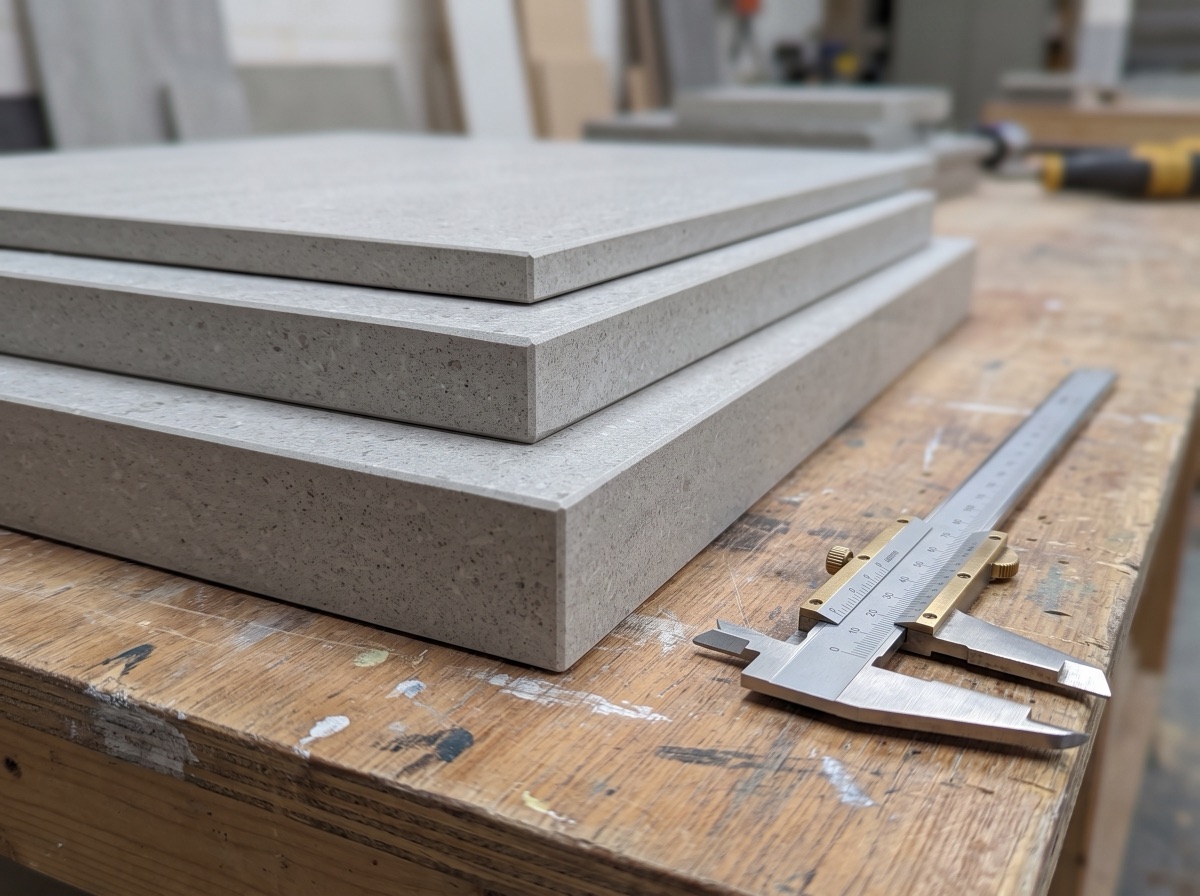
20mm is the UK standard for outdoor porcelain paving — right for patios, paths and pool surrounds on a full mortar bed. 16mm is a lighter, cheaper option for sheltered pedestrian areas on a perfect bed; 30mm is the heavy-duty spec for driveways. Thickness is about the base as much as the slab.
For almost every UK garden project the answer is 20mm. It's the industry-standard thickness for outdoor porcelain — strong enough for patios, paths, steps and pool surrounds on a full mortar bed, and it's the calibrated thickness our own outdoor ranges are supplied in. 16mm and 30mm exist for the edges of the spectrum: lighter pedestrian-only jobs and vehicle-rated work respectively.
Why thickness matters (and why the base matters more)
Porcelain is strong in compression but, like any tile, fails in bending. Thickness buys bending resistance — but so does full, void-free support underneath. A 20mm slab on a perfect full mortar bed outperforms a 30mm slab spot-bonded over voids every time. So read thickness and bedding as one specification, not two.
16mm porcelain: the light-duty option
- Where it works: sheltered pedestrian areas — balconies and terraces where weight matters, small patios laid on a flawless full bed or a raised-pedestal system rated for it.
- Why choose it: lighter to handle (a real benefit on large formats), slightly cheaper, and easier to cut.
- The limits: zero tolerance for bedding voids, and never for vehicles. If your installer is anything less than meticulous, the thickness saving isn't worth it.
20mm porcelain: the UK standard
- Where it works: patios, garden paths, dining areas, steps, pool surrounds — effectively every domestic pedestrian application. This is the thickness the outdoor porcelain range, including Kandla Grey, is calibrated to.
- Bedding: full 30–50mm semi-dry mortar bed over 100mm+ of compacted MOT Type 1, with a priming slurry on the slab back — the porcelain essentials (laying guide).
- Also: 20mm is the thickness pedestal and raised-deck systems are designed around, so a patio laid now keeps its options open.
30mm porcelain: heavy-duty
- Where it works: driveways, vehicle crossings and commercial loadings, on a base engineered for the load (substantial compacted sub-base or a reinforced concrete slab, full-bed laid with primer).
- The alternative: 20mm porcelain fully bonded to a reinforced concrete slab is also an accepted driveway build-up — the concrete does the structural work. Which route wins is a design decision made before ordering, not after (see driveway options).
Indoor vs outdoor porcelain
Indoor porcelain floor tiles run 8–11mm and have no business outside: they're not rated for freeze-thaw exposure, ground bedding or point loads. If a "bargain" outdoor slab is under 16mm, it's an indoor tile wearing the wrong label.
Quick chooser
- Patio, path, pool surround: 20mm on a full mortar bed.
- Balcony/pedestal system: 16mm or 20mm per the system's rating.
- Driveway: 30mm on an engineered base, or 20mm bonded to reinforced concrete.
- Any thickness: full bed + priming slurry, never spot bonding.
Whatever the thickness, quantities work the same way: measure, add the cutting allowance, round to packs — the coverage calculator does it in seconds, and samples settle colour and finish before you commit.
Work out your exact order in seconds
Our coverage calculator turns your patio size into the precise number of slabs and packs — 10% waste allowance included.
Free delivery, £0.98 samples, breakage guarantee
Every order ships free with no minimum spend. Order a £0.98 sample first, choose your delivery date, and if a slab arrives broken we replace it — no quibbling.
Frequently asked questions
How thick are porcelain paving slabs?
Outdoor porcelain paving is typically 20mm thick — the UK standard, and the calibrated thickness of our outdoor ranges. 16mm exists for light pedestrian use and 30mm for heavy-duty and vehicle applications. Indoor porcelain tiles (8–11mm) are not outdoor products.
Is 16mm or 20mm porcelain better for a patio?
20mm is the safer default: more bending strength and more tolerance of small bedding imperfections. 16mm can serve sheltered pedestrian areas on a flawless full mortar bed or a rated pedestal system, and saves weight and a little cost.
Can you use 20mm porcelain paving on a driveway?
Only when fully bonded onto a reinforced concrete slab that carries the load. On a conventional sub-base-and-mortar build-up, driveways call for 30mm porcelain.
What thickness of porcelain do I need for a pool surround?
20mm on a full mortar bed is the standard pool-surround spec — paired with an anti-slip finish, which matters more than thickness around water.
Does thicker porcelain need a different bed?
The bed is the same full 30–50mm semi-dry mortar bed with a priming slurry in all cases — what changes with heavier duty is the base beneath it: deeper compacted sub-base or reinforced concrete for vehicles.