
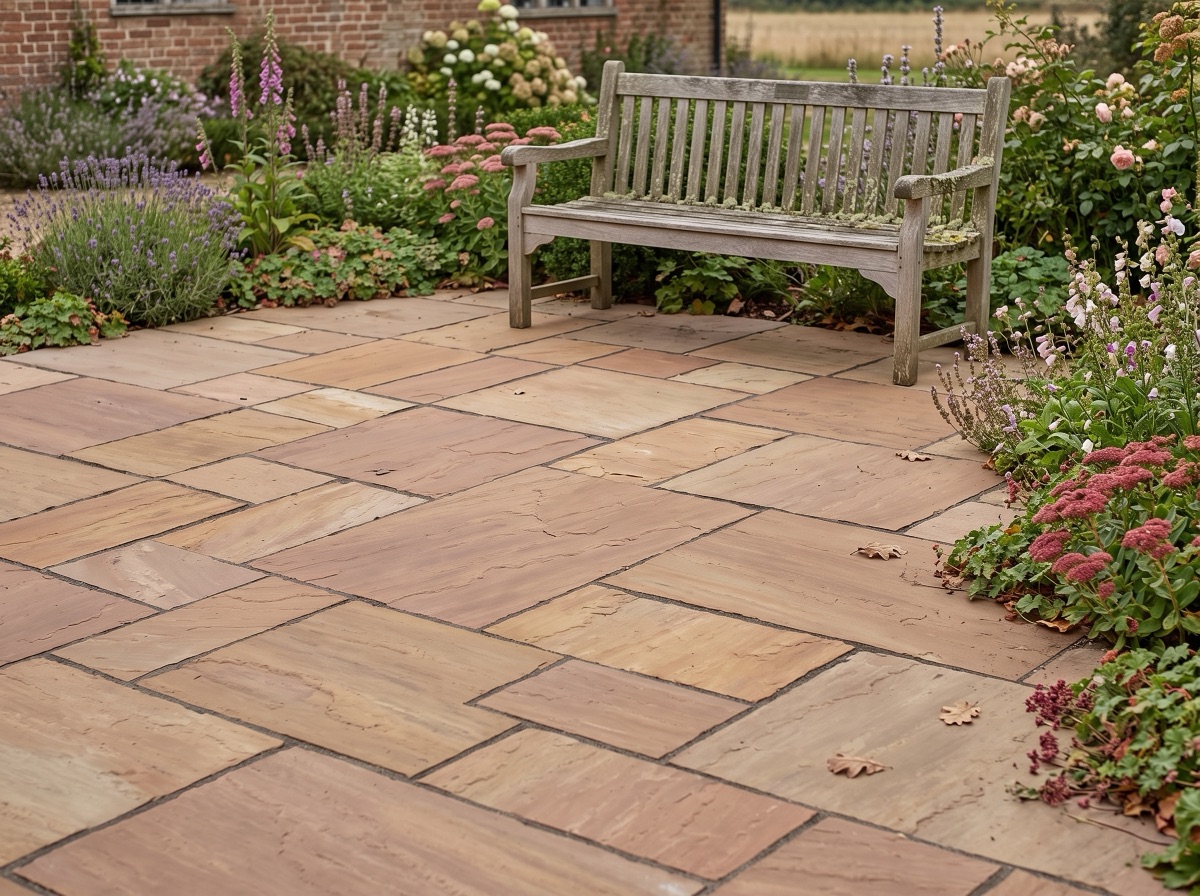
Indian sandstone is the UK's most popular natural paving: quarried stone in colourways like Kandla Grey, Raj Green, Fossil Mint and Autumn Brown, in finishes from riven to honed & sawn, usually as 22mm calibrated packs. This guide covers colours, finishes, laying essentials and long-term care.
Indian sandstone has been the UK's default natural paving for two decades for a simple reason: genuine quarried stone, in colours that suit British gardens and brickwork, at a price manufactured "stone-effect" products struggle to beat. This guide covers what it is, the colourways and finishes, how it's laid, and what it asks of you in maintenance.
What Indian sandstone is
A sedimentary stone quarried mainly in Rajasthan and central India, split or sawn into paving slabs. Because it's natural, every slab varies in tone and figuring — that variation is the appeal, not a defect. Slabs are supplied in mixed-size project packs, and quality packs are calibrated (machined to a consistent thickness, typically 22mm) so laying is dramatically easier than with old-style random-thickness stone.
The colourways
- Kandla Grey — the best-known: silvery grey with subtle tonal movement, at home against any brick or render. So popular that porcelain versions of the colour now exist (see the Kandla Grey hub).
- Raj Green — green-grey base with warm brown and plum undertones; the classic English-garden look that mellows beautifully.
- Fossil Mint — pale cream-buff with distinctive fossil-like mineral markings; bright and Mediterranean in sun.
- Autumn Brown — russet, brown and charcoal blend; forgiving of leaf-fall and mud, well-suited to rural settings.
Natural variation means the sample rule matters doubly here: order physical samples, and expect the delivered pack to vary around the sample rather than duplicate it.
The finishes
- Natural (riven) — hand-split faces with the classic undulating texture; the traditional look.
- Sandblast — sawn flat, then blasted to a fine, even, grippy texture; contemporary without losing stone character.
- Tumbled — edges and face softened for a weathered, aged appearance from day one; supplied as 22mm calibrated packs.
- Honed & sawn — sawn flat and lightly smoothed; the crispest, most modern face, also 22mm calibrated.
Laying essentials
Indian sandstone lays on the standard build-up: excavation to firm ground, 100mm+ of compacted MOT Type 1, and a full 30–50mm mortar bed — never dabs, which telegraph through as rocking slabs and picture-framing stains. Joints run 8–10mm+, filled with pointing mortar or a brush-in compound. Two stone-specific rules: dampen (or slurry-prime) the slab backs so the stone doesn't suck the moisture from the bed, and seal any cut edges before laying. The step-by-step laying guide covers the full sequence, and the coverage calculator sizes the order with a wastage allowance.
Sealing and maintenance
Sandstone is porous, so an impregnating (breathable) sealer — applied once the paving is fully clean and dry — makes leaves, oil and algae dramatically easier to clean off, at the cost of re-application every few years. Routine care is a stiff-brush wash a couple of times a year; avoid brick acid entirely (iron staining risk — see cement-stain removal for what to use instead). Expect the colour to mellow with weathering; a colour-enhancing sealer such as Romex Colour Enhancer can deepen wet-look tones if you prefer the just-laid appearance.
Sandstone or porcelain?
If you want genuine stone character and a lower upfront price, sandstone. If you want batch consistency, zero sealing and the easiest cleaning, porcelain — including in the same Kandla Grey colourway. The head-to-head guide and the two-minute answer hub settle it for your situation.
Work out your exact order in seconds
Our coverage calculator turns your patio size into the precise number of slabs and packs — 10% waste allowance included.
Free delivery, £0.98 samples, breakage guarantee
Every order ships free with no minimum spend. Order a £0.98 sample first, choose your delivery date, and if a slab arrives broken we replace it — no quibbling.
Frequently asked questions
How thick is Indian sandstone paving?
Calibrated project packs are typically 22mm thick, which suits patios and paths on a full mortar bed. Setts and cobbles are thicker (roughly 40–60mm). Driveways need thicker stone and a vehicle-rated build-up.
Does Indian sandstone need sealing?
It's optional but worthwhile: an impregnating sealer applied to clean, dry paving makes staining and algae far easier to manage. Expect to re-apply every few years per the product guidance.
Can you lay Indian sandstone on a dry (sand-only) bed?
Not for a lasting patio — calibrated sandstone should be laid on a full semi-dry mortar bed over compacted MOT Type 1. Sand-only bedding is a light-duty method for stepping stones and paths at most.
What do you mix for laying Indian sandstone?
A bedding mortar of sharp sand and cement at roughly 4:1, mixed semi-dry, laid as a full 30–50mm bed. Dampen or slurry-prime the slab backs so the stone doesn't pull moisture out of the bed too fast.
Why does Indian sandstone vary in colour?
Because it's natural quarried stone — mineral content varies through the beds, so every slab differs in tone and markings. Packs are blended for a balanced spread; lay from several crates at once for the best mix.