
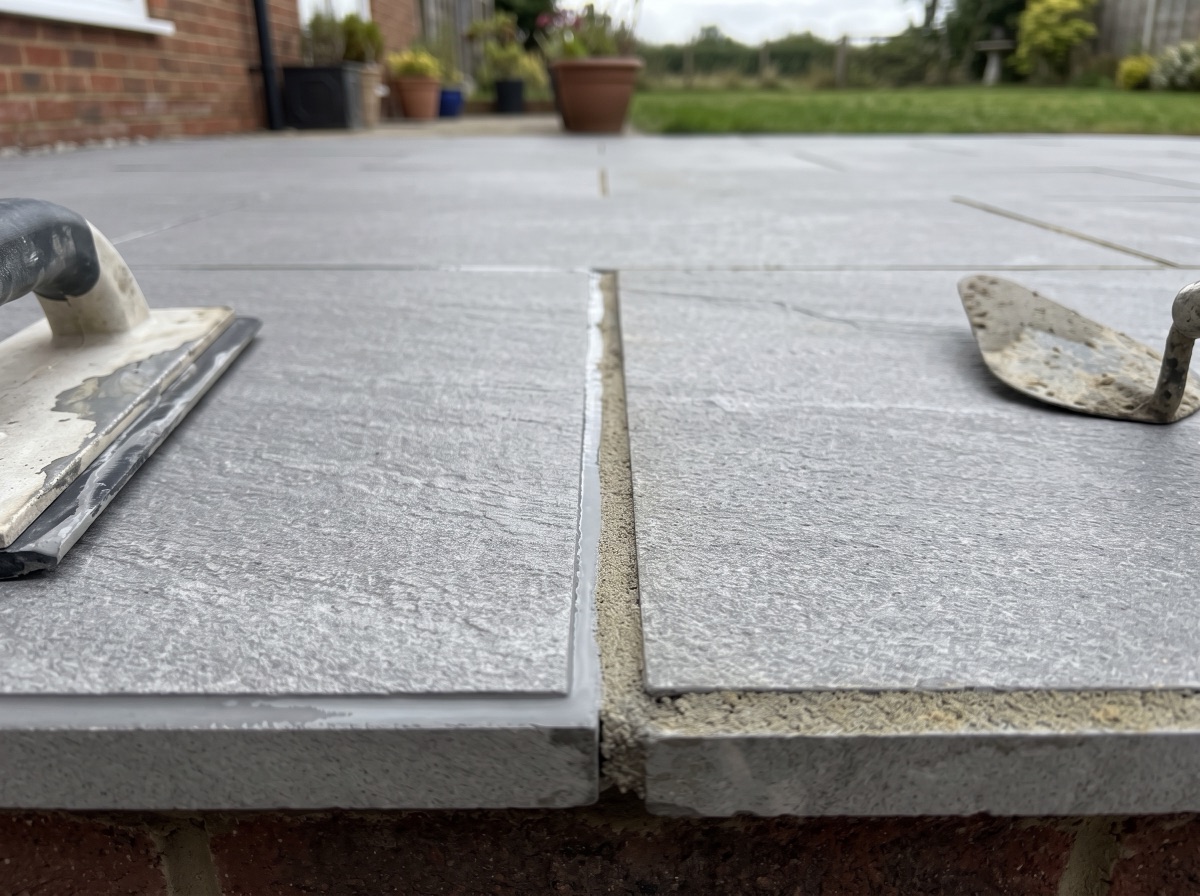
Cement grout is cheaper, easier to work and simple to repair; epoxy and resin grouts are harder-wearing, stain-proof and essentially waterproof but cost more and punish slow work. For most patios a quality cement or polymeric joint is right; epoxy earns its price on heavy wear and stain-critical areas.
Cement grout is the sensible default; epoxy is the specialist upgrade. A well-executed cementitious or polymeric joint does everything a normal patio asks of it, at the lowest cost and with the easiest repairs. Epoxy and resin systems bring genuine advantages — near-zero water absorption, stain immunity, exceptional hardness — and genuine drawbacks: price, short working time, and unforgiving cleanup. Which one is "best" depends entirely on what the joint has to survive.
What we're actually comparing
- Cementitious jointing — traditional sand-and-cement pointing (the mix-ratio guide covers proportions) and modern cement-based flowable grouts such as Flowpoint, which slurry into joints and set rapidly.
- Epoxy / resin systems — two-part epoxy grouts, and the outdoor resin jointing mortars widely used on paving, such as Rompox Easy, where resin binds a graded aggregate into a hard, water-permeable joint.
- Polymeric brush-in compounds — one-part air-curing compounds like PremJoint; the convenience tier between the two (covered fully in the best grout roundup).
Durability and weathering
Epoxy/resin wins on paper. Cured epoxy is harder than the cement joint around most patios, doesn't rely on a water-cement reaction that frost can interrupt during curing, and resists the freeze-thaw cycling that slowly opens hairline cracks in lean or poorly-compacted mortar joints. That said, a properly mixed, properly packed 4:1 mortar joint routinely lasts decades in UK gardens — the cement failures you see are workmanship failures (wet mixes, underfilled joints) far more often than material failures.
Stain and water resistance
Epoxy wins outright. It absorbs practically no water, shrugs off oil, wine and BBQ fat, and doesn't support the algae growth that colonises damp cement joints in shade. Cement joints are porous: they darken when wet, can grow green in shade, and take stains. On a patio around an outdoor kitchen, or anywhere stains are a running battle, this is epoxy's strongest argument.
Workability: where epoxy punishes amateurs
Cement wins for most people. Mortar gives you a relaxed working window and forgives a mid-job tea break; epoxy starts curing when the parts meet and does not renegotiate. Epoxy residue left on a slab face past its window is somewhere between difficult and impossible to remove — on textured anti-slip porcelain especially, haze removal is a real job. Resin jointing mortars are more forgiving than true epoxy grout (most wash in with plenty of water), but they still demand you work fast, wet and clean, exactly per the tub instructions. If in doubt, joint a test area first.
Cost and coverage
Cement wins by a wide margin. Sand and cement cost pennies per metre of joint; epoxy and resin systems are premium products, and wide joints on natural stone consume startling quantities of them. That's why the classic specification splits the difference: traditional mortar or flowable cement grout across the field, with resin reserved for thresholds, steps and high-wear runs — or simply everywhere on a compact porcelain patio, where tight 5mm joints keep resin quantities modest.
Repairability
Cement wins. A cracked mortar joint rakes out and repoints in minutes with materials from any merchant. Epoxy is deliberately permanent: repairs mean grinding it out, and colour-matching a new batch to weathered joints is harder than it sounds. If your paving may be lifted for access (services under a path, say), don't epoxy it in place.
The verdict, by project
- Standard garden patio (porcelain or stone): quality cementitious or polymeric jointing. Save the difference towards better slabs — the grouting method guide gets the execution right.
- Outdoor kitchen and dining zones: epoxy/resin earns its price where fat and wine meet joints (pair it with a stain-proof floor — the outdoor kitchen guide covers the surface logic).
- Driveways, entrances and steps: resin jointing mortar or a strong 3:1 cement joint — wheels and constant footfall are exactly what resin systems are built for.
- Wide-jointed natural sandstone: traditional mortar pointing remains the value choice; the material consumption makes resin expensive fast.
- Anywhere you might need to lift slabs later: cement, without question.
Whichever you choose, joint onto a properly built, fully-bedded patio — jointing can't rescue a bad base (the complete patio guide covers that groundwork), and residue-management is the skill that separates good jobs from stained ones on every product type.
Work out your exact order in seconds
Our coverage calculator turns your patio size into the precise number of slabs and packs — 10% waste allowance included.
Free delivery, £0.98 samples, breakage guarantee
Every order ships free with no minimum spend. Order a £0.98 sample first, choose your delivery date, and if a slab arrives broken we replace it — no quibbling.
Frequently asked questions
Is epoxy grout suitable for outdoor use?
Yes — exterior-rated epoxy and resin jointing systems handle UK freeze-thaw, absorb almost no water and resist staining and algae better than cement joints. Check the specific product is rated for external paving and follow its wet-working instructions exactly.
What are the disadvantages of epoxy grout?
Cost, a short unforgiving working time, difficult residue removal (especially on textured slabs), and deliberate permanence — repairs mean grinding it out. It also demands a competent, fast application, which is why many DIYers choose polymeric compounds instead.
Is epoxy grout stronger than cement grout?
Cured epoxy is harder, less porous and more chemical-resistant than cementitious grout. But a properly mixed and packed cement joint is strong enough for normal patio duty — most cement-joint failures come from wet mixes and underfilling, not the material.
Which grout is best for porcelain paving?
All three families work on porcelain: cement-based flowable grouts and polymeric brush-ins are the popular choices, with resin systems for heavy wear or stain-critical zones. Porcelain's tight joints keep resin quantities and cost manageable.
Can you use epoxy grout over old cement grout?
No — rake the old jointing out to a sound depth first. Any jointing system, epoxy included, needs clean joint walls and adequate depth to grip; a skim over failed mortar fails with it.