
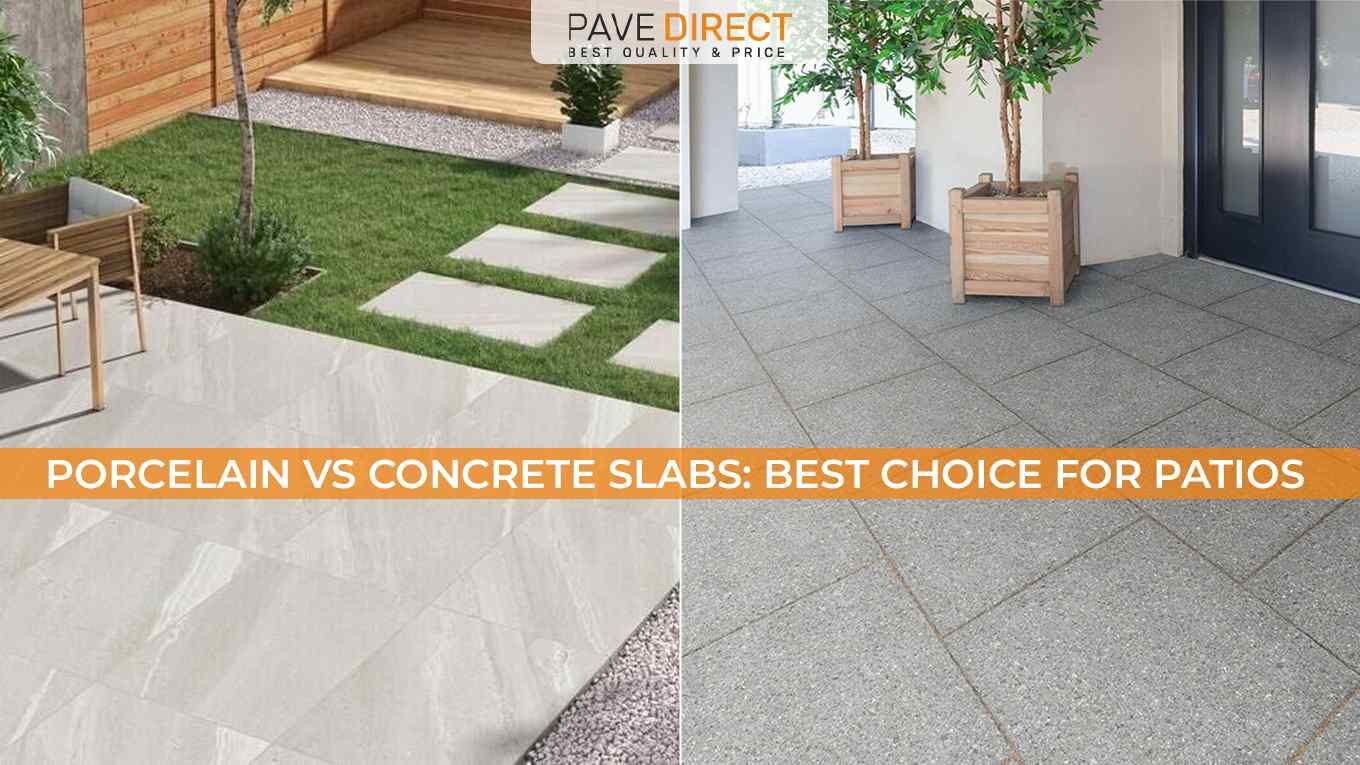
When it comes to creating a durable and beautiful outdoor space, choosing the right patio slabs is crucial not only for style but also for long-term durability. We get a lot of questions from construction professionals and specifiers. Should they go for porcelain paving or concrete slabs?
Each material has its own advantages, different patio designs, cost and Moreover it is suited to different applications and projects.
Choosing between porcelain and concrete pavers is one of the most common dilemmas for UK homeowners. Here, you’ll find all the information you need.
What Are Porcelain Paving Slabs
Porcelain slabs are known for their exceptional appearance and sleek durability. Porcelain’s stylish and clean, smooth finish makes it perfect for contemporary outdoor spaces. Porcelain paving slabs are the top choice for professionals and homeowners in the UK.
At Pave Direct, we offer different types of porcelain paving colours and sizes to make your space look elegant. Here are the reasons why porcelain paving slabs are recommended.
Benefits of Porcelain Patio Paving Slabs
Here are some benefits that will help you know more about porcelain paving:
Weather Resistance and Practical Benefits
Porcelain paving has a non-porous surface which prevents water absorption, reducing the risk of stains, moss and algae growth, considered best for the UK climate. Moreover, porcelain requires minimal maintenance and retains its strength with time. \
Aesthetics and Versatility:
Outdoor porcelain transforms the boring patio through its beauty and durability. Damaged tiles can easily be replaced with another matching tile. Their consistent finish and smooth edges make them suitable for patio, garden and driveways.
High Performance and Long-Term Durability:
Porcelain paving slabs offer excellent performance due to their high density and strength.
What Are Concrete Slabs
It’s used in construction and is known as a structural unit. Most people buy it for patios, driveways, and garden paving. When used in construction, its purpose is to create flat, horizontal surfaces that need to be strong and durable.
Benefits of Concrete Paving Slabs
Durability:
It is the key feature of a concrete slab. Unlike other products, they can withstand heavy loads and adverse weather conditions. A popular choice for patios, driveways and outdoor spaces.
Aesthetic and Versatility:
Concrete slabs come in a wide range of shapes, sizes and colours. This can help you in creating designs according to your needs.
Ease of installation:
In concrete slabs, you don't need special construction skills. This process just includes a proper base. However, it's more often done by the homeowners with basic DIY skills.
Slip-Resistance, Safety, & Performance: Porcelain VS Concrete Slabs
Slip resistance and safety are the most important things when choosing porcelain or concrete slabs, especially in the UK climate.
Slip ratings in outdoor paving slabs is a key factor when purchasing slabs for steps and other slippery surfaces,
Porcelain Paving Slabs
- Provide a strong grip even when wet
- Non-porous surface prevents moss and algae buildup
- UV rays and fade-resistant.
- stain resistance
- Water resistant.
Highly durable and maintain their appearance over time.
Concrete slabs
- Can be slippery when wet.
- As it’s porous, it can allow moss and algae.
- It may become uneven over time.
They are cost-effective and strong, but may require high maintenance over time.
Environmental Impact
When you are comparing Porcelain and concrete slabs, both affect the environment differently.
- Porcelain tiles are environmentally friendly. They are made up of natural materials, and are less affected by environmental degradation over time.
- In contrast, concrete has a greater environmental impact. Cement is its main component and is responsible for 8% of global CO2 emissions. Concrete production can contribute to habitat destruction and water pollution.
Many people who search for the difference between porcelain paving and concrete slabs should know that porcelain is made using high-end materials, but is also natural. While concrete has a higher carbon footprint due to cement.
Best Use Cases
Each product works better in a certain environment, so understanding them would be helpful and easy to install.
Porcelain Paving
- Garden
- Driveways
- Patio
- Pool surrounds
Concrete Slabs
If we talk about concrete slabs uses:
- Heavier load surfaces
- Driveways
- Outdoor slabs
- Industrial areas
- Garages
Key Differences Between Porcelain Slabs & Concrete Slabs
Choosing the right tile can significantly transform the appearance of your outdoor space.
Having so many options might be tough, but here we delve into each material’s manufacturing and installation details.
Feature | Porcelain | Concrete |
Durability | Very High - scratch and stain resistant | Moderate - can crack over time |
Maintenance | Low - minimal upkeep needed | High - requires regular care |
Absorption | Non-porous - repels water | Porous - absorbs moisture |
Weather | Frost and UV resistant | Can crack in wet and cold weather |
Appearance | Modern and sleek finish | Traditional and natural look |
Cost | Higher initial investment | Budget-friendly option |
Installation | Requires professional fitting | Easier to install |
Through this table, you all will easily understand the difference between porcelain and concrete slabs.
Installation Process Comparison
The first step of porcelain paving slabs and concrete slabs is installation. It required strong attention and a proper guide. Their structure, porosity, and thickness make a huge difference.
Porcelain Slabs Installation
Porcelain has a dense nature and is more difficult to cut and drill than concrete slabs.
It required professional techniques and precision because laying porcelain is challenging when you don't have proper knowledge and tools.
Here we will provide a step-by-step guide, including the tools and how to mix up the material. You will also learn about how to cut porcelain paving to adjust that at your outdoor space.
Tools required
- Tape measure
- Spirit level
- Rubber mallet
- Trowel
- Bucket
- Mixer
- Disc cutter
- Dust mask
- Ear defender
- Wheelbarrow
- Shovel
- Plate compactor
Material you’ll need
- MOT type 1 sub-base
- Sharp sand
- Water
- Cement
- Priming slurry
- Porcelain paving
How to Lay Porcelain Slabs - A Step-by-Step Guide
Here is a 7 steps checklist for laying / installing porcelain slabs, for complete guide, read “How to lay porcelain paving slabs”
- Prepare the base: Prepare your base properly, or it will be loose and unsafe.
- Lay a sub-base: Your base needs to be strong, as it will have heavier machines on it.
- Prime your slabs: Do one slab at a time so the primer can stay sticky and do its job properly.
- Use spacers to ensure uniformity: Spacers work as a guide to ensure an equal gape between the tiles.
- Check the levels: Check that each porcelain’s level is accurate.
- Add jointing compound: Use a brush to remove the extra compound on the tile to make it look smooth and clean.
- Let it dry: Leave the area for 24 hours.
Pro tips
- While cutting the porcelain slab, wear the proper safety equipment.
- A diamond blade is recommended for accurate cutting.
- A bench saw will make cutting more accurate.
- Carefully mark the area you want to cut.
- To make edges smooth, use a special diamond polishing pad for a neat and clean result.
Concrete Slabs Installation
Familiarity with concrete isn't the only thing; you still require professional guidelines. It's thick, and its weight can make installation more physically demanding.
- It is an affordable solution
- Strong enough to bear the heavy foot traffic
- Can be installed easily
- Can be customised
Tools required
- Shovel and spade
- Tape measure
- Rake
- Trowel
- String line and pegs
- Rubber mallet
- Wheelbarrow
Base preparation tool
- Plate compactor (Wacker plate)
- Hand tamper
Most tools required are basic and DIY friendly, making concrete slab installation accessible for homeowners without having advanced equipment.
How to Lay Concrete Slabs - A Step-by-Step Guide
- Prepare the ground for a concrete pour: Remove the extra material like stones, grass, etc., and dig to the required depth.
- Concrete preparation: Use wooden strips and make one side a bit lower.
- Ordering and laying concrete: Here, you can now book your order and ensure proper access to unload.
Which One Should You Choose?
Want a modern and long-lasting finish? Choose porcelain. Because its low maintenance, unique designs and trendy. It can last up to 30 years if installed properly.
Looking for something budget-friendly and a strong solution? Then go for concrete. It can bear the heavy load and gives a natural look. And it can last up to 20 years if maintained properly.
Conclusion
Porcelain paving is famous because of its look and is a top choice of homeowners in the UK. It works well in the UK climate. Although it required a high initial investment and a professional installation. Like how to lay porcelain paving
On the other hand, concrete slabs are affordable but require high maintenance. They are strong, versatile and suitable for a wide range of applications. It is prone to cracking because of the heavy loads, but affordable.
Both paving options have their own strength and qualities. If your priority is aesthetic, low maintenance and durability, porcelain is the better choice. However, if you want to go for something affordable and reliable, concrete slabs can work well. Both of them need professional guidance and maintenance.
FAQs
1. What are concrete slabs and porcelain used for?
Concrete slabs are used for driveways, garden paths, and outdoor sitting areas with high traffic. While porcelain is widely used for patios, terraces, and garden areas, it is mostly chosen for its modern look and high durability.
2. How long do concrete and porcelain paving slabs last?
Concrete can easily last up to 20-30 years or more, only if it is installed properly. Also, good maintenance helps them last longer. Porcelain paving lasts up to 30 years due to its high quality and durability.
3. Do concrete slabs need sealing?
Yes, concrete slabs are porous, and sealing protects them from water, stains, and damage, especially in harsh weather conditions. A high-quality sealer increases its longevity and improves appearance.
4. Can I install concrete slabs and porcelain paving myself?
Yes, you can if you have prior paving installation experience; however, Pave Direct recommends consulting a professional while you install them or hiring an expert contractor if you do not have paving experience to avoid costly mistakes.
5. Do concrete slabs crack?
Yes, they do because of constant weather changes, weak sub-base or poor installation. Proper base and care can reduce the chances of cracking.
Work out your exact order in seconds
Our coverage calculator turns your patio size into the precise number of slabs and packs — 10% waste allowance included.
Free delivery, £0.98 samples, breakage guarantee
Every order ships free with no minimum spend. Order a £0.98 sample first, choose your delivery date, and if a slab arrives broken we replace it — no quibbling.