
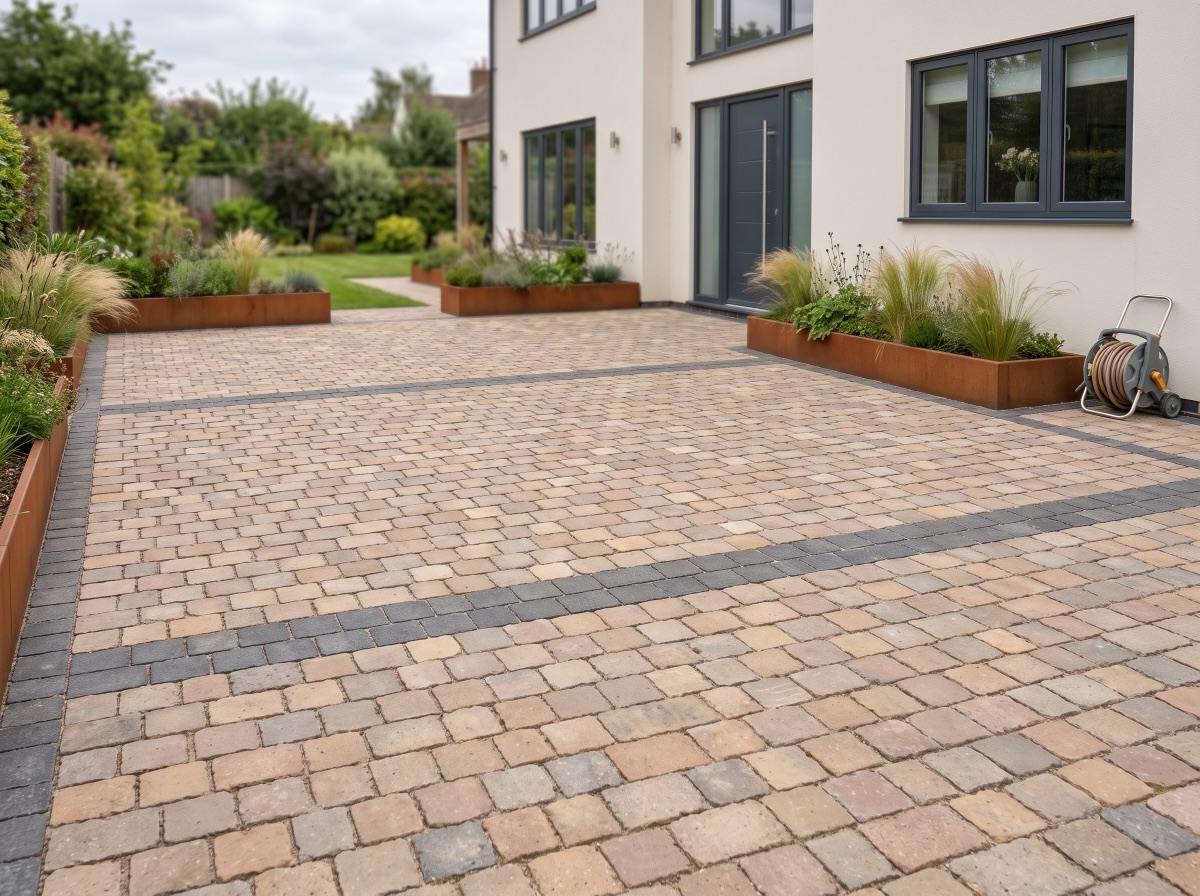
The strongest driveway designs for 2026 share a pattern: one restrained field material, a contrasting border or apron, planting worked into the layout, and drainage designed in from day one. Here are the layouts, edges, EV-bay details and material pairings worth copying.
Good driveway design in 2026 is restraint plus one deliberate detail. The drives that lift a house use a single, calm field material, then spend the design effort on edges — a contrasting border, a sett apron at the road, a planting strip breaking up the expanse. Add the two modern practicalities (somewhere sensible to charge a car, and a legal route for rainwater) and you have the whole recipe.
Start with the rule, not the mood board
In England, paving over 5m² of front garden with an impermeable surface needs planning permission — unless the water drains to a permeable area or the surface itself is permeable. Every design idea below assumes you've answered the water question first: permeable field material, drainage channels at the garage and road thresholds, or falls directed into planting. It's far cheaper to design drainage in than to retrofit it.
Borders and aprons: the highest-value detail
A contrasting border is the single most effective driveway upgrade per pound. Classic pairings that work:
- Charcoal border around a grey field — crisp and contemporary; a black porcelain or charcoal sett edge frames grey porcelain or light gravel cleanly.
- Natural stone sett apron at the road entrance — a couple of courses of sandstone or granite setts takes the daily turning wear and announces the entrance.
- Single-course soldier edge along lawns and borders — keeps gravel in, mower edges clean and lines sharp.
Mixed materials, one hierarchy
The mixed-material look keeps getting stronger, but the drives that work obey a hierarchy: one dominant field (60–80% of the area), one secondary material, one accent — not four competing surfaces. Proven combinations: resin or gravel field with stone sett parking bays; large-format porcelain wheel tracks through gravel; block paving with a porcelain path peeling off to the front door. For how the field materials themselves compare on cost and durability, see the driveway paving options guide.
Design for the EV era
If a charge point is on your horizon, design the bay now: position a parking bay within cable reach of the charger location, duct the cable route under the paving before anything is laid (ducting costs pennies at build time), and give the bay a firm, level, well-lit surface. A subtly contrasted bay — different laying pattern, not necessarily different colour — marks the space without turning the drive into a car park.
Green joints and planting strips
Softening is the defining look of current front-garden design: planted strips between wheel tracks, a border bed between drive and boundary, low evergreen structure at the entrance. Beyond looks, every planted area is somewhere for water to go — which is often what makes the 5m² rule a non-issue. Keep planting low near the road for visibility, and leave a paved walking route so nobody cuts across the bed.
Laying patterns that change the read of the space
- Stack bond (grid) in large-format porcelain — the most contemporary read; demands tight, consistent joints.
- Stretcher/running bond laid across the drive's length — visually widens a narrow drive.
- Herringbone — the structural king for block paving under turning wheels, and its diagonal energy suits period houses.
- Random coursed natural stone — relaxed, traditional, forgiving of organic garden edges.
Lighting: low, warm, functional
Skip the runway look. Three layers earn their keep: a wall or pillar light at the entrance, low-level bollards or recessed markers where the drive edges drop to planting, and a brighter task light at the door and charge point. Warm colour temperature, downward-facing fittings, and cabling ducted under the paving at build time.
Colour direction for 2026
The safe money remains on greys and warm neutrals: mid-grey fields with charcoal accents for contemporary houses, buff and brown natural stone for brick and stone frontages. Porcelain gives you batch-consistent colour across a large area (browse the porcelain range); natural sandstone gives tonal movement that hides tyre marks and everyday grime gracefully. Order samples and judge them dry and wet against your brickwork — a driveway is the biggest colour decision on the plot.
Small front gardens: make one move
On a compact frontage, one confident move beats three timid ones: a single field material edged in one contrast course, a clear paved path to the door, and one planted bed. The same space-stretching logic as the small-garden paving guide applies out front — fewer, larger units read calmer than lots of small ones.
From idea to order
Once the layout is sketched, the coverage calculator turns areas into slabs and packs (with a wastage allowance for the cuts a driveway inevitably needs), and the groundworks sequence is the same as any paved area — just built to vehicle-grade depths. Anything carrying a car needs the base designed for it: 150–200mm+ of compacted sub-base and, for porcelain, the vehicle-rated build-up covered in the thickness guide.
Work out your exact order in seconds
Our coverage calculator turns your patio size into the precise number of slabs and packs — 10% waste allowance included.
Free delivery, £0.98 samples, breakage guarantee
Every order ships free with no minimum spend. Order a £0.98 sample first, choose your delivery date, and if a slab arrives broken we replace it — no quibbling.
Frequently asked questions
What is the most popular driveway style in 2026?
The dominant look is a single calm field material — grey porcelain, block or resin — framed by a contrasting border or sett apron, with planting worked into the layout. Restraint in the field, character at the edges.
Do I need planning permission to redesign my driveway?
In England, only if you pave more than 5m² of front garden with an impermeable surface that does not drain to a permeable area. Permeable surfaces, or designs that direct water to lawns, borders or a soakaway, avoid the requirement — but always confirm locally.
How do I design a driveway for an electric car?
Position a bay within cable reach of your planned charger, duct the cable route under the paving before it is laid, keep the bay level and well lit, and mark it with a change of laying pattern rather than a loud colour change.
Can you use porcelain paving on a driveway?
Yes, when it is specified for vehicle loads: either thicker vehicular-rated slabs on a properly built base or 20mm porcelain bonded to a reinforced concrete slab. It is a design decision to make before ordering, not after.
What colour driveway is best?
Mid-greys suit contemporary houses and hide tyre marks well; buff and brown natural stone flatters brick frontages. Judge samples wet and dry against your own brickwork before deciding — light changes everything.