
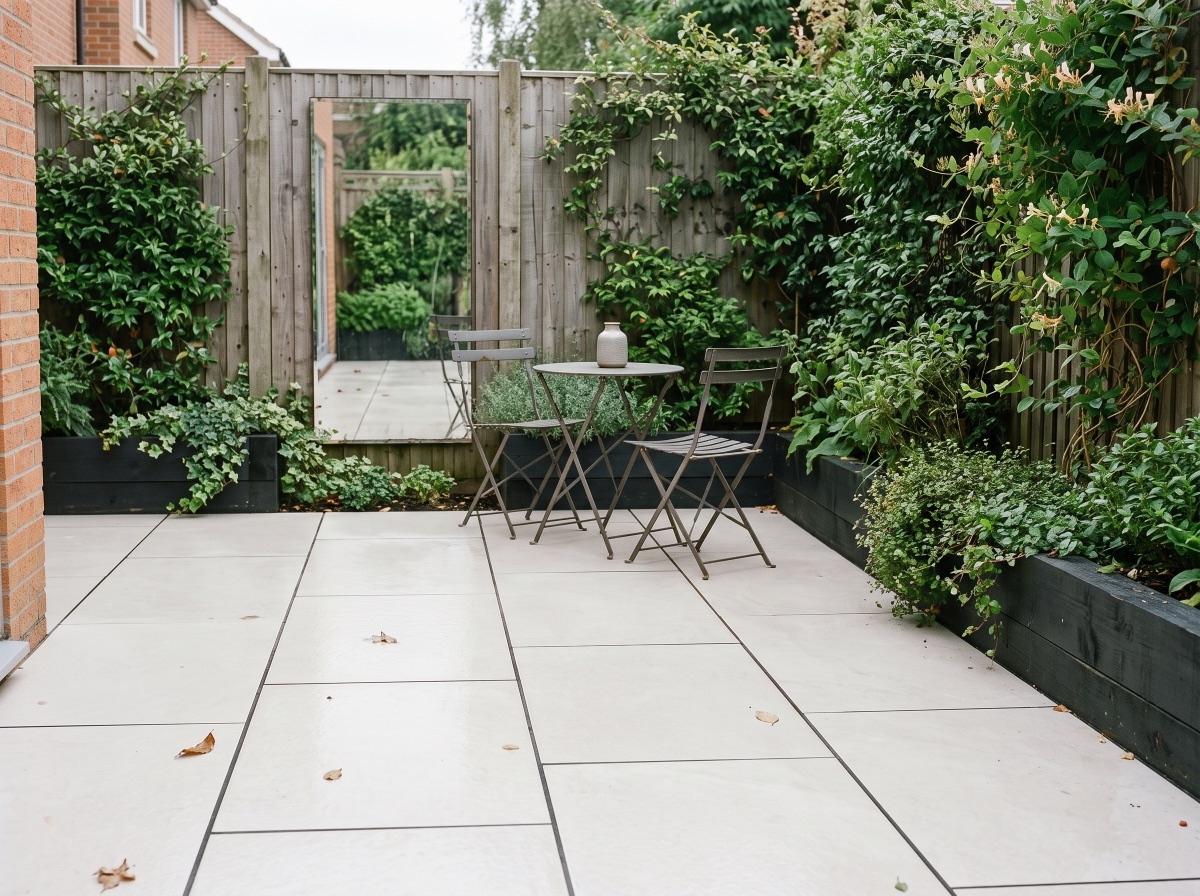
Small gardens reward big moves: fewer, larger slabs, light reflective colours, one continuous surface run to the boundary, and joints aligned with the sight line. Here are the paving ideas that make a compact garden feel bigger — and the busy-pattern habits that shrink it.
In a small garden, the paving IS the design. With little room for lawns and borders to carry the scheme, the floor does the visual work — and the counter-intuitive rule is that small spaces want big slabs. Fewer joints mean less visual noise, and less noise reads as more space. Add a light, consistent colour, run the surface tight to the boundaries, and a 5×5m courtyard starts behaving like twice the garden.
Go large-format (yes, really)
The instinct to use small units in small spaces is exactly backwards. A 900×600 slab in a compact courtyard means whole runs with just a handful of joints — calm, architectural, and easier to keep clean than a mosaic of edges. Porcelain is the natural fit because its batch-consistent colour keeps the whole floor reading as one plane (the range); a pale grey like those in the grey porcelain hub or a warm light tone from the white & light collection bounces the most daylight into shaded plots.
Use direction like a designer
- Lay joints along the longest sight line — continuous joint lines running away from the main window or door pull the eye down the garden and stretch it.
- Lay across a narrow plot to visually widen it — the same trick estate agents' photographers use with floorboards.
- Diagonal laying makes a boxy plot feel dynamic, at the price of more cutting (the cutting guide makes the waste manageable, and the calculator's allowance covers it).
- Stack bond (a clean grid) is the most contemporary read for a courtyard — but it exposes sloppy joints, so it rewards careful laying.
One surface, edge to edge
The single biggest space-stretcher: run one paving surface tight to the boundaries and skip the fiddly perimeter borders. Planting then comes back as containers and pockets on the surface rather than strips around it — movable, generous, and never nibbling the usable floor. If you want a border, make it one contrast course in the same format family, not a change of material.
Blur the inside-outside line
If your kitchen or living space opens onto the garden, matching the outdoor floor tone to the indoor one — or literally running an indoor/outdoor porcelain pairing through the threshold — makes both rooms borrow each other's size. Keep the outdoor surface anti-slip rated (anti-slip range, R-ratings explained) and the finished level 150mm below the DPC with a fall away from the house; the threshold detail is where this idea is won or lost.
A level change beats a bigger footprint
One shallow step — even 150mm — divides a small garden into two "rooms" without a single fence panel: dining terrace by the house, seating or planting platform beyond. Terracing logic scales right down to town gardens (the terracing guide covers levels and steps; the terrace design guide the styling). Light the step and make it anti-slip — small gardens get used at night.
Planting pockets: leave slabs out on purpose
Omitting a slab or two from the grid creates crisp planting pockets inside the paving — a multi-stem tree in one, herbs by the kitchen door in another. It costs nothing (you're buying fewer slabs), guarantees somewhere for water to soak, and gives a hard courtyard the green relief that stops it feeling like a car park. Put the pockets where you won't walk, and duct an outdoor tap or lighting cable to them while the ground is open.
Small-garden practicalities
- Drainage is less forgiving: an enclosed courtyard has nowhere natural for water to go, so build the 1:80 fall towards a drained edge, channel or planting pocket from day one — the groundwork sequence in the complete patio guide applies at any size.
- Access decides logistics: pallet delivery is kerbside — in a terrace-house garden every slab may travel through the house or a narrow side gate, which is a reason to order once, accurately (calculator), not twice.
- Maintenance is on display: in a small garden you see every metre of floor from the house, all year. Low-maintenance, stain-resistant porcelain earns its keep here more than anywhere (see the two-hours-a-year cleaning routine).
- Budget honestly: small areas mean modest quantities — real per-m² prices are in the cost guide, and a £0.98 sample judged in YOUR light is non-negotiable, because small spaces amplify colour choices.
Three ready-made looks
- The calm courtyard: light grey 900×600 porcelain, stack bond aligned with the view, two planting pockets, one containerised tree, festoon lighting. Minimum elements, maximum air.
- The outdoor room: matched indoor-outdoor tone through bifold doors, one shallow step to a seating platform, built-in bench on the boundary, warm low lighting (pairs well with a compact budget outdoor kitchen).
- The soft grid: large-format slabs with planting joints on two sides, gravel margin at the shady end, stepping-stone run to a store or studio — the green-and-grey balance that suits period terraces.
Work out your exact order in seconds
Our coverage calculator turns your patio size into the precise number of slabs and packs — 10% waste allowance included.
Free delivery, £0.98 samples, breakage guarantee
Every order ships free with no minimum spend. Order a £0.98 sample first, choose your delivery date, and if a slab arrives broken we replace it — no quibbling.
Frequently asked questions
What size paving slabs are best for a small garden?
Large formats — 900×600 is the sweet spot. Fewer joints mean less visual noise, which makes a small space read bigger. Small units do the opposite, busying the floor and shrinking the space.
What colour paving makes a small garden look bigger?
Light, consistent colours — pale greys and warm off-whites — reflect the most daylight into enclosed plots and recede visually. Keep the whole floor one colour; contrast belongs in a single border course or the planting, not in a patchwork.
How do I make a small patio look bigger?
Run one surface edge-to-edge without perimeter borders, align joint lines with the longest sight line, match the indoor floor tone at the threshold, and use containers and planting pockets instead of border strips. One shallow level change adds a second "room" without adding area.
Should I use gravel or slabs in a small garden?
Slabs for the areas you live on — furniture wobbles and feet scuff on gravel — with gravel as a margin or texture change at the edges if you like the contrast. In tight spaces a fully paved floor with planting pockets is usually calmer and more usable.
How do I drain a small enclosed courtyard?
Build a 1:80 fall into the base towards a drained edge — a channel drain, gully or generous planting pocket that acts as a soakaway. Enclosed courtyards have no lawn to shed water to, so the drainage route must be designed before the first slab is laid.