
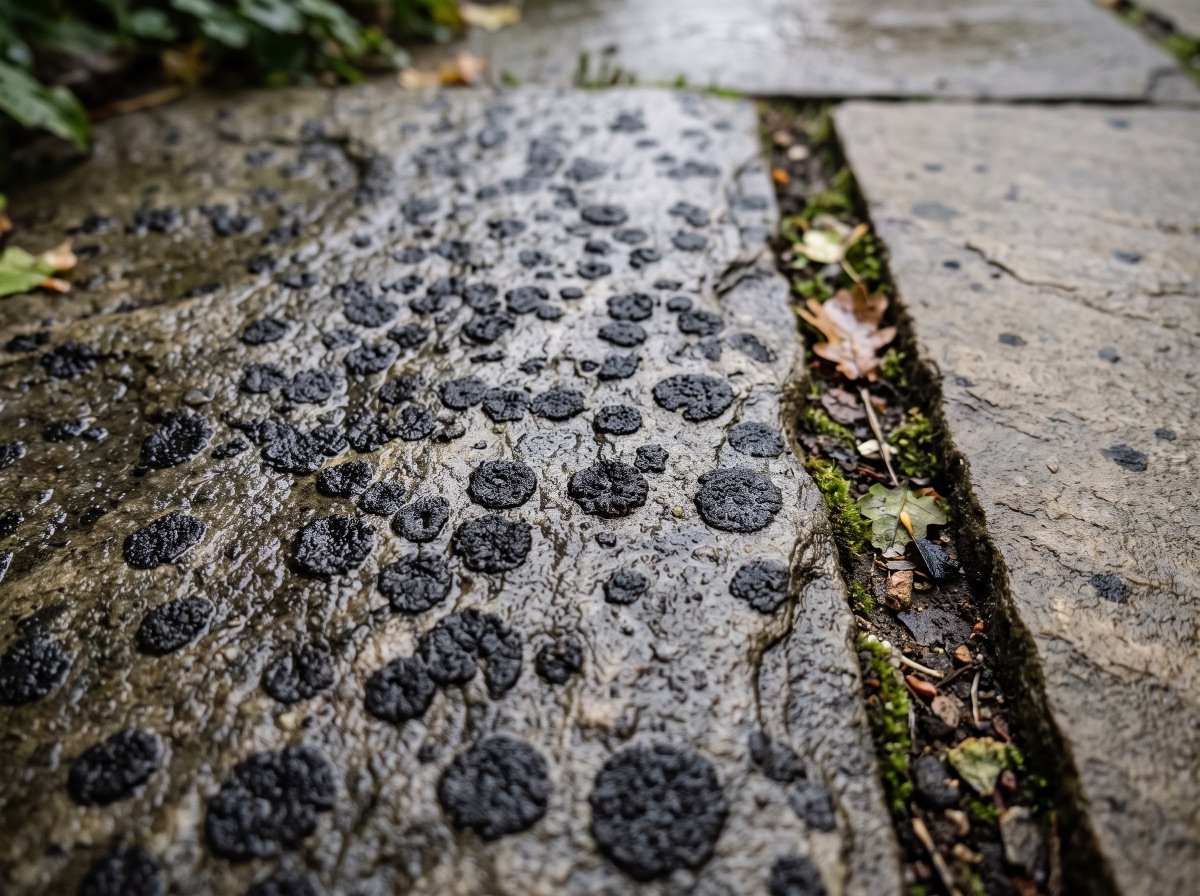
Black spot is a lichen that grows into the stone rather than sitting on it, which is why pressure washing and household bleach do not shift it. Removing it takes a dedicated black spot treatment, left to dwell and usually applied more than once, followed by sealing to slow its return.
Black spot is a lichen, not dirt — and it grows into the surface of the stone rather than sitting on top of it. That single fact explains why pressure washing and household bleach leave the marks exactly where they were. Removing it properly means a dedicated black spot treatment, left to dwell, usually applied more than once, then sealing to slow its return.
What black spot actually is
Those flat black discs, typically 2-10mm across with a slightly crusty texture, are a crustose lichen — most often a Verrucaria species. A lichen is not a plant: it is a fungus and an alga living as one organism, and the crustose types anchor themselves by growing their body into the top layer of the stone.
This is why black spot behaves so differently from ordinary patio grime. Algae and general dirt sit on the surface and wash off. A crustose lichen is partly inside the stone, so anything that only cleans the surface removes the top of the organism and leaves the rest to regrow. It is also extremely slow-growing and extremely tough — the same organism survives on exposed coastal rock.
It appears most readily on porous, textured natural stone: Indian sandstone and limestone are the classic hosts, particularly in damp, shaded, low-airflow spots where the surface stays wet.
Why pressure washing makes it worse
Jet washing is the first thing almost everybody tries, and it is actively counterproductive:
- It removes the visible cap of the lichen but not the part embedded in the stone, so the marks return — often looking worse against freshly cleaned slab.
- On riven sandstone it erodes the softer material around the harder grains, opening up the surface.
- A more open, rougher surface holds more water and gives the next generation of lichen a better foothold.
- Close-range washing strips jointing compound and can drive water under slabs.
If you do wash, keep the lance well back, use a fan tip rather than a pencil jet, and treat it as preparation for a chemical treatment rather than as the treatment itself.
What else does not work
- Household bleach. Too dilute to kill an embedded lichen, and strong enough to lighten or patch-mark natural stone. It also kills plants where it runs off.
- General patio cleaner. Formulated for algae, moss and grime — all surface organisms. It will make the patio cleaner and leave every black spot in place.
- Scrubbing. You will remove stone before you remove lichen.
- Waiting. Black spot does not weather off on its own; left alone it spreads.
How to remove it, step by step
- Identify the stone first. Sandstone and limestone need different chemistry — see the warning below. If you do not know which you have, find out before buying anything.
- Clear the surface. Sweep, remove moss and leaf litter, and let the patio dry. Treatments work on the lichen, not through a layer of debris.
- Test on a hidden area. A slab under a planter, or an offcut. Wait the full dwell time and check for colour change before doing the whole patio.
- Protect the surroundings. Wet down or sheet nearby planting, and keep pets and children off. Wear gloves, eye protection and covered footwear.
- Apply the treatment as instructed. Even coverage, at the manufacturer's stated dilution. Resist the urge to make it stronger.
- Let it dwell. This is the step people cut short. These products work over hours, not minutes.
- Rinse if the instructions say to. Some are rinse-off, some are leave-to-weather. Follow the label rather than habit.
- Expect to repeat. Two or three applications spread over weeks is normal on an established infestation.
The limestone warning
Some black spot removers are acid-based. Never use an acidic product on limestone. Limestone is calcium carbonate and acid dissolves it — you will etch, dull and pit the surface permanently, and the damage is not repairable. The same caution applies to any stone with a calcareous content, and to the mortar joints on any patio, which acid will also attack.
Read the product's own guidance on stone type before you buy, not after. If you are unsure what your slabs are, a non-acidic biocidal treatment is the safer default.
How long it really takes
Manage your expectations here, because this is where most people conclude a product "didn't work". A treatment kills the lichen; it does not lift the stain out on contact. Once dead, the remains break down and weather away over several weeks to a few months of ordinary rain and frost.
Work in dry, mild weather so the product stays where you put it and gets its dwell time. Avoid applying before heavy rain, and avoid frost. Late spring and early autumn are the practical windows in the UK.
Stopping it coming back
Black spot is opportunistic — it colonises surfaces that stay damp and shaded. Reduce that and you reduce recurrence:
- Seal the stone. An impregnating sealer such as a natural stone sealer reduces porosity, so the surface dries faster and gives lichen less to key into. Seal only once the patio is clean, dry and fully treated — sealing over live black spot locks it in.
- Fix the drainage. Standing water is the root cause. If the patio holds puddles, the fall is wrong; the sub-base guide covers the 1:80 minimum.
- Let light and air in. Cut back overhanging branches and shrubs that keep slabs permanently damp.
- Clear leaf litter through autumn. Rotting leaves hold moisture against the surface all winter.
- Re-treat early. A handful of spots dealt with promptly is a ten-minute job; a colonised patio is a season's work.
If you like the colour depth a sealer brings, a colour enhancer does the same protective job while deepening the tone of natural stone.
Porcelain does not get black spot
Worth knowing if you are weighing up a replacement rather than a rescue. Black spot needs porosity to anchor into, and outdoor porcelain is fired to near-zero water absorption — there is effectively nothing for a crustose lichen to grow into. Surface algae can still form in a permanently damp spot, but it washes off, because it is genuinely on the surface.
That is the honest trade-off between the two materials: sandstone gives you natural variation and warmth and asks for maintenance; porcelain gives up some of that character and asks for almost none. The porcelain vs sandstone comparison sets out the rest of it, and samples are the quickest way to judge the look for yourself.
When to stop treating and start replacing
Treatment is the right answer for most patios. Replacement starts to make sense when the slabs are heavily colonised across most of their area and the surface has already been eroded by years of jet washing, or when the patio has drainage faults that will simply regrow the problem. In that case you are fixing the base anyway, and the material choice is genuinely open again.
Related reading: cleaning outdoor porcelain, removing dried cement, and stopping weeds in block paving.
Work out your exact order in seconds
Our coverage calculator turns your patio size into the precise number of slabs and packs — 10% waste allowance included.
Free delivery, £0.98 samples, breakage guarantee
Every order ships free with no minimum spend. Order a £0.98 sample first, choose your delivery date, and if a slab arrives broken we replace it — no quibbling.
Frequently asked questions
What causes black spots on patio slabs?
A crustose lichen, most often a Verrucaria species — a fungus and an alga living as one organism. It anchors by growing into the top layer of the stone, which is why it favours porous natural stone such as Indian sandstone and limestone, particularly in damp, shaded spots with poor airflow.
Does bleach remove black spot from paving?
No. Household bleach is far too dilute to kill a lichen embedded in the stone, and it is strong enough to lighten or patch-mark natural stone and damage nearby planting. A dedicated black spot treatment applied at the stated dilution and given its full dwell time is what works.
Will a pressure washer remove black spot?
No, and it tends to make things worse. It strips the visible cap of the lichen but leaves the part growing inside the stone, so the marks return. On riven sandstone it also erodes the surface, leaving it rougher and more water-retentive — better conditions for the next generation.
How long does black spot remover take to work?
The treatment kills the lichen within its dwell time, but the dead remains then weather away over several weeks to a few months of rain and frost. Two or three applications spread over a few weeks is normal on an established infestation. Apply in dry, mild weather, not before rain or frost.
Does sealing prevent black spot?
It helps rather than guarantees. An impregnating sealer reduces the stone's porosity so the surface dries faster and offers less for a lichen to anchor into. Seal only after the patio is clean, dry and fully treated — sealing over live black spot traps it. Fixing drainage and shade matters just as much.