
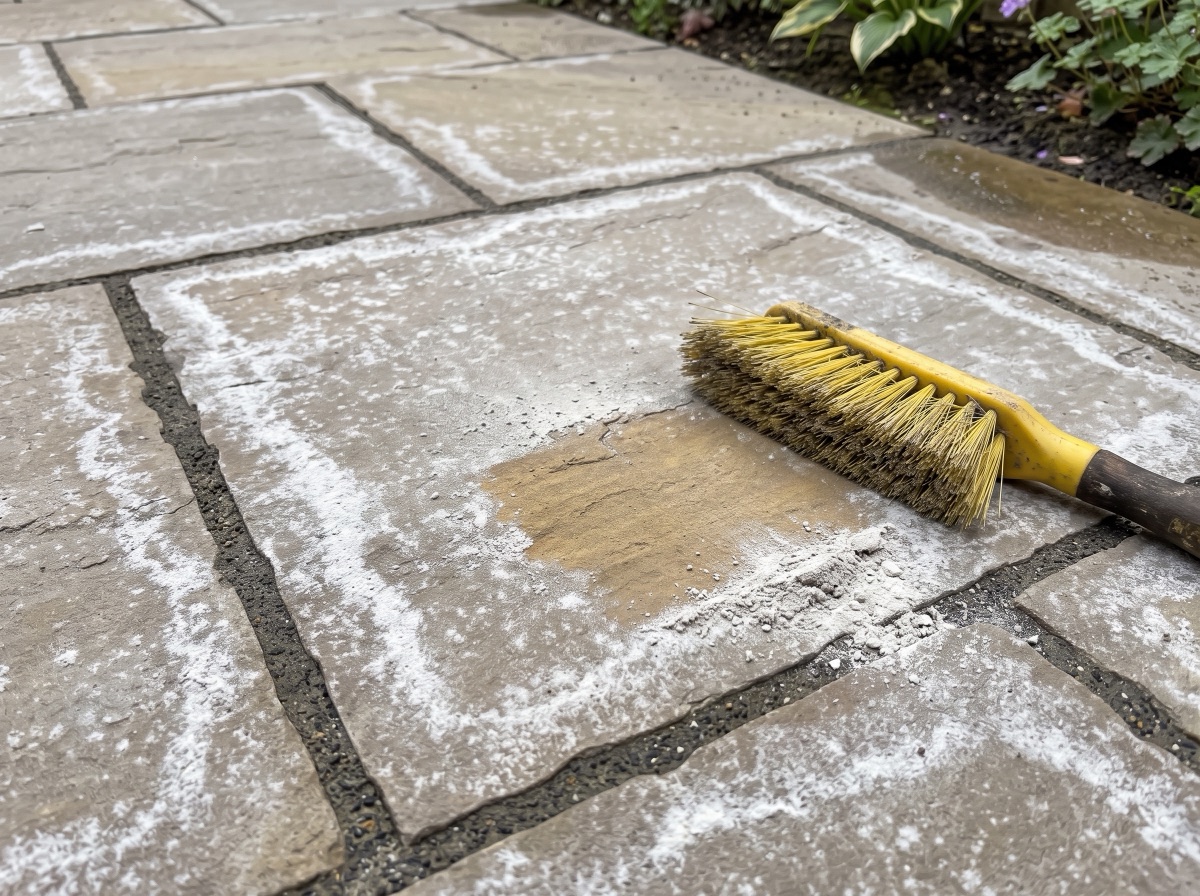
The white bloom on new paving is efflorescence — mineral salts carried to the surface as the slab and bedding dry out. It is not a fault and not a stain, and it usually weathers away within the first year. Brush it off dry; washing it with water makes it worse.
The chalky white bloom that appears on new paving is efflorescence: mineral salts carried up to the surface by water as the slabs and bedding dry out. It is not a stain, not damage, and not a sign you have been sold faulty stone. It clears on its own, usually within the first year. Brush it off dry — washing it with water is what makes it look worse.
What efflorescence actually is
Cement-based products contain soluble salts, principally free lime. While a new patio is still drying, water moves through the mortar bed and the slab, dissolving those salts and carrying them to the surface. The water evaporates; the salts are left behind as a white deposit, which then reacts with carbon dioxide in the air and turns into a chalky film of calcium carbonate.
That is the whole mechanism, and it explains everything about how efflorescence behaves. It needs three things at once: soluble salts, water to move them, and a surface to evaporate from. Take away any one and it stops.
Why it shows up on new patios
A newly laid patio has all three factors at maximum. The mortar bed is full of free lime and still full of water, and it has a large surface to dry through. This is why efflorescence is overwhelmingly a first-season phenomenon, and why it tends to appear:
- In the first weeks to months after laying, often after the first spell of wet-then-dry weather.
- Worse in autumn and winter, when slow drying gives salts more time to migrate.
- Around slab edges and joints — often called "picture framing", because the mortar bed and the jointing are the salt source.
- Unevenly across the patio, which is normal and follows how the bed dried, not a defect in particular slabs.
It is not a defect — with one exception
Efflorescence does not harm the stone, does not weaken anything, and is not covered by any sensible definition of a faulty product. Every cement-bedded paving material can show it.
The one case worth taking seriously is efflorescence that keeps returning long after the first year. Persistent efflorescence means water is still moving through the build-up, which points at something real underneath — poor drainage, standing water, a void under the slabs, or moisture tracking in from surrounding ground. At that point the white marks are a symptom, and the fix is drainage, not cleaning. Start with the falls and drainage guide.
What not to do
- Do not wash it off with water. This is the mistake almost everybody makes. Water dissolves the salts, carries them back into the surface, and redeposits them as it dries — so the patio looks clean while wet and worse the next day. It also feeds the exact process you are trying to stop.
- Do not pressure wash it. Same problem, plus surface damage on riven natural stone.
- Do not seal over it. Sealing traps the salts under the sealer, which can leave a permanent milky haze. Seal only once efflorescence has fully stopped.
- Do not reach straight for acid. Efflorescence removers are usually mild acids, and acid on limestone dissolves the stone itself. See the warning below.
- Do not panic in year one. The most effective treatment for most patios is patience.
How to remove it properly
- Wait for dry weather and let the surface dry fully. Efflorescence only brushes off dry; on damp stone you are just moving paste around.
- Brush it off with a stiff dry brush. A stiff bristle broom, no water. Much of it lifts as powder.
- Sweep the powder off the patio rather than back into the joints, so the salts leave the site instead of being recycled.
- Repeat after the next few dry spells. Each wet-dry cycle brings a fresh flush to the surface, and each dry brushing removes it. Over a season the supply genuinely runs out.
- Only then consider a proprietary efflorescence remover, if a stubborn film remains after the first year. Identify your stone first, test on a hidden area, and follow the manufacturer's dilution and dwell instructions exactly.
The limestone and polished-surface warning
Never use an acid-based efflorescence remover on limestone. Limestone is calcium carbonate and acid dissolves it — the result is permanent etching, dulling and pitting that cannot be repaired. Be equally careful with polished or honed surfaces, where acid will take the finish off, and with the mortar joints on any patio, which acid also attacks.
If you are not certain what your slabs are, do not use an acidic product. Dry brushing and time carry no risk at all, and on most patios they are all that is needed.
Telling white marks apart
Not every white mark is efflorescence, and the right treatment depends on which one you have.
| What you see | Likely cause | What to do |
|---|---|---|
| Chalky white bloom on new paving, patchy, worse after rain then drying | Efflorescence | Dry brush, repeat, wait. No water. |
| White outline following slab edges only | Picture framing — efflorescence from the bed and joints | Same as efflorescence; check the bed is solid and void-free |
| Hard white crust where water drips or runs from a downpipe or wall | Limescale from run-off | Fix the water source first, then treat the deposit |
| Milky or hazy sheen over the whole surface, appeared after sealing | Sealer applied over trapped moisture or salts | Stone-specific sealer removal — take advice before treating |
| Flat black discs, not white at all | Black spot lichen | See removing black spot |
| Grey cement smears and hardened spots from installation | Cement residue | See removing dried cement |
Does porcelain get efflorescence?
Yes — and this surprises people, because porcelain is immune to so much else. The porcelain body itself absorbs almost no water, so the salts are not coming from the slab. They come from the mortar bed underneath, migrating up and surfacing at the joints and slab edges.
The practical consequence is that a bonded, void-free bed and correct drainage matter as much for efflorescence on porcelain as they do on natural stone. Voids under slabs hold water, and held water keeps feeding the process. The adhesives guide covers getting a genuinely solid bed.
Reducing it next time
- Get the drainage right. The single biggest factor. Fall of at least 1:80, and somewhere for the water to go.
- Lay on a full, solid bed. Voids trap water directly under the slab, which is exactly where you do not want a reservoir.
- Avoid laying in cold, wet conditions where practical — slow curing means slow drying, and slow drying means more salt migration.
- Keep materials covered and off the ground on site, so slabs and sand are not soaking before they even go down.
- Do not over-water the mix, and keep excess mortar off the face of the slabs as you work.
- Seal after the first year, not before — once efflorescence has run its course. An impregnating sealer then helps keep water out of the stone.
Further reading: patio sub-bases, cleaning outdoor porcelain, and common problems with porcelain paving. Choosing materials for a new patio? Order a sample and see it in your own light first.
Work out your exact order in seconds
Our coverage calculator turns your patio size into the precise number of slabs and packs — 10% waste allowance included.
Free delivery, £0.98 samples, breakage guarantee
Every order ships free with no minimum spend. Order a £0.98 sample first, choose your delivery date, and if a slab arrives broken we replace it — no quibbling.
Frequently asked questions
What are the white marks on my new paving slabs?
Almost certainly efflorescence — soluble mineral salts, mainly free lime from the cement, carried to the surface by water as the slabs and mortar bed dry out. It is a normal part of a new patio curing, it does not damage the stone, and it is not a manufacturing fault.
Will efflorescence go away on its own?
Usually yes, within the first year. Each wet-then-dry cycle brings a flush of salts to the surface and normal weathering carries them away. The supply is finite, so it fades over a season or two. Dry brushing after each dry spell speeds it up considerably.
Should I wash efflorescence off with water?
No — this is the most common mistake. Water dissolves the salts and redeposits them in the surface as it dries, so the patio looks clean while wet and worse the next day. Let the surface dry fully and brush the deposit off with a stiff dry brush instead.
Can I use acid to remove efflorescence?
Only with care, and never on limestone — acid dissolves calcium carbonate and permanently etches and pits the surface. Avoid it on polished or honed finishes too, and remember it attacks mortar joints. If you are unsure what your stone is, stick to dry brushing, which carries no risk.
Does porcelain paving get efflorescence?
It can. The porcelain body absorbs almost no water, so the salts are not from the slab — they migrate up from the mortar bed beneath and surface at the joints and edges. A solid void-free bed and proper drainage are the practical defences, just as with natural stone.