
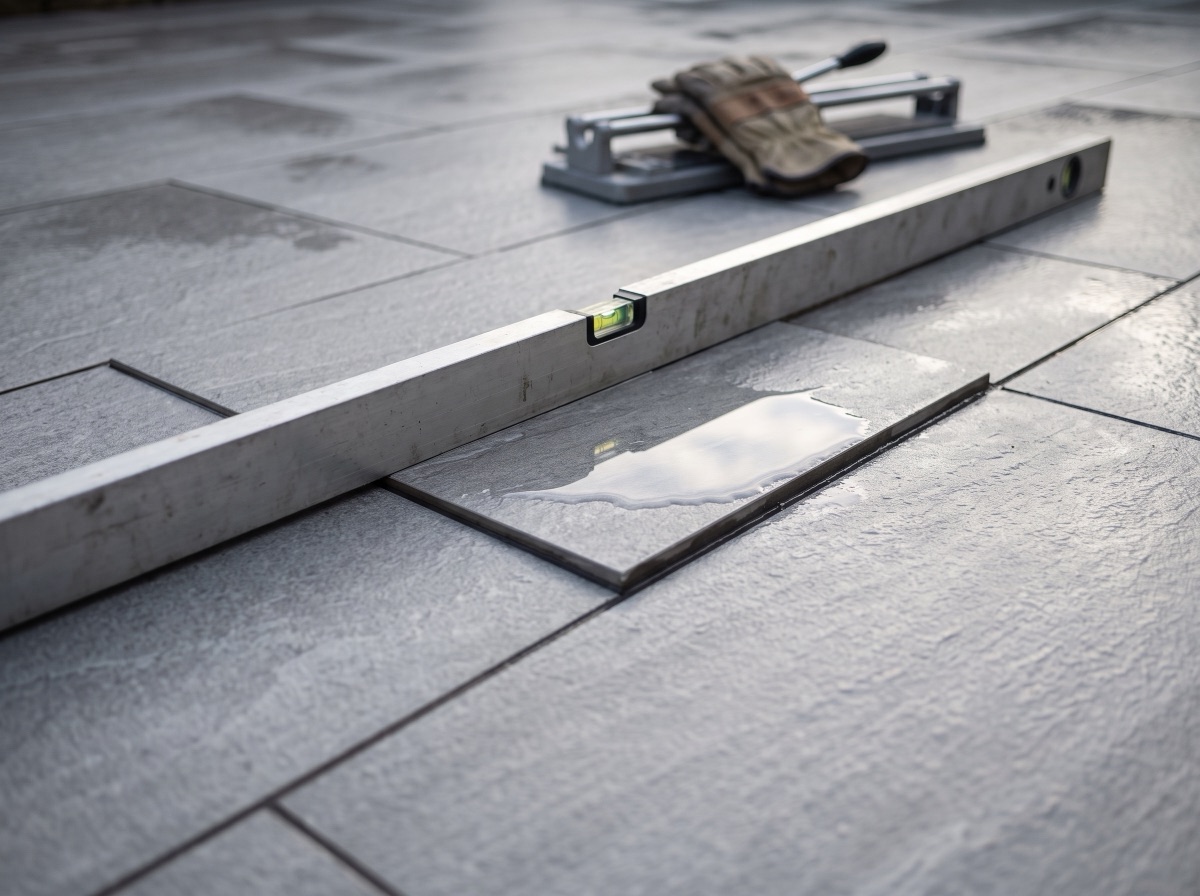
Most porcelain paving problems are installation problems: slabs laid without priming slurry debond, spot-bonded slabs crack and drum, dry cuts chip, and grout haze gets left to cure. The material itself is extremely durable — here is every common failure, what causes it, and how to avoid each one.
Porcelain paving rarely fails — porcelain installations do. The slab itself is dense, frost-proof, stain-resistant and colour-stable; nearly every "porcelain problem" you'll read about traces back to how it was bedded, cut, jointed or specified. That's genuinely good news: every failure on this list is preventable, and knowing them before you buy is exactly how you avoid them.
1. Slabs coming loose (debonding)
The problem: slabs that lift, rock or sound hollow within the first year or two.
The cause: porcelain's greatest strength — near-zero porosity — is also its installation catch. It won't suck moisture from a mortar bed the way natural stone does, so plain mortar simply doesn't grip it.
The fix: a cement-based priming slurry brushed onto the back of every slab, laid onto a full mortar bed while both are fresh. This is non-negotiable, and it's the single most common corner cut by inexperienced installers. The laying guide and adhesives guide cover the technique.
2. Cracked slabs and corners
The problem: a crack across a slab or a snapped corner, often months after laying.
The cause: voids under the slab. "Spot bonding" (five dabs of mortar) leaves unsupported spans; point loads — a table leg, a dropped pot, a van wheel — do the rest. Occasionally the cause is a slab bridging a moving joint in a concrete base below.
The fix: a full, void-free mortar bed at 30–50mm, proper sub-base compaction (see the complete patio guide), and matching the specification to the load — 20mm porcelain on a standard patio build-up is a pedestrian product; driveways need the vehicle-rated approach in the thickness guide.
3. Chipped edges from cutting
The problem: nibbled, chipped cut edges that spoil an otherwise crisp job.
The cause: porcelain is hard and brittle — dry cutting at speed with a worn or wrong blade chips the glazed surface.
The fix: a continuous-rim diamond blade rated for porcelain, water suppression, a slow feed rate, and cutting face-up with the final pass from the face side. Full technique in the cutting guide — and lay cut edges against walls where the eye never lands.
4. Grout haze and jointing stains
The problem: a cloudy film or picture-framed staining around the joints that won't wash off.
The cause: jointing residue — especially from cement-based and some resin compounds — left to cure on the surface, or slurry tracked across the face in the rain.
The fix: joint in dry weather, work clean, and wash residue off the same day per the product's instructions. Choose the right compound in the first place (grout guide; epoxy vs cement). Cured haze can often be removed with the manufacturer's residue remover — test a corner first.
5. Lippage (uneven slab edges)
The problem: adjacent slabs sitting at slightly different heights — you feel it underfoot and see it in low sun.
The cause: large-format slabs magnify small bedding errors; rushing the levels does the rest.
The fix: string lines, a long level, consistent 8–10mm joints, and checking every slab in both directions as it's tapped down. Large formats reward patient layers and punish fast ones.
6. Slippery when green
The problem: porcelain sold as low-maintenance turning slick in shade.
The cause: not the porcelain — the algae film growing on any hard surface that stays damp and shaded. Smooth indoor-style finishes make it worse outdoors.
The fix: specify an anti-slip finish for outdoor use (anti-slip range, R-ratings explained) and wash shaded areas occasionally — the cleaning guide takes minutes to read and the job takes an hour a year.
7. Shade variation between batches
The problem: a visible colour step between areas laid from different orders.
The cause: porcelain is batch-consistent within a production run; separate runs can differ subtly, exactly like paint batches.
The fix: order the whole job in one go — the coverage calculator exists precisely so you order once with a cutting allowance — and mix slabs from multiple packs as you lay. If you must top up later, put the new batch in the least visible zone.
8. Ponding water
The problem: puddles that sit after rain, feeding the algae in problem 6.
The cause: porcelain's flatness is unforgiving — water can't drain through it or hide in surface texture, so inadequate falls show up immediately.
The fix: build a 1:80 fall into the sub-base and bed, away from the house, and check falls with a level during laying rather than with a hosepipe afterwards.
The honest summary
None of this is a reason to avoid porcelain — the same list for natural stone would include staining, sealing cycles and colour weathering that porcelain simply doesn't have (see the sandstone vs porcelain comparison). It is a reason to take the installation seriously: priming slurry, full bed, correct blade, clean jointing, real falls. Get those five right and porcelain is about the lowest-maintenance paving you can put in a UK garden. If you're weighing up a purchase, order a sample, and browse the full porcelain range with the specification questions above in hand.
Work out your exact order in seconds
Our coverage calculator turns your patio size into the precise number of slabs and packs — 10% waste allowance included.
Free delivery, £0.98 samples, breakage guarantee
Every order ships free with no minimum spend. Order a £0.98 sample first, choose your delivery date, and if a slab arrives broken we replace it — no quibbling.
Frequently asked questions
What are the common problems with porcelain paving?
The recurring ones are installation faults: slabs debonding when laid without priming slurry, cracks over voids from spot bonding, chipped dry cuts, grout haze left to cure, lippage on large formats, algae slipperiness on smooth finishes in shade, batch shade variation and ponding from inadequate falls. All are preventable.
Why do porcelain slabs come loose?
Because porcelain is nearly non-porous, plain mortar cannot bond to it. Every slab needs a cement-based priming slurry on its back, laid onto a full fresh mortar bed. Slabs laid without primer are the most common porcelain failure in the UK.
Does porcelain paving crack easily?
No — porcelain is very strong in service, but it is brittle over voids. A slab supported by a full mortar bed on a compacted sub-base resists normal loads for decades; a spot-bonded slab with hollow spans can crack under a table leg.
Is porcelain paving slippery when wet?
Outdoor-rated anti-slip finishes are designed for wet feet — check the slip rating on the specific product. What makes any paving slippery is an algae film in damp shade, so choose an anti-slip finish and rinse shaded areas occasionally.
Does porcelain paving fade or stain?
Porcelain's colour is fired into the slab, so it does not fade like concrete products, and its near-zero porosity means everyday spills wipe off rather than soaking in. The staining people see around joints is usually jointing residue, not the slab.
Is porcelain paving worth it?
For a low-maintenance, colour-stable, stain-resistant surface, yes — provided it is installed properly with priming slurry and a full bed, and specified correctly for the load. The material is rarely the weak link; the installation is.